
High-Gloss Epoxy Floor Systems
Showroom Flooring
Floors that light the product — mirror-gloss, vehicle-rated, poured overnight
Request a Free Estimate
Showroom Epoxy Flooring
In a showroom, the floor is a lighting instrument. A mirror-gloss surface doubles every fixture, wraps the product in reflection and makes the whole room read a grade more expensive — which is why dealerships, galleries and design studios treat the floor as part of the merchandising, not the building. The trick is that the same floor also has to be a working industrial surface: cars drive on it, displays drag across it, and it has to look poured-yesterday for years.
Epoxy systems are the only flooring category that does both jobs at once. A marbleized metallic pour gives the space a one-of-a-kind statement floor; pearl and solid systems deliver clean, even gloss in an exact brand color; and underneath every finish sits a vehicle-rated build over diamond-ground concrete, sealed with a non-yellowing polyaspartic topcoat that shrugs off hot tires and window sun. Where the showroom meets a service corridor or delivery bay, the system transitions to a textured working surface without a seam — one floor, two duties.
Top Epoxy Flooring manufactures its own VOC-free materials and installs with in-house crews across Southern California, under a three-year commercial warranty. See the broader commercial and industrial flooring range or request a free on-site estimate below.
Systems Behind a Showroom Finish

Mirror-Gloss Metallic Pours
Metallic pours are hand-worked pigment in a high-build epoxy — marbled, veined or smoked, and never the same floor twice.

Non-Yellowing Polyaspartic
UV-stable polyaspartic topcoats keep white floors white and gloss at full depth — no yellowing under showroom glass and lighting.

Vehicle-Rated Build Thickness
Vehicle-rated build thickness carries cars, lifts and loaded dollies — showroom looks over an industrial specification.

Quartz Transition Zones
Quartz texture takes over at service corridors and delivery doors — traction where work happens, gloss where product shows.

Self-Leveling Slab Prep
Self-leveling prep erases old tile ghosting and slab waves first — a mirror finish is only as flat as the slab under it.

Low-Odor Overnight Chemistry
VOC-free, low-odor chemistry pours after close and cures by morning — no fumes in a room customers walk into at ten.
Auto Dealership Floors
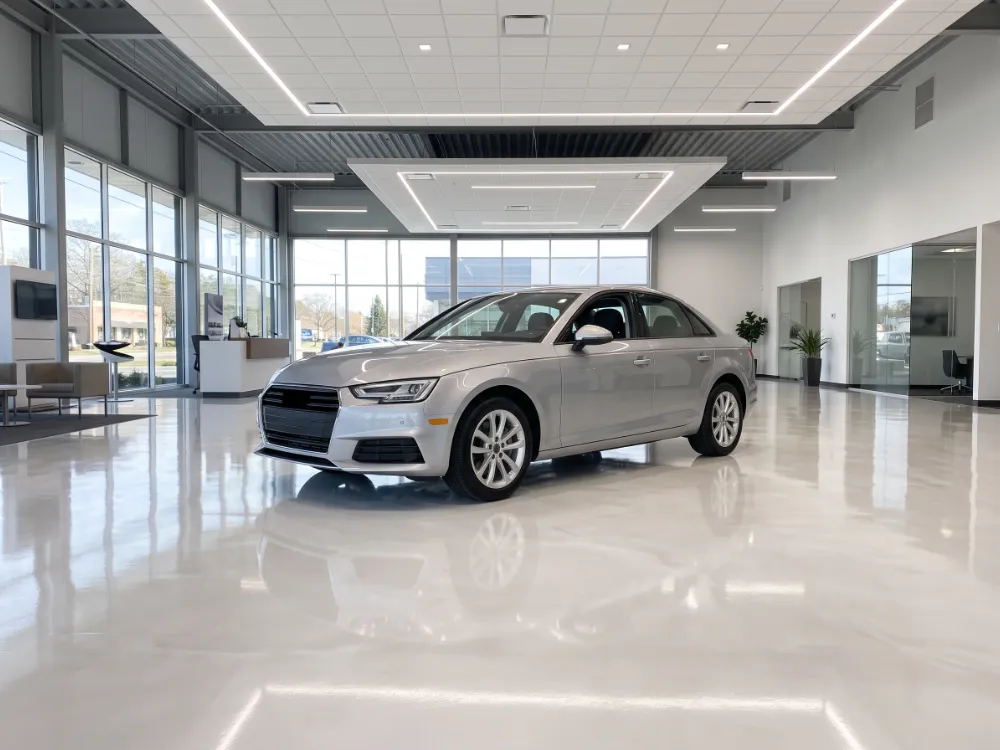
Dealership floors carry cars all day and sell them at the same time. The specification handles both: a build thickness rated for vehicle traffic, a surface that takes hot-tire contact without the pickup that ruins ordinary coatings, and a gloss level that turns every ceiling fixture into product lighting. Pearl whites and light grays are the dealership classics — they bounce light under the sheet metal and make paintwork pop — with brand-color accents poured in where the franchise standard calls for them.
Furniture & Design Galleries
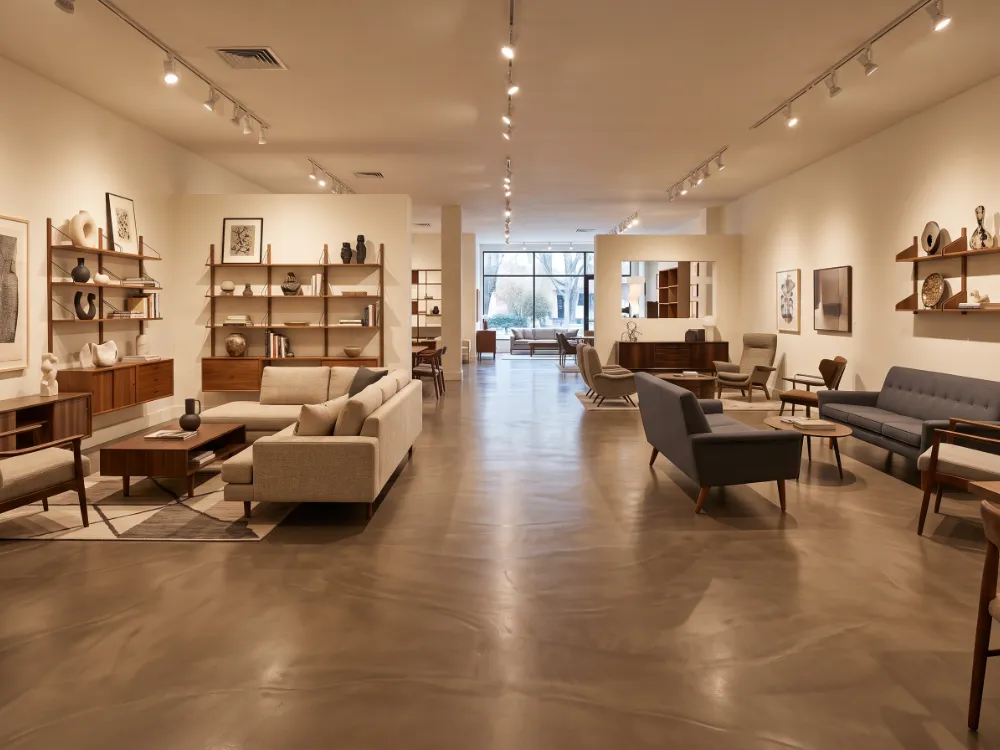
Galleries need a floor that frames product without competing with it. Warm metallics and satin solids give the space depth and a finished-interior feel while staying visually quiet under the merchandise, and the seamless surface means display resets — the constant dragging, rolling and rearranging of gallery life — leave no history. When the collection changes and the space rebrands, the floor recoats to a new tone in a night instead of becoming a demolition line item.
Metallic Statement Floors
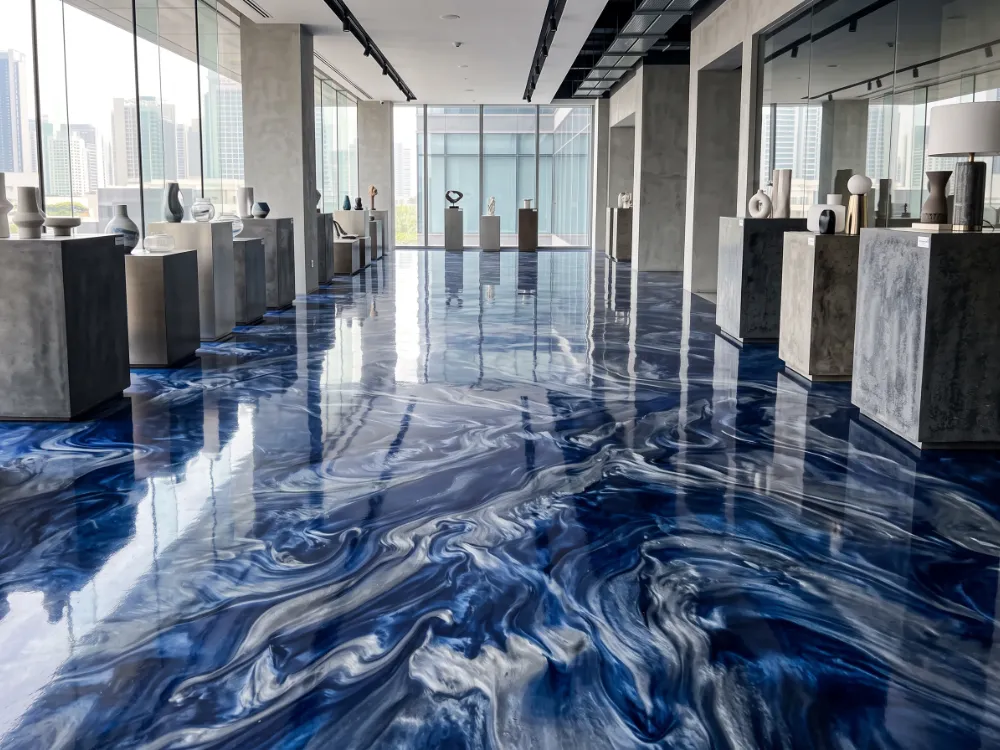
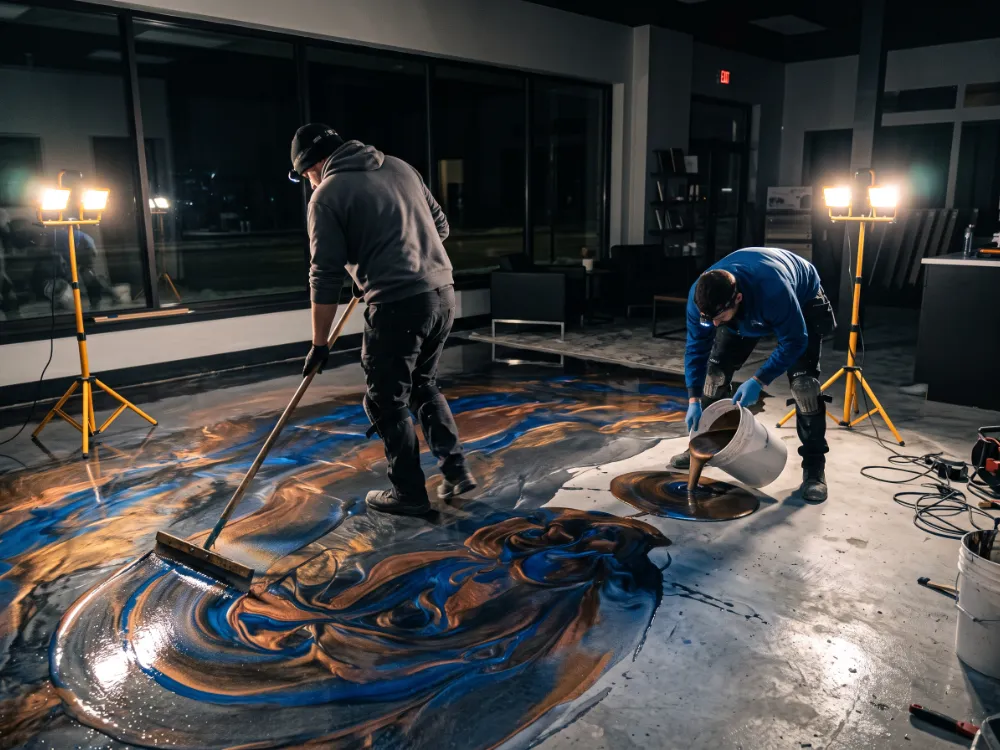
Sometimes the floor is the exhibit. A marbleized metallic pour — deep blues shot with silver, smoke and charcoal, bronze over black — is worked by hand while it cures, which makes every installation unrepeatable by definition. Under gallery or showroom lighting the surface reads as movement, and visitors photograph the floor as often as the product. It remains, underneath the drama, a vehicle-rated industrial system with a wear coat built for traffic.
Advantages Under the Gloss
A showroom floor succeeds when nobody thinks about it twice: the gloss holds, the color never shifts, the tires never mark it, and the annual maintenance conversation never happens. That is a materials specification, not a cleaning schedule — and it is what these systems are engineered for.
Gloss That Sells Product
Non-yellowing topcoats hold true color and full gloss under sun-facing glass — measured in years, not seasons.
Hot-Tire Proof
Hot-tire rated — cars park, move and park again without the tire pickup that peels bargain coatings.
Recoat-Fresh Between Seasons
Overnight pours and recoats — the showroom closes at nine and opens on schedule, every time.
Solid Color & Brand Palettes
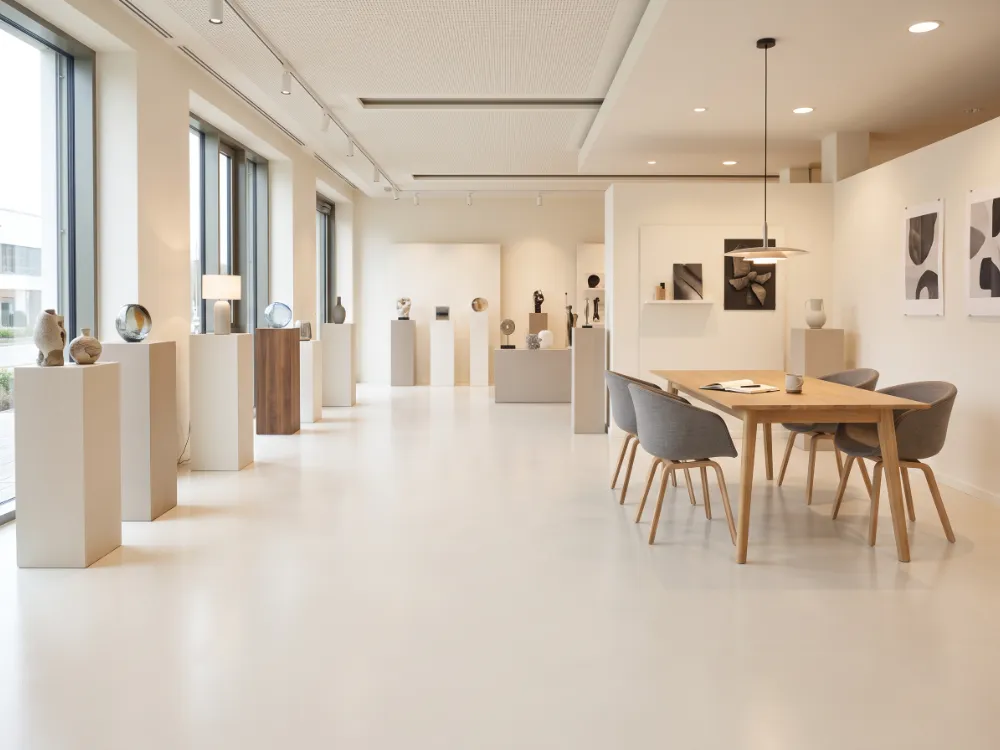
When the brand book rules the interior, the floor follows it exactly:
- Custom color matching to your brand standard — not the nearest stock tone
- Gloss, satin or matte sheen specified to the lighting design
- Zone and accent banding poured in, sealed under the wear layer
- Uniform color wall-to-wall — no tile lot variation, no grout grid
Service Corridors & Delivery Transitions
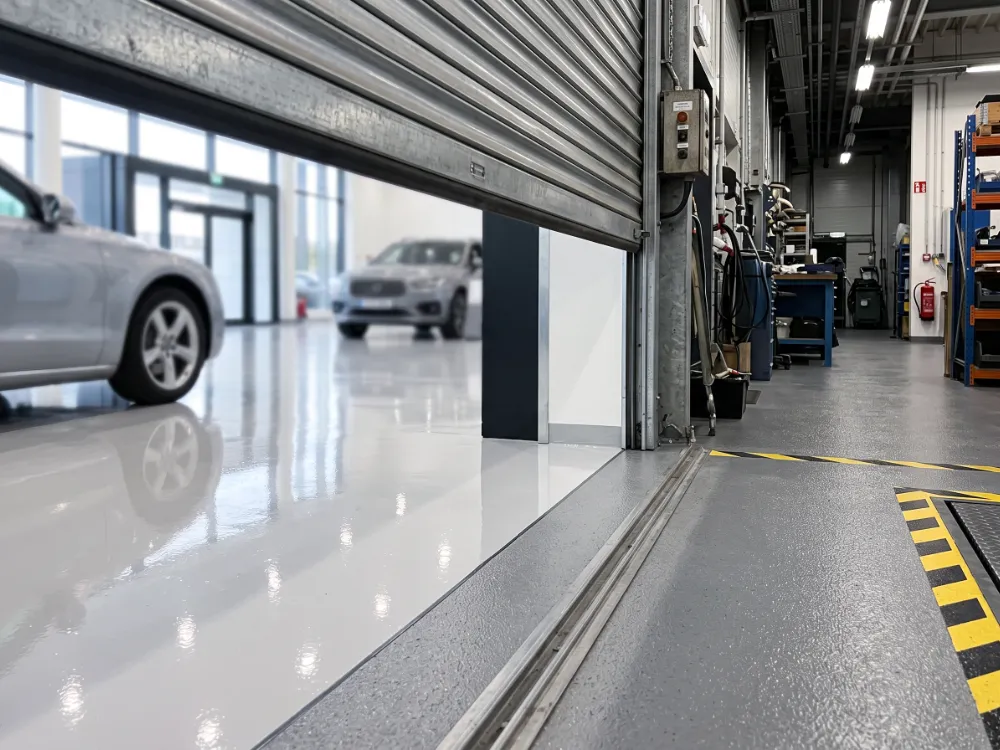
Every showroom has a back door where the polish meets the work: delivery bays, prep rooms, the corridor to the service department. The system transitions there without a seam — gloss gives way to quartz texture, white gives way to working gray — so the floor stays continuous while the duty changes. Customers see one intentional surface; operations gets traction, impact tolerance and wash-down chemistry where it needs them.
Poured Overnight, Open On Schedule
Showrooms sell every day they are open, so the floor goes in while they are closed. Metallic pours run as single-night events per section — prep, pour, hand-working, cure — and solid systems phase zone by zone behind temporary screens. Fast-cure, VOC-free chemistry means the doors open on time with no solvent trace in the air, and a scheduled recoat years later is one more night, not a renovation.
Frequently Asked Questions
Can cars really drive on a mirror-gloss floor?
Yes — the gloss is cosmetic, the build is industrial. Vehicle-rated thickness over diamond-ground concrete carries showroom traffic, delivery moves and service runs, and the wear layer is harder than anything a tire does to it at parking speed.
What about hot-tire pickup — we’ve seen coatings peel where cars park?
That failure belongs to thin, bargain coatings with weak bonds. Our systems key into ground concrete with a full-rejection bond and cure into a surface hot tires cannot soften — hot-tire pickup is specifically what the chemistry is formulated against.
Will a white or light floor yellow over time?
Not under a polyaspartic topcoat — it is UV-stable by design. Ordinary epoxy ambers under sunlight and showroom glass; the topcoat we seal every floor with holds true color and gloss depth for years, which is why we can put white floors in front of south-facing windows.
How unique is a metallic floor, really?
Genuinely one of a kind. The pigment is worked by hand while the pour cures, so the veining and movement can be guided — toward your palette, your drama level — but never duplicated. Two floors from the same crew on the same week will not match.
Can you match our exact brand color?
Yes — solid systems are pigment-matched to your standard, not approximated from a stock chart. Accent bands, zone colors and even a subtle two-tone layout pour in as part of the system and sit under the clear wear coat permanently.
How long does installation take, and do we close?
You close at night, not for the project. A section preps and pours in an evening, cures by morning, and larger floors phase zone by zone behind screens. The showroom sells every scheduled day — the floor happens in the hours between.
How do we keep the gloss looking new?
A dust mop and a neutral-cleaner damp mop — no wax, no buffing, no polish schedule. Gloss lives in the topcoat, not in a maintenance product, so it does not dull with missed cleanings or build up with repeated ones.
What happens when a display or car leaks oil on the floor?
Wipe it up — that is the whole procedure. The surface is non-porous, so oil, coolant and coffee sit on top instead of soaking in. Nothing stains, which on a light showroom floor is the difference between an incident and a shrug.
What does a showroom floor cost?
Metallic statement floors, pearl systems and solid colors price differently, and slab condition matters as much as square footage. We manufacture our own materials — distributor-direct pricing — and the free on-site estimate gives you a number per finish option so the design decision comes with its price tag attached.
Years from now, can the floor be refreshed without redoing it?
Yes — that is built into the system. The clear wear coat recoats in a single overnight session, restoring full gloss without touching the color layer beneath. A showroom floor stays permanently one night away from new.
Front of House to the Service Bay
Showroom gloss, corridor traction and delivery-bay durability — one seamless system set, poured overnight, under one three-year commercial warranty, across Los Angeles, Orange, Ventura and the surrounding counties.
Related: retail space flooring, office flooring, the commercial and industrial overview, and the color chart.
FREE onsite Estimate
5 stars rated company
Get it done right the first time...


