
Slab Leveling & Overlay Specialists
Self-Leveling Concrete
Wavy, settled, worn-out slabs poured flat again — no jackhammers, no demolition, no weeks of downtime
Request a Free Estimate
Self-Leveling Concrete & Epoxy
Gravity is honest: set a marble down in most older Southern California homes and it will roll. Slabs settle, wear into waves, and inherit height mismatches from decades of remodels — and every finish floor laid over that history telegraphs it. Self-leveling systems are the fix that skips demolition: flowable materials that find their own level across the floor, turning a rolling slab back into a flat plane in a single pour.
Top Epoxy Flooring installs both branches of the family across Los Angeles, Orange, Ventura, San Bernardino, Riverside and San Diego counties: cementitious self-leveling underlayment that corrects flatness under any future finish, and 100%-solids self-leveling epoxy that pours as the finished wear surface itself — a sixteenth to an eighth of an inch of seamless, glass-flat resin. Moisture testing, diamond grinding and priming come first on every pour, because toppings are unforgiving of skipped preparation.
Most pages on this subject sell one system or hide the specifications entirely. This page gives you both systems, the real numbers, and the honest boundary where leveling stops making sense — so the estimate you request is already an informed one.
What Goes Into Every Leveling Pour

Diamond Grinding Preparation
Diamond grinding opens the slab so the pour bonds into the concrete rather than resting on it — toppings live or die by this step.

Moisture Vapor Testing
Moisture vapor testing comes before any material; damp slabs get a barrier primer matched to the reading.

Primer & Moisture-Barrier Basecoat
System-specific primers lock the pour to the prepared slab — the step DIY leveling jobs skip and regret.

Laser Flatness Survey
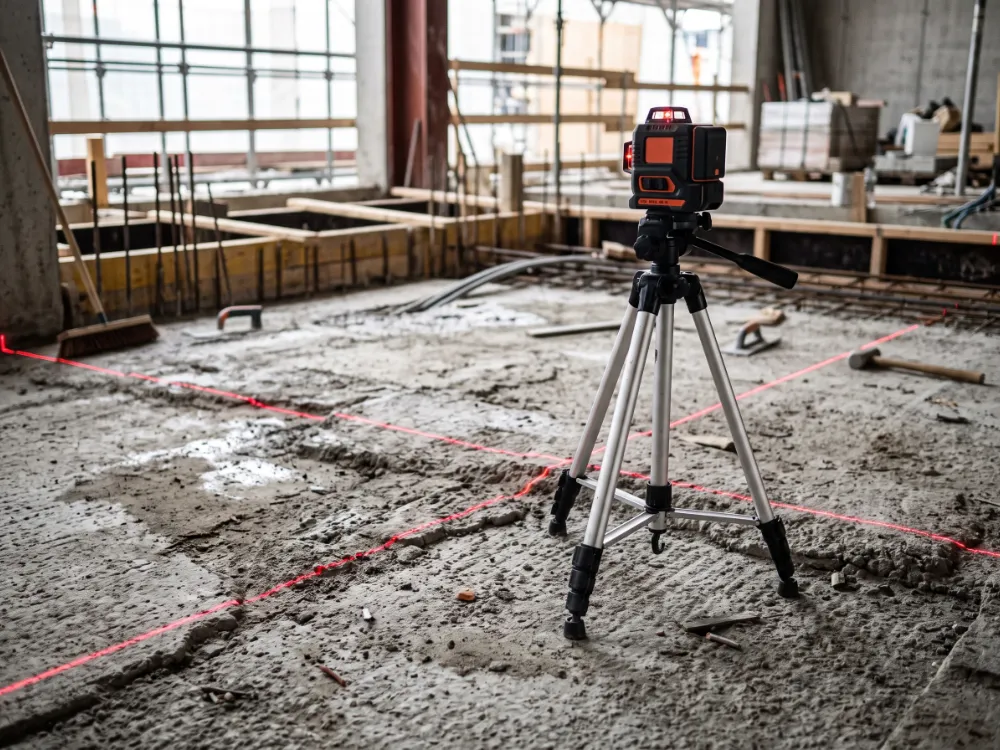
A laser flatness survey maps every dip and crown, so the pour is planned in numbers instead of guesses.

Single-Pour Seamless Application
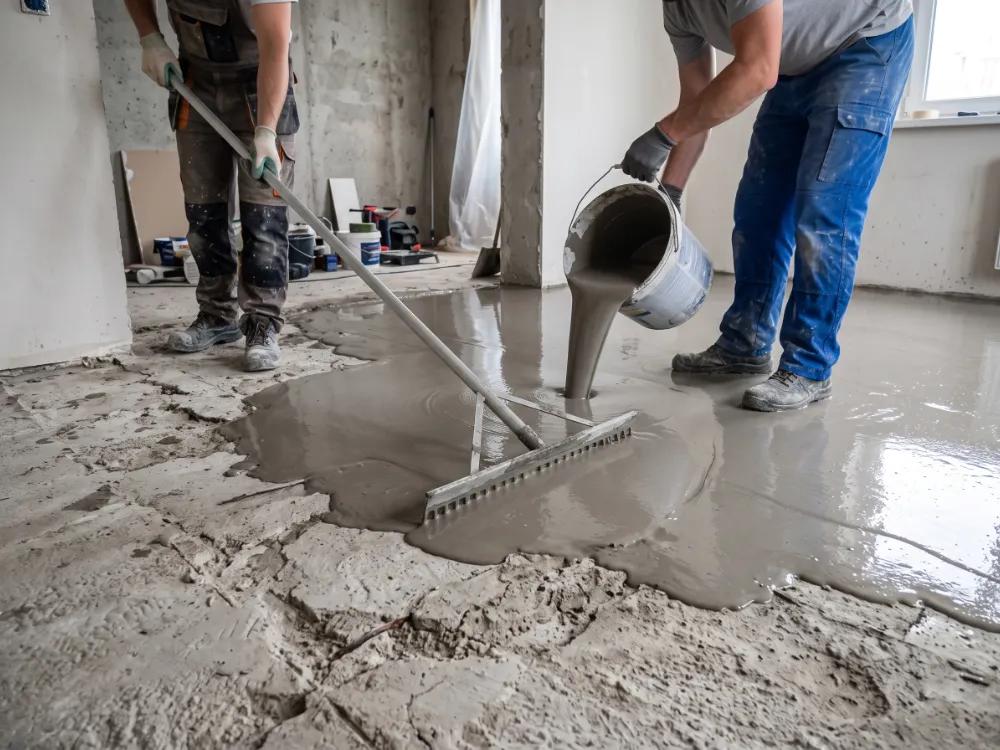
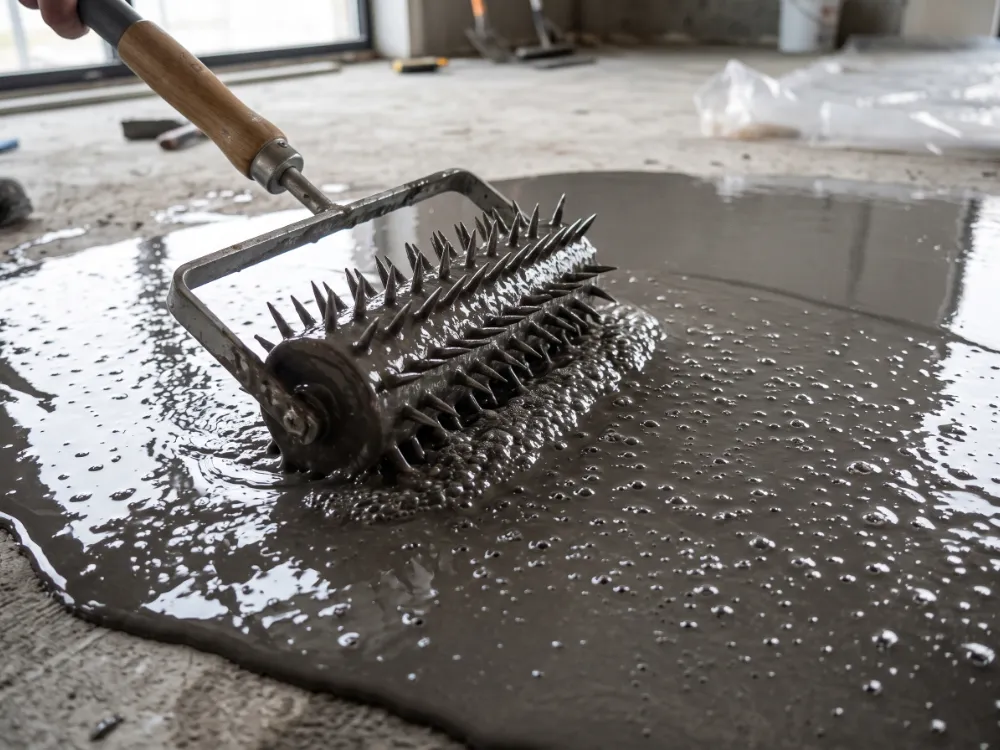
The material is poured, gauge-raked and spike-rolled in one continuous operation — seamless from wall to wall.

UV-Stable Topcoat Option
Self-leveling epoxy floors can finish under a UV-stable polyaspartic topcoat for extra wear and sun resistance.
Two Systems, One Family
"Self-leveling" covers two different materials with one talent — flowing flat:
- Cementitious underlayment — a mineral compound poured from feather-edge to over an inch, correcting dips, waves and room-to-room height mismatches. It is the flatness fix under any finish: our coating systems, tile, plank, anything.
- Self-leveling epoxy — 100%-solids resin poured at 62–125 mils that IS the finish: a seamless, high-gloss wear surface for showrooms, commercial and industrial floors.
The diagnosis picks the system; badly settled slabs headed for a decorative finish often take both — underlayment for flatness, resin for the surface.
The Mid-Century Settlement Problem
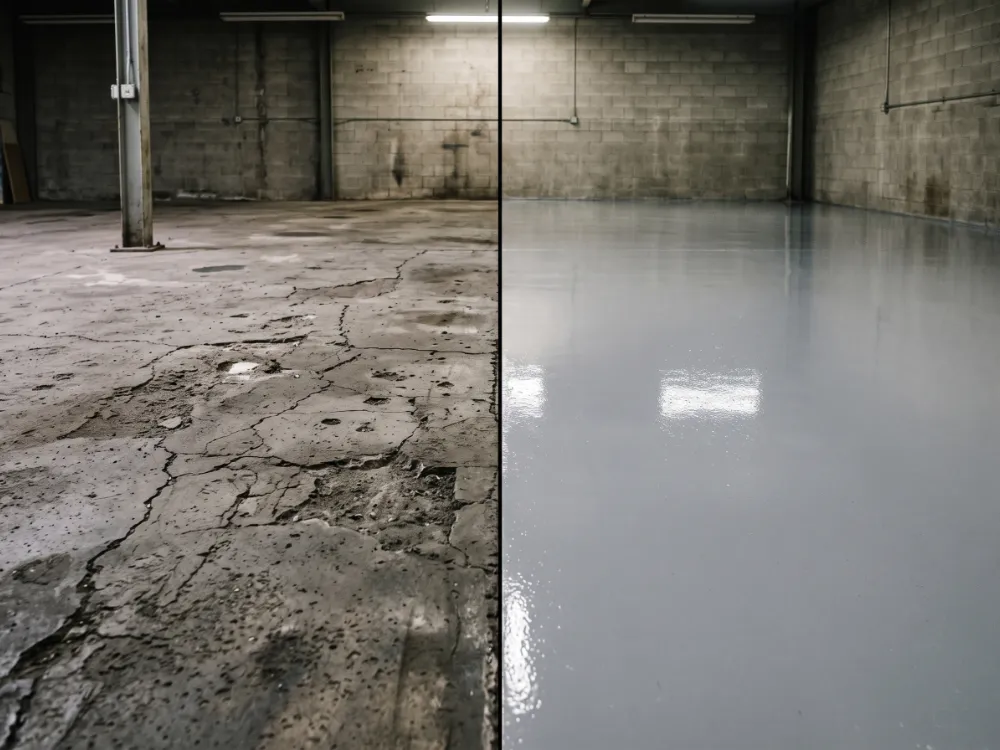
A huge share of Southern California's housing stock was slabbed in the 1950s through 70s, and those floors have spent decades settling into the soil beneath them — a low corner here, a hump at a doorway there, a garage that drains toward the house. Furniture wobbles, doors catch, and every flooring installer who visits quotes around the problem instead of through it.
A leveling pour ends the negotiation: laser-mapped, primed, and flowed flat in a day, the slab becomes the plane it was poured to be — ready for any floor, including simply a coated version of itself.
Self-Leveling Epoxy: the Poured Finish
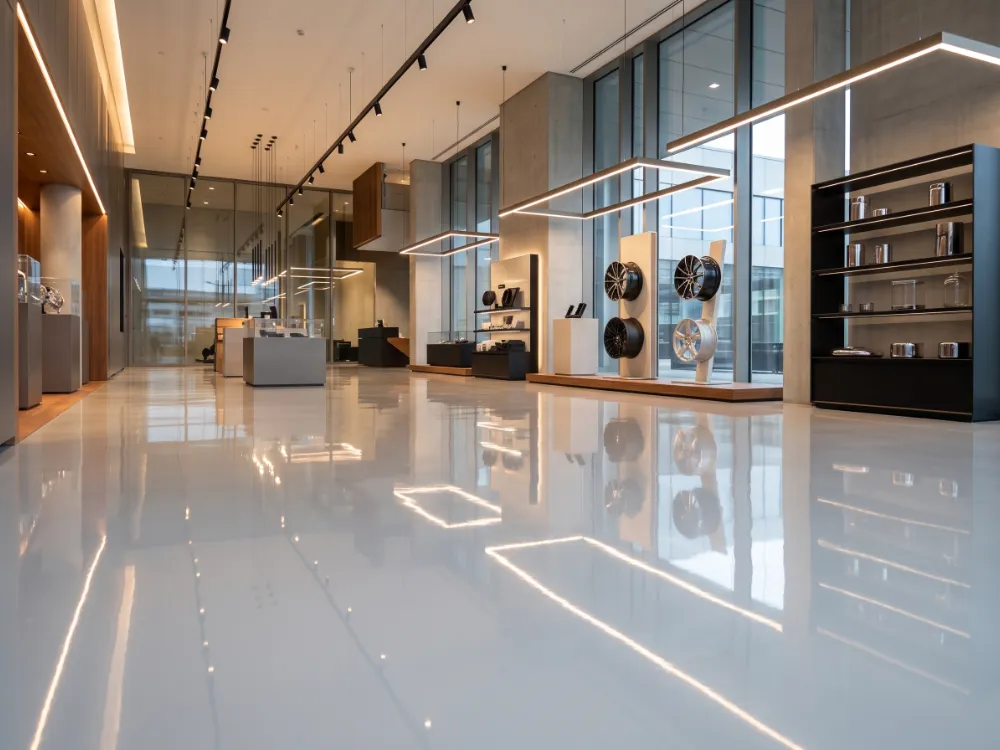
Where roller-applied coatings build in passes, self-leveling epoxy arrives all at once: buckets of 100%-solids resin poured and gauge-raked into a single continuous sheet up to an eighth of an inch thick, spike-rolled to release air, curing into the flattest, glassiest floor resin can make. Showrooms and galleries choose it for the mirror; commercial kitchens and labs for the seamlessness.
Pigmented any color from our own production line, and optionally finished under a UV-stable polyaspartic topcoat, it is the flagship answer when the floor itself is meant to impress.
Advantages of Self-Leveling Systems
Flat floors without demolition: settled slabs corrected in a day at a fraction of replacement cost, seamless resin wear surfaces poured up to an eighth of an inch thick, and every pour built on tested moisture numbers and diamond-ground bond — by the company that manufactures the resin.
Flat Without Demolition
No demolition, no re-pour: roughly a third of replacement cost and days instead of weeks of disruption.
Two Systems, One Diagnosis
Real specifications stated plainly — pour thicknesses, cure windows and moisture readings, not "call us" vagueness.
A Fresh Canvas for Any Finish
One crew levels and finishes: the same company pours the flatness fix and warranties the floor that goes over it.
Industrial Wear Surfaces
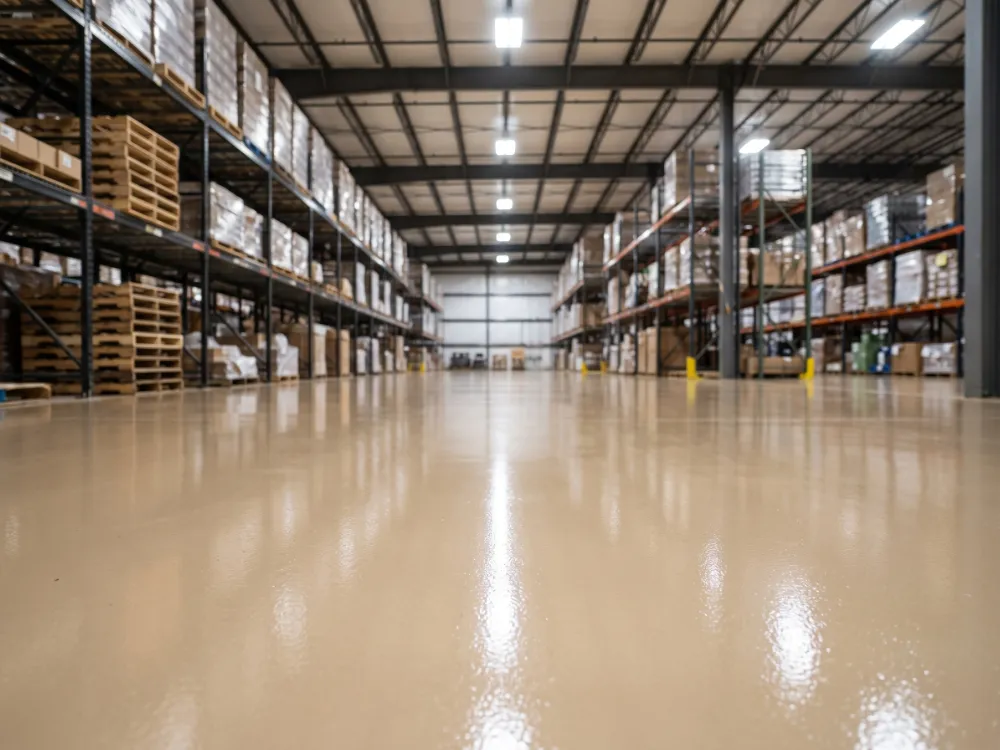
In warehouses and production spaces, self-leveling epoxy earns its keep as a working surface: thick enough to absorb wheel traffic and impact, seamless enough to clean in one pass, and flat enough to make racking, machinery and material handling behave. Worn aisle lanes and battered pour-backs disappear under one continuous sheet.
Slip-resistant broadcast textures, line striping sealed under the topcoat, and chemistry upgrades — including Novolac topcoats for aggressive exposure — bolt onto the same base system as operations demand.
The Flatness Fix Under Everything Else
Half our leveling work is invisible in the finished photo: underlayment poured so that a flake, metallic or solid color system lands on a flat canvas. Decorative finishes magnify substrate flaws — a mirror-gloss floor makes a quarter-inch dip look like a pond — so on wavy slabs, leveling is not an upsell; it is the difference between a floor that photographs well and one that actually is well.
The laser survey happens during the estimate, so you see the numbers that justify — or rule out — the leveling line item before anything is scheduled.
Moisture: the Non-Negotiable Test
Flowable systems bond over large, uninterrupted areas, which makes them the floors most punished by untreated slab moisture — vapor pressure under a big monolithic pour has nowhere to vent. So every leveling project starts with vapor testing, and readings above threshold trigger a moisture-barrier primer engineered for the number, not a hopeful standard primer.
White, powdery efflorescence on your slab is the classic early flag — mention it when you call, and we will bring the test equipment to the first visit.
Frequently Asked Questions
What is the difference between self-leveling underlayment and self-leveling epoxy?
They solve different problems. Cementitious self-leveling underlayment is a flowable mineral compound that corrects flatness — filling dips, waves and height mismatches to create a level substrate for whatever floor comes next. Self-leveling epoxy is a 100%-solids resin poured at roughly a sixteenth to an eighth of an inch that IS the finished floor: a seamless, glossy wear surface. Your slab's diagnosis decides which one — sometimes both.
How thick do these systems go on?
Underlayments pour from feather-edge up to over an inch where a slab has really settled, in a single pass. Self-leveling epoxy wear surfaces run around 62 to 125 mils — a sixteenth to an eighth of an inch — dramatically thicker than roller-applied coatings, which is where their glass-flat look and durability come from.
Can self-leveling fix cracks and low spots?
Low spots, dips and waviness — yes, that is the whole job. Cracks get repaired first and then flow-covered, but a crack that is still moving will eventually telegraph through any topping, so we treat active cracks structurally before pouring. Diagnosis before material, always.
Will it bond to my old slab?
Bonded correctly, it becomes part of the slab. That means diamond grinding to open the surface, priming per the system, and moisture testing before anything flows. Failures you read about — toppings that pop loose — are prep failures, which is why our leveling crews are the same people who prep every coating floor we warranty.
My house is mid-century and the floors visibly slope — is that fixable?
Usually, and it is one of our most common leveling calls. Slabs from the 1950s–70s settle unevenly over decades; a laser survey maps exactly where yours sits, and underlayment restores a flat plane room to room without jackhammers. Structural settlement that is still moving is the exception — that gets flagged honestly to a foundation contractor first.
What finishes can go over a leveled floor?
Anything in our catalog: flake, solid color, metallic, stained finishes, tile or plank if you are going another direction — or nothing but a sealer, since fresh underlayment can be finished in its own right. Self-leveling epoxy needs no cover at all; it pours as the finished surface, optionally under a UV-stable polyaspartic topcoat.
How soon can the floor be used?
Foot traffic typically returns around 24 hours after a pour, with full service and vehicle loads following over the next days depending on system and temperature. Most residential leveling projects run one to two days of work plus cure — no demolition phase, which is the entire economic argument.
What about moisture — my slab has white powdery patches?
That efflorescence is a moisture flag, and we treat it as one: vapor testing comes before any pour, and damp slabs get a moisture-barrier primer engineered for the reading. Self-leveling systems are unforgiving of skipped moisture work — so we never skip it.
Is a self-leveling epoxy floor slippery?
At full gloss it behaves like any smooth resin floor — fine dry, slick wet — so commercial pours typically take a slip-resistant additive in the topcoat, and broadcast texture is available where operations demand real grip. The traction level is specified to the space, not left to chance.
When does leveling stop making sense versus replacing the slab?
When the slab is failing structurally — heaving, actively settling, crumbling through its depth — a topping would just ride the failure. For everything short of that, leveling wins by roughly a third of replacement cost, days instead of weeks, and no demolition. Our assessment tells you plainly which side your floor is on.
Related Slab Work
Leveling pairs with the rest of our concrete services — often on the same project.
Concrete resurfacing · Concrete grinding & surface prep · Epoxy floor repair · Urethane cement flooring · Solid color epoxy floors · Garage floor coating · Warehouse flooring · Commercial & industrial flooring
FREE onsite Estimate
5 stars rated company
Get it done right the first time...


