
Epoxy Floor Coatings for Distribution
Warehouse Flooring
Forklift-rated, dust-proof, striped-in — coated aisle by aisle while the operation keeps shipping
Request a Free Estimate
Warehouse Epoxy Flooring
Warehouse concrete fails quietly and then expensively. Bare slabs shed dust onto inventory and into equipment, joints hammer wheels until pallet jacks rattle, and painted striping disappears under forklift tires a quarter after it dries. By the time the floor becomes a line item, it has already been taxing the operation for years — in cleaning hours, wheel maintenance and the general grime that bare concrete guarantees.
A warehouse coating system reverses all of it at once. High-build epoxy — specified in mils for your traffic, up to quarter-inch troweled urethane mortar where the duty is brutal — seals the slab into a dust-free, light-reflective work surface. Joints and spalls are rebuilt with rigid polymer so wheels roll instead of hammer. Safety striping, pedestrian walkways and staging zones are coated into the floor under the wear layer, where forklifts polish them instead of erasing them. And the whole installation is sequenced aisle by aisle around your racking and your shipping schedule, because a distribution operation does not pause for paint.
Top Epoxy Flooring manufactures its own materials and installs with in-house crews across Southern California under a three-year commercial warranty. See the wider commercial and industrial flooring range or request a free on-site estimate below.
Systems Specified for Warehouse Duty

Mil-Rated High-Build Epoxy
High-build epoxy specified in mils to your traffic class — a rated wear surface, not a paint-thin roll coat that fails in the aisles first.

Urethane Mortar Heavy Duty
Troweled urethane mortar — up to a quarter inch — for the heaviest duty zones: dock plates, drag chains, steel-wheeled traffic.

Quartz Broadcast Traction
Quartz broadcast texture where traction matters — dock aprons, ramps and any zone that sees weather tracked in.

Joint & Spall Rebuild
Control joints and spalls rebuilt with rigid polymer and ground flush — the fix for wheel hammering that shakes equipment apart.

Dust-Proofed Concrete
Sealed, dust-proofed concrete — the slab stops shedding onto inventory, racking feet and everything with a filter.

Moisture-Vapor Barriers
Moisture-vapor barrier basecoats on on-grade slabs — tested during the estimate, engineered in where the readings demand it.
Racking Aisles & Storage Floors
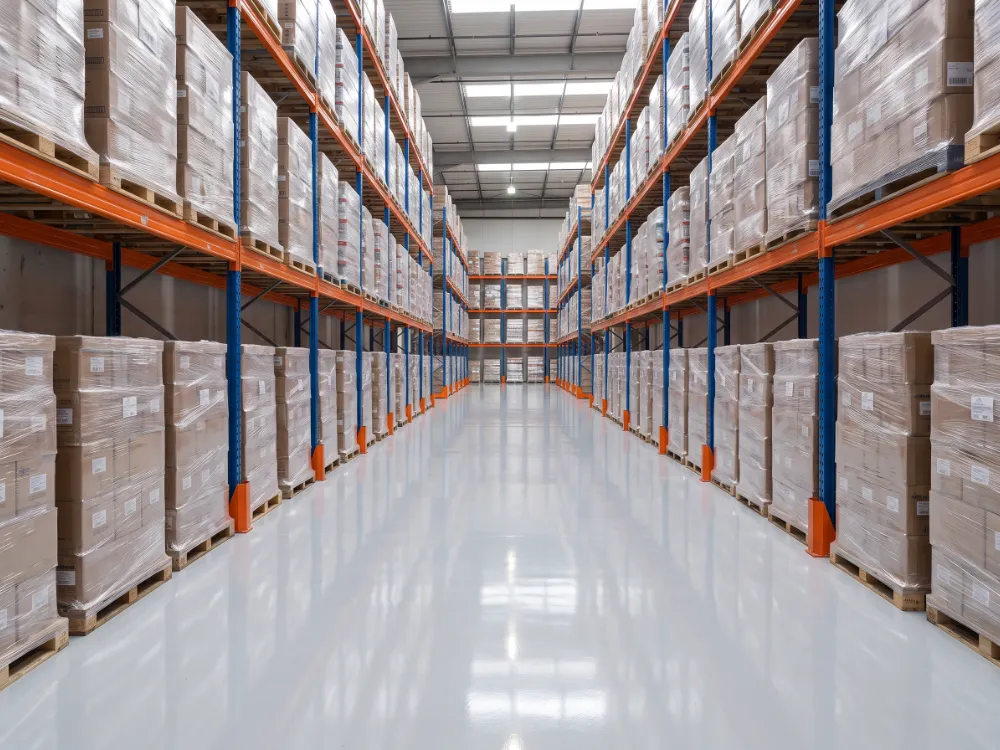
Under racking, the floor carries point loads that concentrate tons onto a few square inches of baseplate; in the aisles, it takes the same forklift running the same line hundreds of times a shift. A high-build system handles both — rated for static load under the uprights and dynamic wear in the wheel paths — while the sealed, light-reflective surface brightens rack faces enough that pickers read labels faster and lighting bills quietly drop.
Forklift Routes & Floor Markings
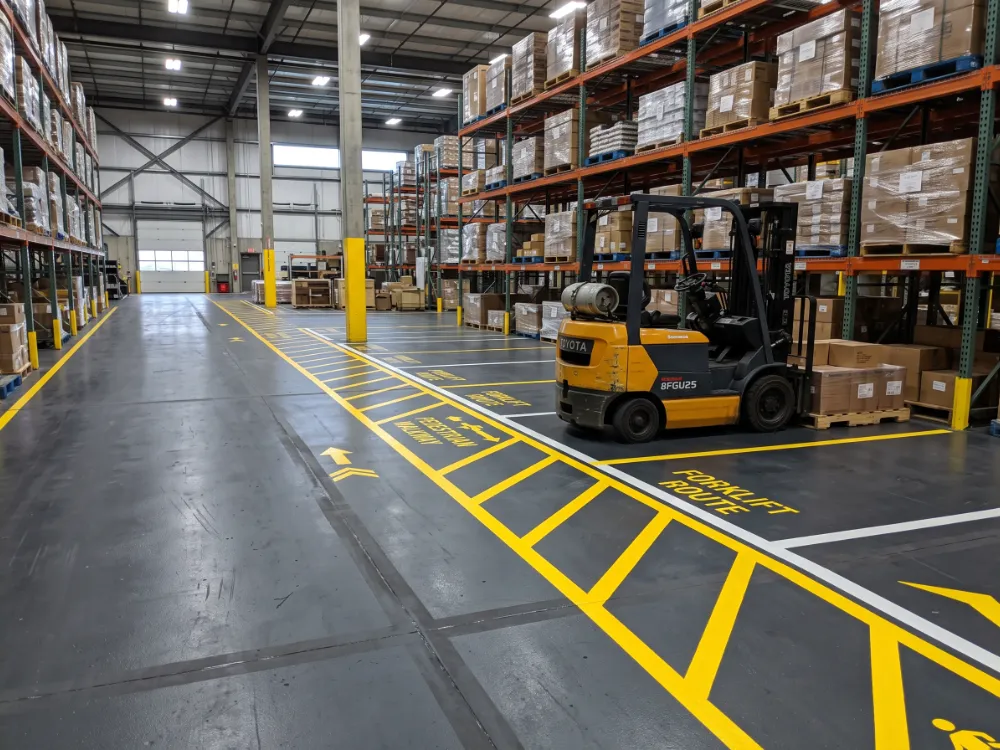
The safety layout becomes part of the floor itself:
- Pedestrian walkways, forklift lanes and hatched keep-out zones coated in, then sealed under the clear wear layer
- No repainting cycle — forklifts polish the striping instead of erasing it
- OSHA-convention colors or your internal standard, applied from your drawings
- Rebuilt joints along every route, so wheels roll quiet and hardware stays tight
Loading Docks & Staging
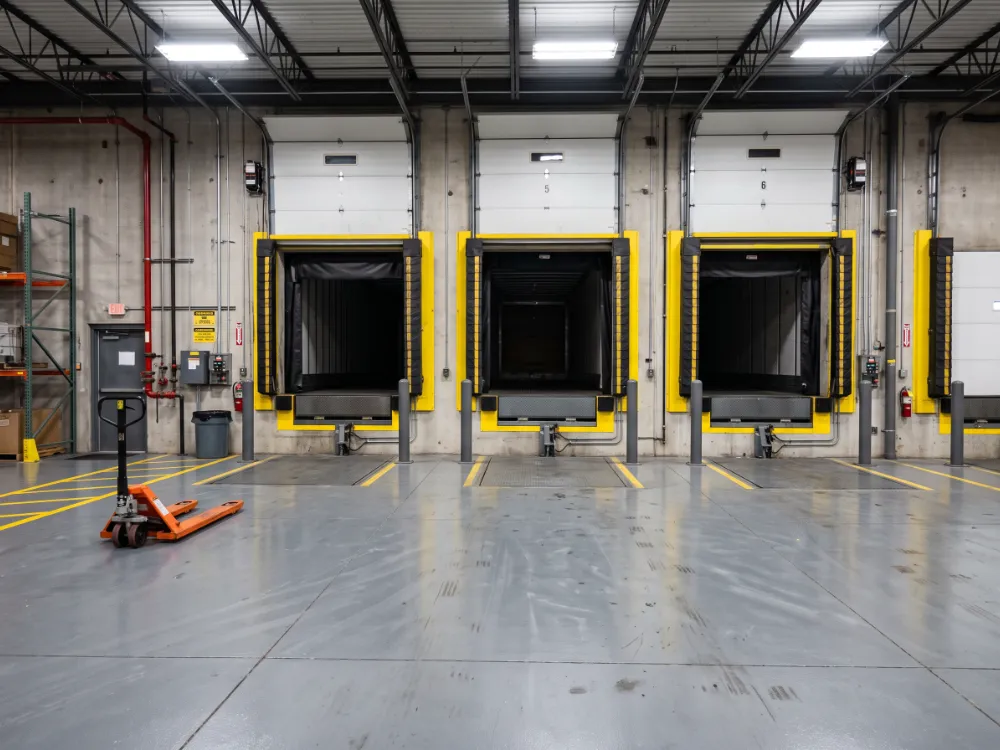
Docks are the floor’s hardest duty station: dock plates slamming, pallet jacks pivoting under load, weather blowing in every time a door opens. Here the specification steps up — urethane mortar or heavy-build epoxy at the dock aprons, quartz traction where rain gets tracked, and impact-tolerant detailing at the plate edges. Staging lanes mark out in coated color so trailers load from a floor plan, not from memory.
Advantages in a Distribution Operation
A warehouse floor is measured in operational terms: uptime during the install, dust off the inventory, wheels that stop hammering, striping that stops fading. The system is engineered against those metrics — and installed against your shipping calendar, not ours.
Racking Point-Load Rated
Point-load rated under racking, wear-rated in the wheel paths — specified to your equipment list, not a brochure average.
Aisle-by-Aisle Scheduling
Aisle-by-aisle sequencing around live operations — racking stays loaded, shipping never misses a wave.
Striping That Outlives Paint
Dust-proofed and sealed — cleaning crews scrub a surface instead of fighting the slab itself.
Pick, Pack & Ship Zones
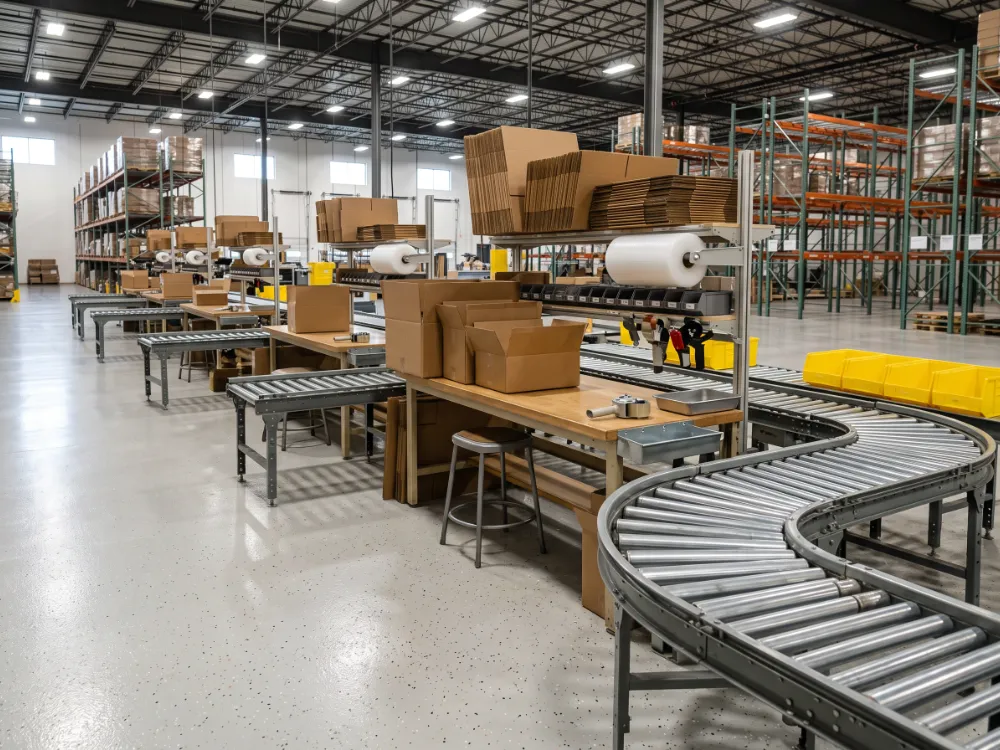
Fulfillment zones mix foot traffic, cart wheels and conveyor legs on the same square meters all shift long. A flake or solid system with a double wear topcoat keeps these floors bright and legible — station zones marked in coated color, spill-prone packing areas sealed non-porous, and a surface comfortable enough underfoot that anti-fatigue matting shrinks to where it is genuinely needed. Small operational gains, multiplied by every order.
Offices, Break Rooms & Front Areas
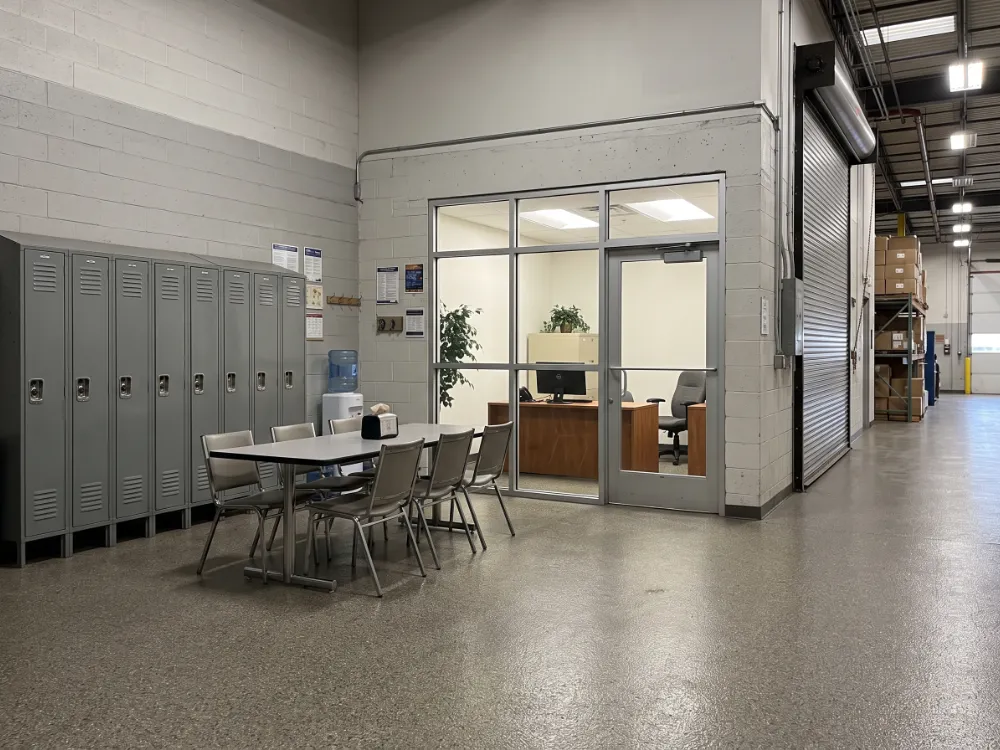
The warehouse front-of-house — offices, break areas, restrooms, the corridor where drivers sign in — gets the commercial treatment: flake systems in warmer tones, seamless and scrubbable, visually continuous with the operations floor. One finish standard across the building reads as a run operation to every customer, auditor and new hire who walks it.
Installed Around a Live Operation
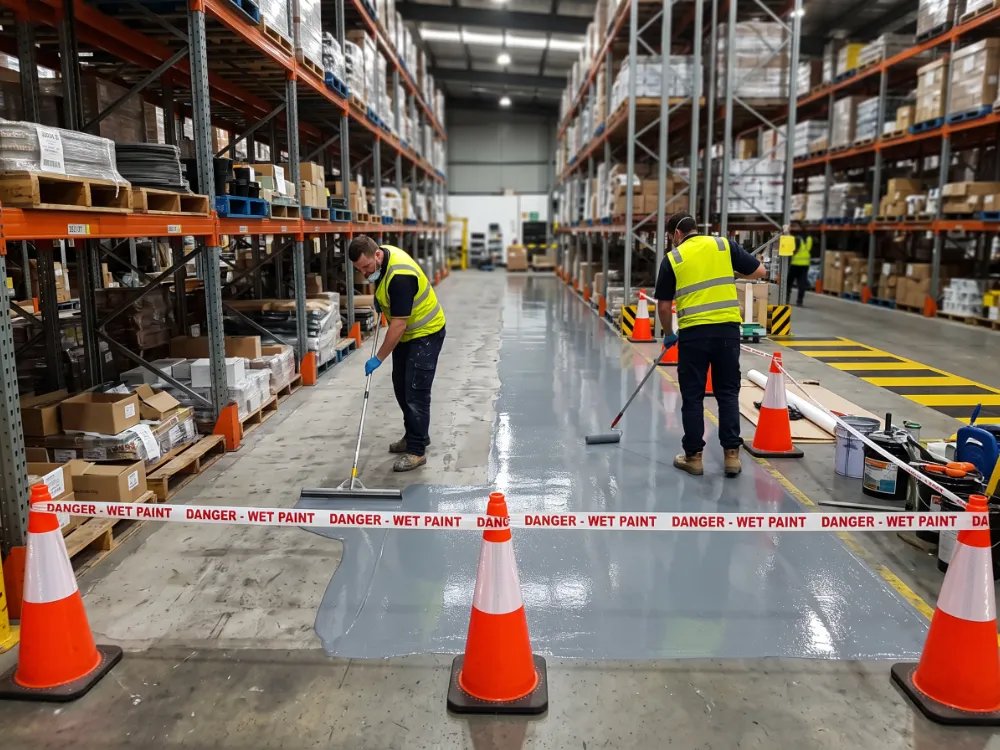
Warehouse installs are sequencing problems, and we plan them that way. Racking rows are coated in alternating aisles so picking never stops; dock sections rotate so receiving always has doors; fast-cure systems hand each zone back on a posted schedule measured in hours. Nights and weekend waves cover the zones that never sleep. The operation keeps shipping through every phase — that is the specification the schedule is built to meet.
Frequently Asked Questions
Can you coat the floor without emptying the racking?
Yes — aisle-by-aisle sequencing is standard. Alternating aisles are cordoned, ground and coated while adjacent rows keep picking, then the pattern flips. Full rack teardown is almost never required; where uprights must move, we plan it rack row by rack row with your team.
What thickness does a forklift floor need?
It depends on the duty: high-build epoxy systems measured in tens of mils handle standard forklift traffic, while dock zones and steel-wheel routes step up to troweled urethane mortar at up to a quarter inch. The specification follows your equipment list and traffic map — that is what the site walk-through is for.
Our joints are spalled and every pallet jack rattles across them. Fixable?
Completely — and it is one of the highest-return parts of the job. Joints are cut clean, rebuilt with rigid polymer rated for wheel traffic and ground flush. The hammering stops, the joint edges stop chipping, and wheel and caster maintenance drops with it.
How does the floor stop concrete dust?
Bare concrete sheds fine dust continuously as the surface wears — onto inventory, into equipment filters, over everything. A coated floor seals the slab completely: the dusting ends the day the system cures, which is often the first difference the operations team notices.
How long does painted-on striping last versus coated-in?
Painted lines fade in months under forklift tires and get repainted forever. Coated-in striping sits beneath the clear wear layer, so traffic polishes it instead of wearing it away — the safety layout keeps its contrast for the life of the floor.
What about the loading dock — it takes the worst abuse?
Docks get their own specification: urethane mortar or heavy-build epoxy at the aprons, impact detailing at dock plate edges, and quartz traction where weather tracks in. It is engineered as the hardest-duty zone on the floor, because it is.
Will the install shut down our shipping schedule?
No — the schedule is built backward from yours. Zones rotate around live operations, docks are coated in door groups so receiving always has capacity, and fast-cure chemistry reopens each section in hours, on a posted timeline your ops team signs off before we start.
How long does a warehouse epoxy floor last?
Specified correctly, ten to fifteen-plus years under forklift traffic, with high-wear lanes refreshed by recoat rather than replacement. Material and workmanship are covered together under our three-year commercial warranty — one company answers for both, because we manufacture and install.
What does warehouse floor coating cost?
Square footage, slab condition and duty mix set the number — a racking aisle and a dock apron are different specifications. We manufacture our own materials, so pricing is distributor-direct, and the free on-site walk-through with moisture testing produces a per-zone quote.
Do you test for slab moisture first?
Always on on-grade slabs. Vapor drive is the silent killer of cheap coatings — it bubbles and delaminates them from below. Where readings are high, a moisture-vapor barrier basecoat is engineered into the system, and the problem is designed out before the first coat goes down.
From Receiving to the Front Office
Racking aisles, forklift routes, docks, fulfillment zones and the offices up front — one specification set, one aisle-by-aisle schedule, one three-year commercial warranty, across Los Angeles, Orange, Ventura and the surrounding counties.
Related: manufacturing flooring, the commercial and industrial overview, and office flooring for the front of the building.
FREE onsite Estimate
5 stars rated company
Get it done right the first time...


