
Below-Grade Epoxy Coating Specialists
Basement Floor Coating
The floor that solves basement moisture instead of surrendering to it — seamless, mold-proof, warrantied for life
Request a Free Estimate
Basement Floor Coating
Every guide to basement flooring ends the same way: "test for moisture first." Almost none of them tell you what to do when the test comes back damp — which, for a slab sitting directly on the ground, it usually does. This page is about the answer: an epoxy system that starts from the assumption of below-grade moisture and is engineered to defeat it, rather than a pretty floor that hopes for the best.
Top Epoxy Flooring manufactures and installs its own coating systems across Los Angeles, Orange, Ventura, San Bernardino, Riverside and San Diego counties — and basements are a specialty case we take seriously, from hillside homes in the canyons to the older housing stock where below-grade rooms are common. The materials are VOC-free, which matters more in a basement than anywhere else in a house, and residential floors carry a limited lifetime warranty from the company that made the coating.
The system is simple to describe and exacting to build: measure the moisture, grind the slab, seal it under a vapor-barrier basecoat, then finish in flake or solid color with a tough polyaspartic wear coat. What follows explains each decision, so you can compare this against the carpet, vinyl and paint your basement will otherwise chew through.
What Goes Into Every Basement Floor

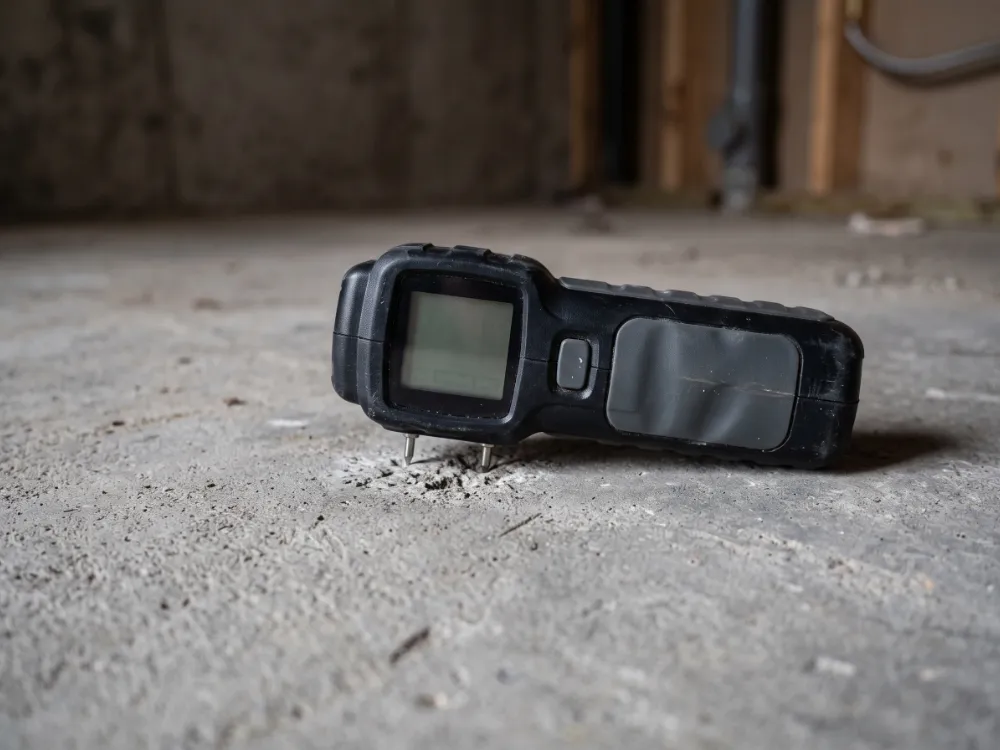
Slab Moisture Testing First
Every basement project begins with a moisture measurement, because the reading — not a sales pitch — decides which basecoat your slab needs.

Diamond Grinding Preparation
Diamond grinding opens the concrete into a bonding profile and levels old paint, adhesive and sealer residue in one pass.

Moisture-Vapor-Barrier Basecoat
Damp slabs get a moisture-vapor-barrier epoxy basecoat dense enough to hold back ground moisture permanently — the layer everything else depends on.

Seamless Mold-Blocking Film
The cured system is one seamless, inorganic, non-porous film: no fibers to feed mold, no seams to trap damp, nothing for a musty basement to work with.

VOC-Free for Enclosed Spaces
Our materials are VOC-free — no solvent fog in an enclosed, low-ventilation room below your living space, during install or after.

Durable Polyaspartic Topcoat
A polyaspartic topcoat finishes the floor with the same wear layer our garage systems use — gym racks, storage shelves and workbenches included.
Start With the Truth About Your Slab
A basement slab is the bottom of a hole in the ground, and the ground is never perfectly dry. Moisture vapor migrates upward through concrete year-round — invisible until it collects under something that cannot breathe, which is why basement carpet smells and basement paint peels in sheets.
So the first tool on a basement job is a meter, not a roller. We measure what the slab is actually emitting, and that number picks the system. It is an unglamorous step that no floor covering store will perform, and it is the reason our basement floors do not come back to haunt us.
The Vapor-Barrier Basecoat
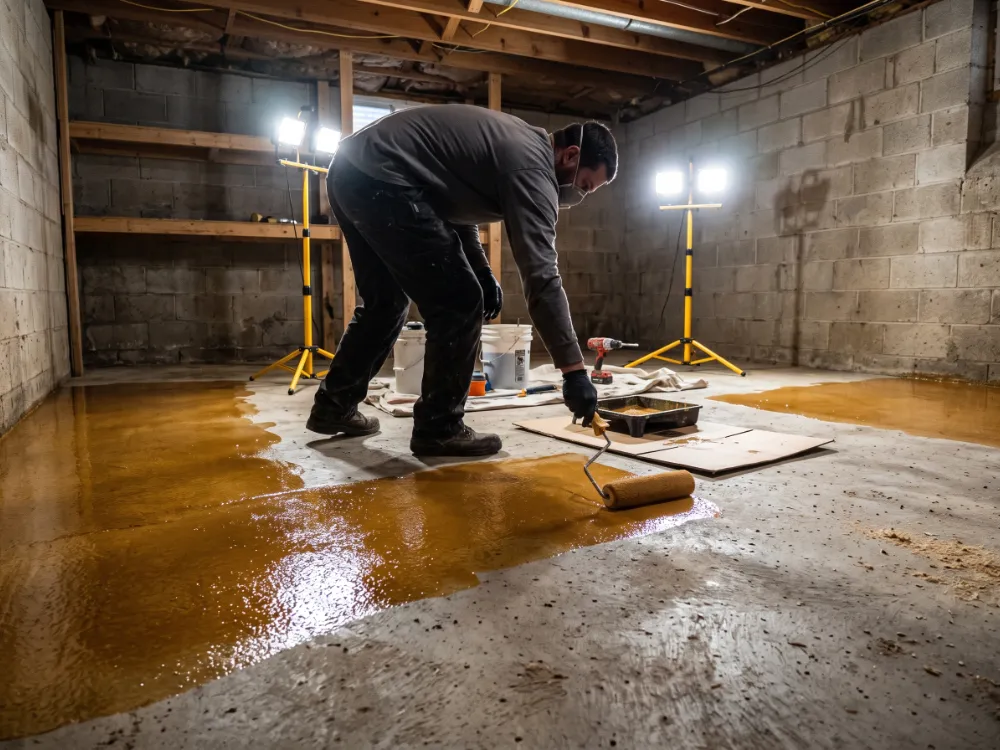
When readings call for it, the first coating down is a moisture-vapor-barrier epoxy — a dense, 100%-solids formulation rolled into the diamond-ground slab, engineered to resist the vapor pressure that destroys ordinary coatings from below. It cures into a permanently dry foundation for everything above it.
This is the layer that separates "epoxy over a basement slab" from "epoxy that survives a basement slab." It is also where our being the manufacturer pays off: the barrier formulation is our own product, not a substituted line item, and the lifetime residential warranty covers the system it anchors.
Rec Rooms, Home Gyms and Media Dens
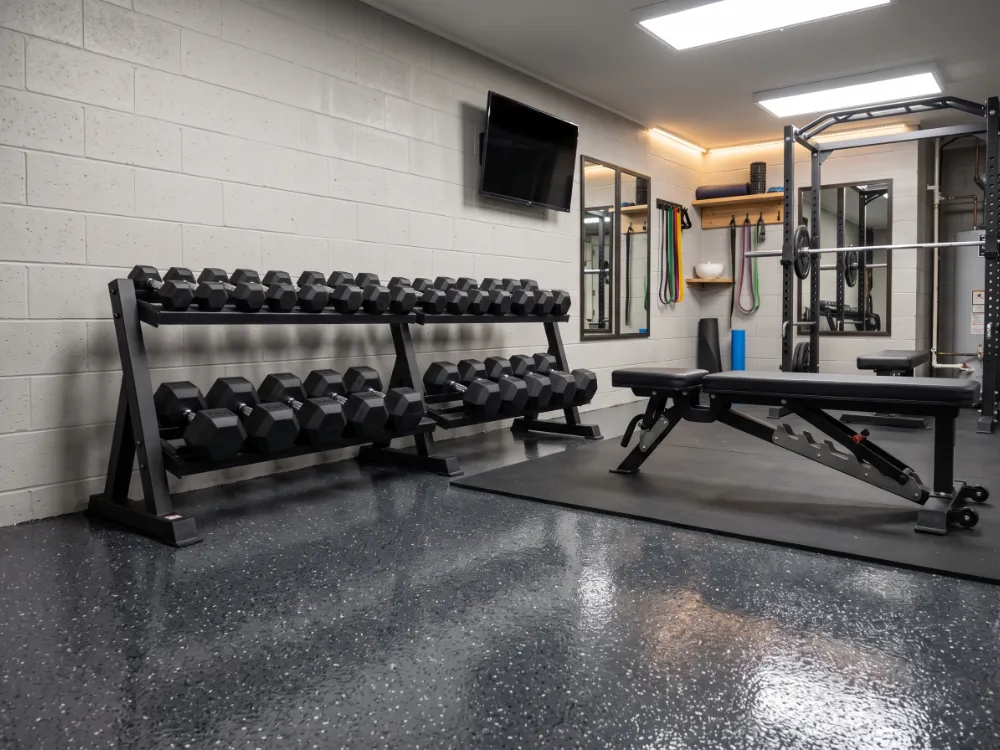
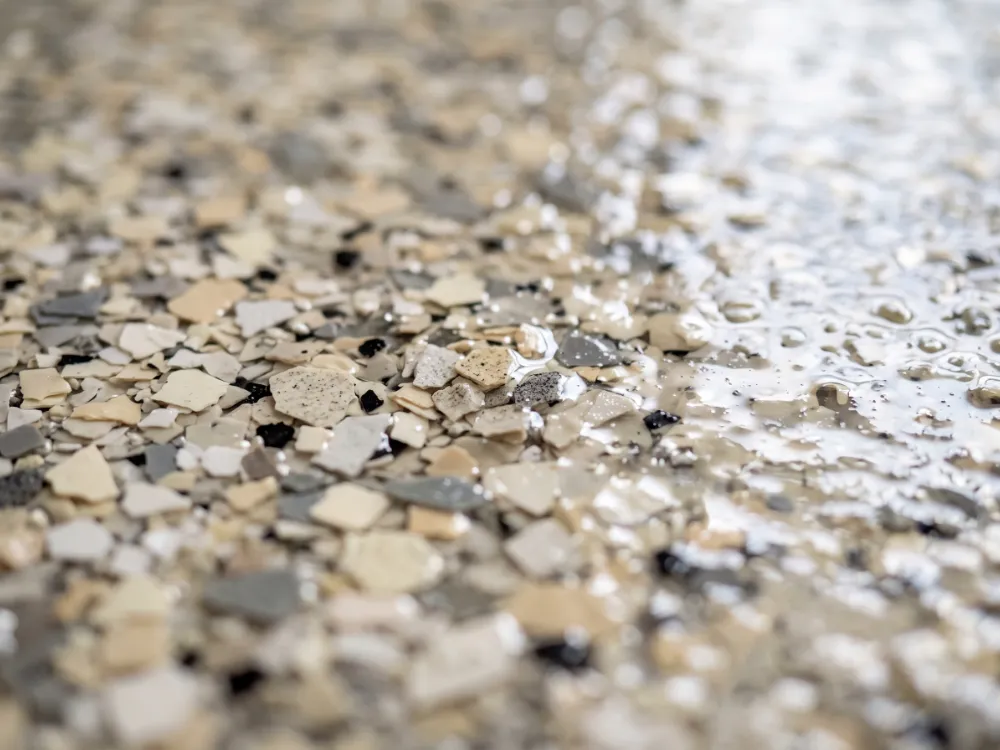
The finished-basement dream — the gym, the game room, the theater — deserves a floor that plays along. A flake system over the barrier basecoat delivers exactly that: rubber mats and racks sit on it without imprinting, dropped dumbbells scuff the sacrificial topcoat instead of the floor, and the full broadcast hides the grit that stairs funnel downward.
Light blends do double duty below grade, bouncing lamp light around rooms that never see a window and making the whole space feel less like a basement and more like the square footage you paid for.
Why Retailers Choose Our Coatings
Every flooring contractor buys coating from somebody. We are the somebody. Our VOC-free epoxy, polyaspartic and polyurea systems come out of our own production and go down by our own crews — which is why we can schedule around your trading hours, price at distributor level, and put a plain three-year commercial warranty behind every retail floor we install.
Moisture Solved, Not Just Named
Manufactured in our own plant, installed by our own crews — no subcontractors on your sales floor, no middleman in the price.
Safe Chemistry Below Grade
Overnight and weekend installation, phased section by section — the store closes at nine and opens on schedule.
Backed by the Manufacturer
Three-year commercial warranty in writing — the material and the workmanship answered for by one company.
Laundry, Storage and Workshop Floors
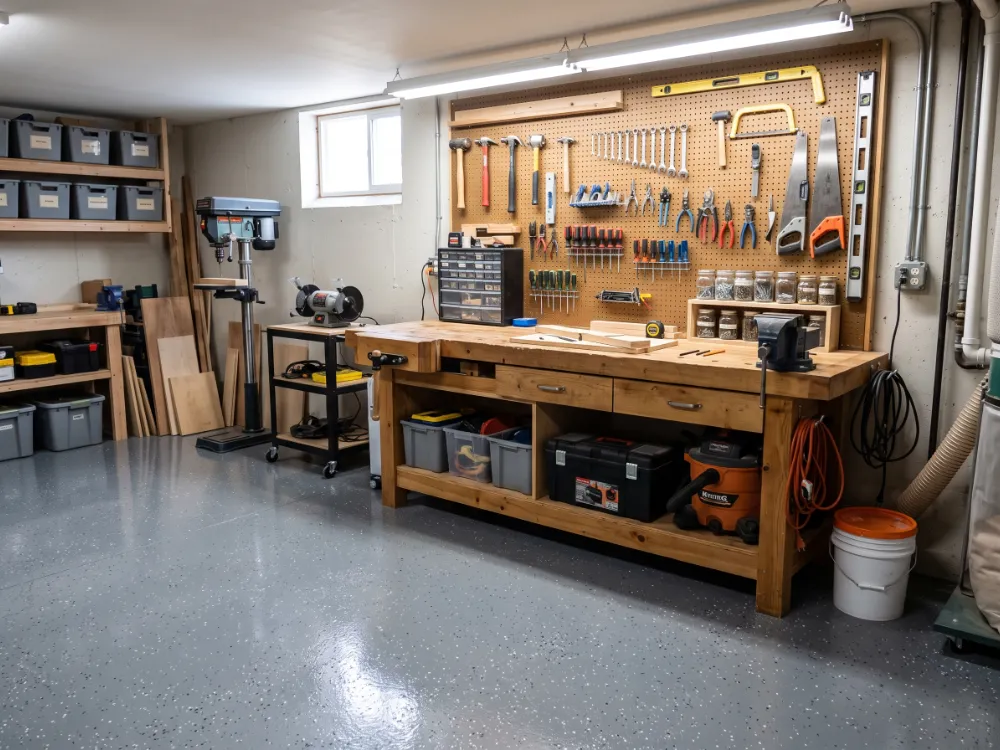
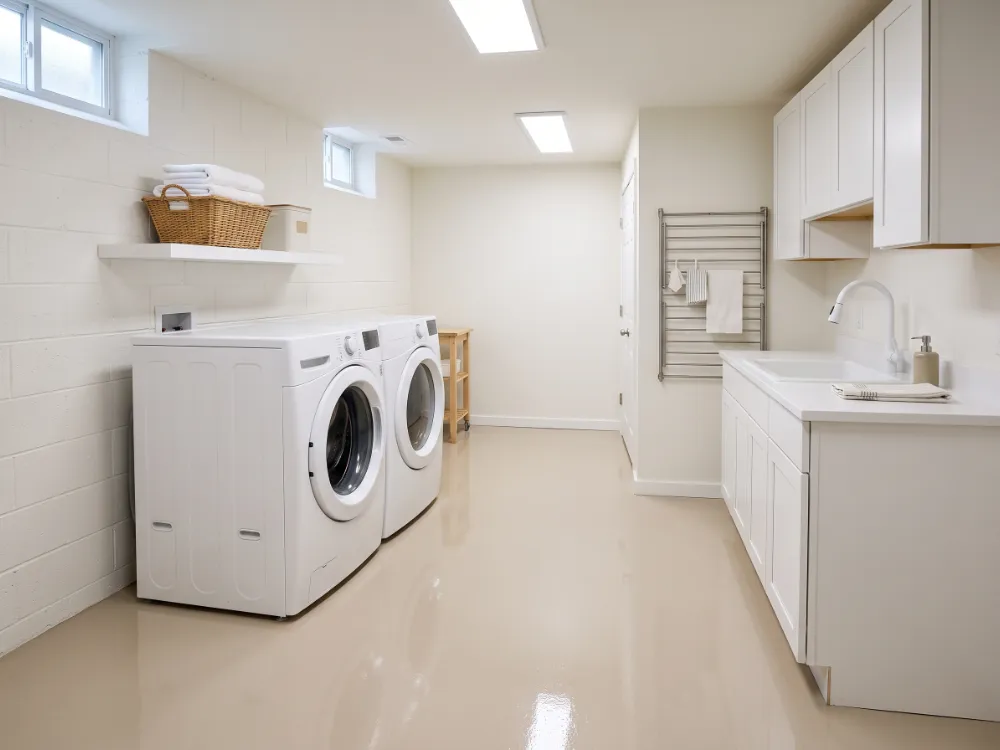
The working basement earns the same engineering. Solid color epoxy turns laundry and storage areas into bright, wipeable rooms where a detergent spill or a burst supply line is an incident, not a renovation. Workshops get a surface that sweeps clean of sawdust and shrugs off dropped tools, oil and solvent drips.
Because the finish is non-porous, the perpetual basement problems — efflorescence bloom, slab dust migrating onto everything, that mineral damp smell — simply stop at the coating line.
When Water Wins Anyway
Basements flood — a water heater lets go, a storm finds a window well — and the floor decides whether that is a bad afternoon or a five-figure claim:
- Nothing absorbs. Water sits on the sealed film instead of soaking into pad, plank or slab.
- Cleanup is extraction and a mop. No demolition, no drying fans running for a week, no torn-out carpet at the curb.
- Nothing feeds mold afterward. The film is inorganic and seamless; there is no damp layer left behind to bloom later.
- The floor is unharmed. Cured epoxy does not delaminate from a wetting event — it was built expecting one.
Brighter, By Design
Dark is the basement's natural state, and the floor is the biggest reflector in the room. A light flake blend or a pale solid color under a gloss topcoat returns a startling amount of lamp light to the walls and ceiling — basements measurably brighten the day the topcoat cures, before a single fixture is added.
Pair a light field with a satin sheen for a soft, finished-room glow, or go full gloss in gyms and workshops where maximum light matters more than subtlety. Every blend on our color chart is available below grade.
Frequently Asked Questions
Can epoxy go over a damp basement slab?
Yes — if the system is built for it. Below-grade concrete almost always passes some ground moisture upward, so our basement floors start with a moisture-vapor-barrier epoxy basecoat engineered to hold that vapor back. What fails is ordinary coatings applied straight over damp concrete; the barrier layer is the difference.
How do you know how much moisture a slab has?
We test before we quote a system — surface meter readings and, where results are borderline, standardized vapor-emission testing. The numbers decide the build: a dry slab can take a standard basecoat, a damp one gets the vapor barrier. Guessing is how basement coatings blister, so we never skip the measurement.
How does the vapor-barrier basecoat work?
It is a specialized 100%-solids epoxy dense enough to resist moisture vapor pressure pushing up from the ground. Rolled into diamond-ground concrete, it cures into a film that ground moisture cannot migrate through, giving every layer above it a permanently dry foundation. It is the same layer we trust under garage and interior floors on damp slabs.
Will an epoxy floor stop mold and mildew in my basement?
It removes the floor from the equation. Mold needs organic material and trapped moisture — carpet and wood deliver both, while a cured epoxy film is inorganic, seamless and non-porous, so there is nothing to feed on and nowhere for damp to hide. Combined with the vapor barrier below, the floor itself becomes a mold-dead zone.
What happens if my basement floods?
Cleanup becomes a mop job instead of a demolition. Water sits on the sealed surface rather than soaking in, so once it is extracted the floor is dry — no tearing out saturated carpet, no warped planks, no lingering odor. For homes in hillside or older neighborhoods where water finds the lowest room, that resilience is the whole argument.
Do basements in Southern California really need this?
The homes that have basements here — older houses, hillside properties, view lots — are exactly the ones where below-grade moisture is real. We treat every basement as a below-grade slab with testing and the appropriate barrier, the same engineering answer basements get anywhere, without hedging about how rare they are.
Is the installation safe for an occupied home?
Yes. Our materials are VOC-free, which matters most in a basement — an enclosed, low-ventilation space directly under living areas. There is no solvent fog during installation and no off-gassing after cure, so the household stays home while the floor goes in.
Flake or solid color for a basement?
Both work over the same barrier system, so it is about how the room lives. Flake hides tracked-in grit and gym-equipment wear and suits rec rooms, gyms and workshops; solid color reads cleaner for laundry areas, storage and finished spaces. Light colors in either finish visibly brighten a dark basement.
Is an epoxy basement floor cold underfoot?
It takes the temperature of the slab, like tile — cool in a basement's favor in summer, and easily warmed with area rugs where people linger. Unlike carpet, a rug on epoxy can be picked up, washed and moved, and there is no pad underneath collecting moisture against the concrete.
How long does a basement floor last, and what warranty applies?
Below grade is actually gentle duty — no UV, no vehicles, moderate traffic — so a properly built system outlasts practically everything else in the room. Because we manufacture our own coatings, residential basement floors carry our limited lifetime warranty, backed by the maker of the material rather than a product label.
Related Floors and Repairs
The basement system shares its engineering with the rest of our residential lineup — explore the neighbors.
Garage floor coating · Epoxy flake flooring · Solid color epoxy floors · Polyaspartic floor coating · Living room epoxy flooring · Epoxy floor repair · Concrete grinding & surface prep · Color chart
FREE onsite Estimate
5 stars rated company
Get it done right the first time...


