
Exterior Concrete Coating Specialists
Driveway Coating & Repair
Cracks repaired, surface sealed, sun defeated — the first thing guests see, finally worth seeing
Request a Free Estimate
Driveway Coating & Repair
The driveway works harder than any surface on the property — several thousand pounds of vehicle rolling over it daily, tires arriving hot from the freeway, oil dripping where the car sleeps, and sun beating on it every hour it is exposed. It is also the first thing every visitor sees. Most driveways answer all that with bare, cracking, oil-shadowed concrete; this page is about the other option.
Top Epoxy Flooring repairs and coats concrete driveways across Los Angeles, Orange, Ventura, San Bernardino, Riverside and San Diego counties in a single scope: cracks, spalls and pitting fixed first, then our five-layer outdoor system — moisture vapor barrier, pigmented polyaspartic basecoat, full flake broadcast, polyaspartic topcoat and a urethane wear coat with slip-resistant additive. Every layer is our own manufactured, VOC-free material, and outdoor work carries a three-year warranty.
What ranks online for driveway coating is mostly chemistry blogs debating epoxy versus polyaspartic. Useful, but incomplete — the real questions are whether your cracks can be fixed, what happens under hot tires, and how the surface grips a sloped driveway in the rain. Those answers are below.
What Goes Into Every Driveway

Crack & Spall Repair
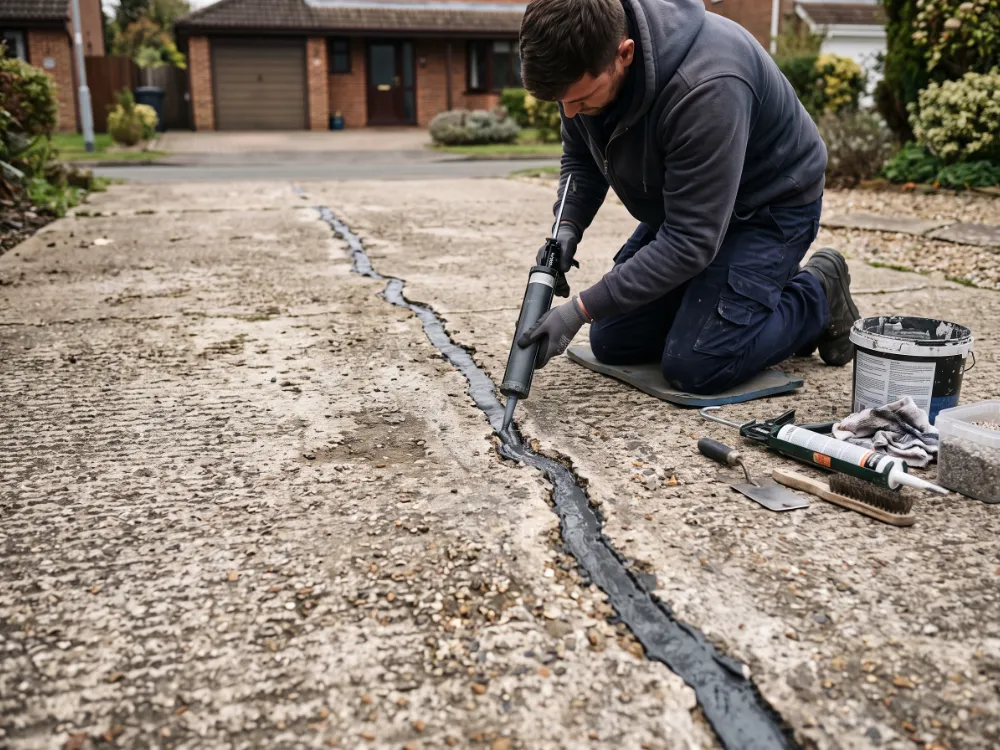
Repair opens the job: cracks routed and filled, spalled and pitted areas patched flush — the coating gets a sound slab or it doesn't go on.

Diamond Grinding Preparation
Diamond grinding strips sealers and laitance and opens the bonding profile that keeps a driveway coating attached under hot tires.

Moisture Vapor Barrier
A moisture vapor barrier seals the slab against ground moisture — the invisible force that pushes lesser driveway coatings off from below.

Pigmented Polyaspartic Basecoat
The pigmented polyaspartic basecoat bonds color into the concrete with the flexibility outdoor temperature swings demand.

Urethane Slip-Resistant Topcoat
The final urethane topcoat carries slip-resistant additive — engineered grip for slopes, rain and wet shoes as standard equipment.

Hot-Tire Pickup Resistance
Every exposed layer tolerates tire heat and full UV — hot-tire pickup and sun fade are covered failures, not expected ones.
Repair Is Half the Job
A driveway coating is only as good as the concrete under it, so ours starts as a repair service:
- Cracks — routed open, filled with structural repair compound, ground flush.
- Spalling and scaling — delaminated surface patches cut back to sound concrete and rebuilt level.
- Pitting and erosion — filled and refinished so the broadcast lands on one uniform plane.
- Oil-saturated zones — ground and treated so old leaks cannot sabotage the new bond.
Then the flake broadcast does the cosmetic magic: every repair line disappears under uniform texture, and the driveway reads as new rather than patched.
The Five-Layer Outdoor System
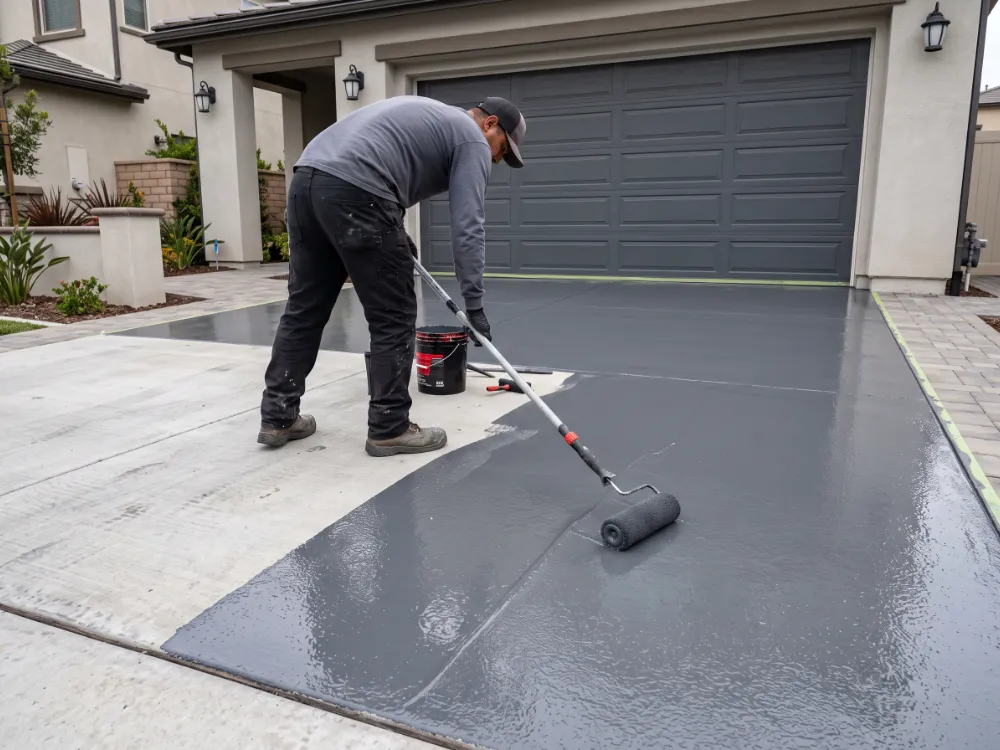
Driveways get the same five-layer stack we trust on pool decks and balconies: vapor barrier at the bottom, pigmented polyaspartic basecoat, full flake broadcast, a polyaspartic topcoat and a urethane wear coat with slip additive. Five materials, each doing the one job it is best at.
Vehicle duty is why the layers matter. The barrier defeats ground moisture, the basecoat's elongation absorbs slab movement, the broadcast builds thickness, and the paired topcoats split UV duty and abrasion duty between chemistries designed for each. A one-bucket product cannot make those trades.
Hot Tires, Answered
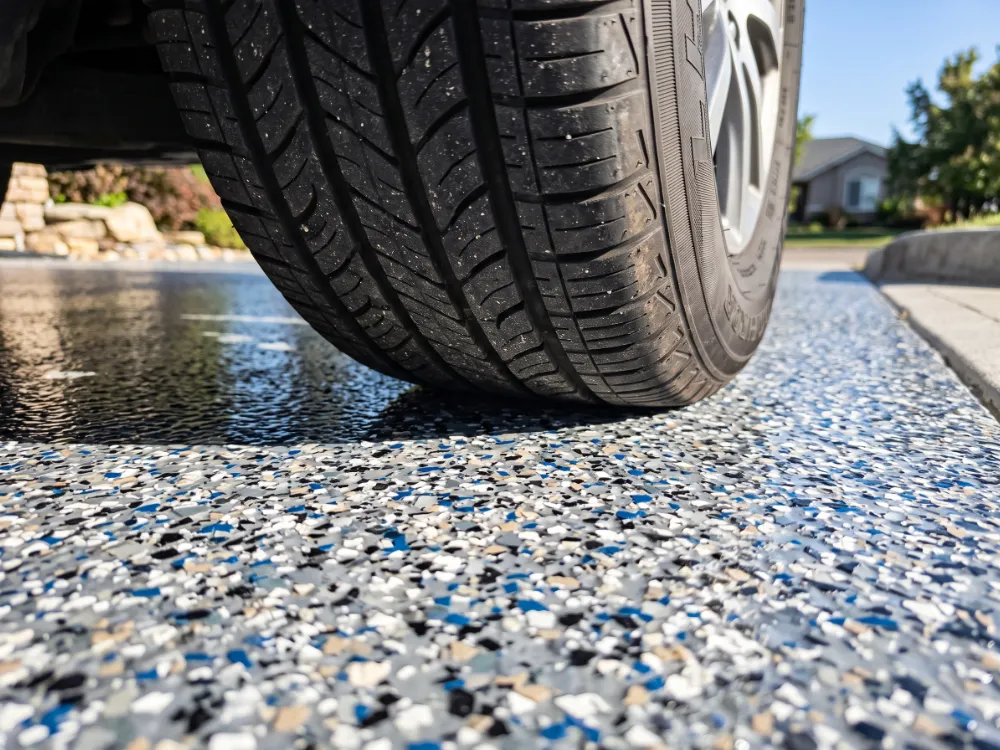
Hot-tire pickup — the bald tire-print patches that ruin cheap driveway coatings in their first summer — is a bond and heat problem, and a sun-baked Southern California driveway is its natural habitat. Tires arrive off the freeway well over a hundred degrees, park on an already-hot slab, and peel soft coatings as they cool.
The counter is everything under the surface: a diamond-ground bonding profile, a penetrating basecoat with no loose film edge to grab, and wear layers whose heat tolerance was chosen for exactly this scenario. It is why we can put parking on our driveways under warranty instead of under disclaimers.
Advantages of Our Driveway System
Repair and coating in one crew, one scope and one warranty: a five-layer, UV-stable surface that holds under hot tires, grips on wet slopes and turns the most visible concrete you own into curb appeal — from the company that manufactures every layer.
Repair and Coating, One Crew
One scope covers it all: cracks and spalls repaired, slab ground, five layers built — no separate repair contractor needed.
Sun-Proof for the Long Haul
UV-stable polyaspartic and urethane wear layers shrug off full sun and hot tires — the two killers of driveway coatings.
Grip on Every Slope
Slip-resistant urethane finish grips wet, sloped concrete — with a three-year outdoor warranty from the manufacturer.
Sun-Proof by Chemistry
Driveways are the most sun-exposed concrete on a property — no roofline, no shade tree covers the whole slab, and the exposure runs from sunrise to sunset. Standard epoxy visibly ambers within a year of that duty, which is why it never appears above the barrier layer in our outdoor systems.
Every visible layer we install outdoors is aliphatic — polyaspartic base and topcoat, urethane finish — chemistry that does not react to UV at all. The blend you choose keeps its color through years of full Southern California exposure, without a maintenance recoat to prop it up.
Grip for Slopes and Storm Days
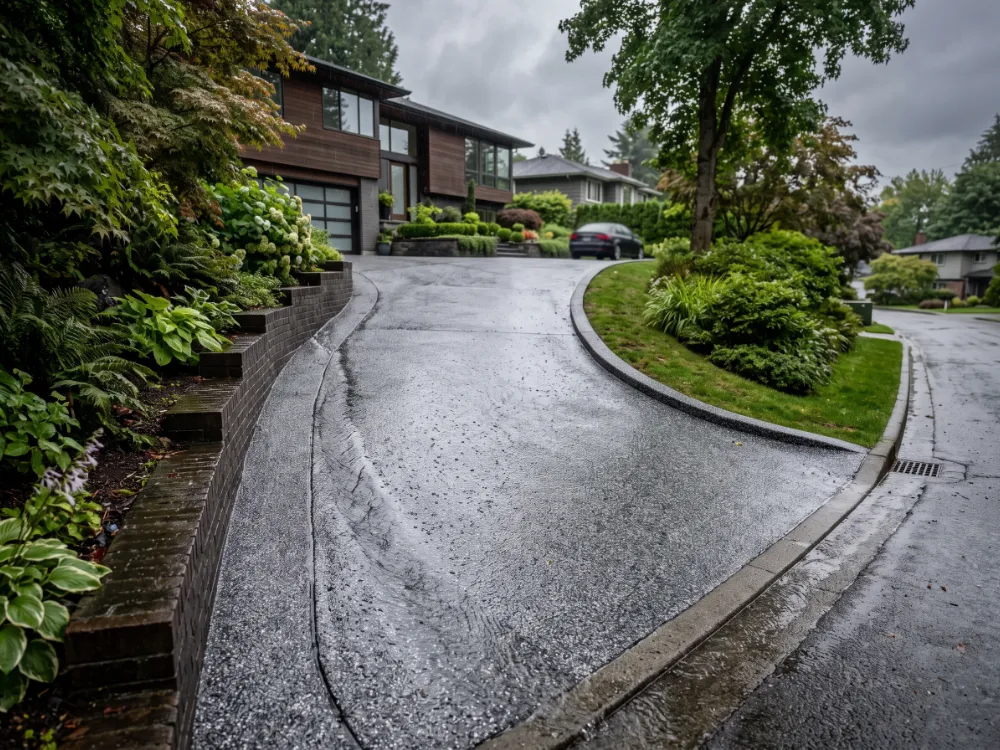
Half the driveways we coat have real slope, and a sloped, sealed surface in the first rain of the season is where smooth coatings become a liability — for tires backing out and for anyone walking down to the mailbox. So traction is standard: the flake broadcast's texture plus a slip-resistant additive locked into the urethane wear coat.
The finished surface sheds water and keeps its footing, wet or dry, without the harsh grit of a broadcast-sand driveway that eats knees and bike tires.
Curb Appeal, Engineered
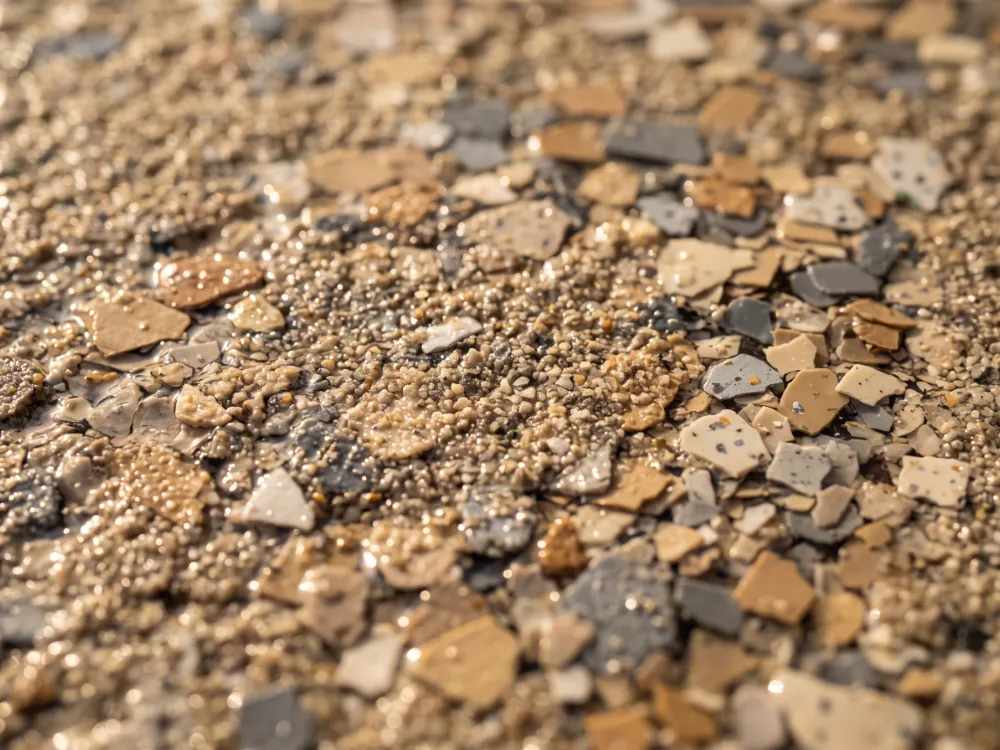
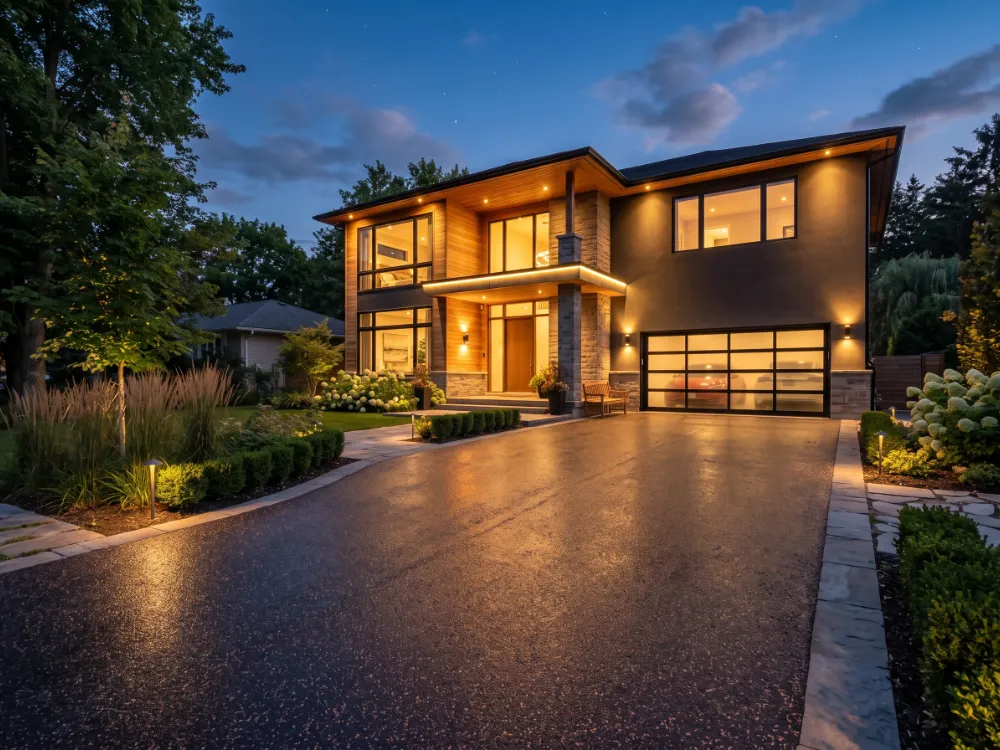
A coated driveway changes the front of a house the way new paint changes a room — suddenly the largest surface in the frame looks intentional. Flake blends are chosen against the house palette: warm grays and sands for stucco, charcoal mixes for modern builds, quiet speckles that hide tire dust and leaf stains between rinses.
It photographs well at listing time, too. Ask any agent what buyers infer from a cracked, oil-stained driveway — then ask what they infer from this one.
Frequently Asked Questions
Can a cracked, pitted driveway be coated?
Usually, yes — repair is the first half of the job, not a disqualifier. Cracks are routed and filled, spalled and pitted areas patched flush, and the slab diamond-ground to one sound plane before any coating goes down. Only a structurally failed driveway — heaving, sinking, crumbling through its depth — needs replacement instead.
Coating, resurfacing or full replacement — how do I choose?
If the slab is structurally sound, coating over proper repairs delivers a new surface for a fraction of replacement cost and days instead of weeks. Deeply eroded surfaces may take a resurfacing overlay first. Replacement is the last resort for structural failure. We assess honestly — pouring new concrete is not our product, so we have no thumb on that scale.
Why do driveway coatings peel, and why won't yours?
Peeling is a bond failure: paint or thin epoxy laid over unprepared, sun-baked concrete, then attacked by hot tires. Our system starts with diamond grinding for a mechanical bond, uses a moisture vapor barrier and a penetrating polyaspartic basecoat, and finishes in wear layers rated for exactly this duty — which is why hot-tire pickup is a warranty item, not an expectation.
What is hot-tire pickup, exactly?
After a drive, tires can reach temperatures that soften cheap coatings; as the rubber cools and contracts it grips and peels the softened film away — the classic tire-print bald patches. A sun-baked Southern California driveway is the worst case, so the resistance has to be engineered in: proper grinding, penetrating basecoat and topcoats with real heat tolerance.
Will the driveway fade or yellow in constant sun?
No — every exposed layer is UV-stable. The pigmented polyaspartic base, the polyaspartic topcoat and the final urethane coat are all aliphatic chemistries that do not amber, chalk or fade, which is precisely why standard epoxy is never the visible surface in our outdoor work.
Is a coated driveway slippery when it rains?
Ours is more grippy wet than bare troweled concrete. The flake broadcast builds in texture, and the final urethane coat carries a slip-resistant additive as standard — a real safety matter on sloped driveways, where rain plus smooth sealer is how cars slide and pedestrians fall.
How soon can I park on it?
Foot traffic the next morning, vehicles typically after about 48 hours depending on temperature. The fast-curing outdoor chemistry keeps the driveway out of service for days, not weeks — and we schedule so street parking is a brief inconvenience rather than a lifestyle.
Do oil and fluid leaks stain the coating?
They sit on it. The cured wear layers are non-porous, so motor oil, brake fluid, coolant and rust drips stay on the surface until wiped or rinsed — the permanent oil shadows that brand bare concrete simply cannot form. It is the difference between a stain and a spill.
What does a coated driveway look like — is it just gray paint?
It reads as a finished architectural surface: a full flake broadcast in blends that flatter the house — warm grays, sand tones, charcoal mixes — under a satin wear coat. Flake also hides tire dust and everyday grime between rinses far better than a monochrome surface would.
How long does it last, and what warranty applies?
Built on repaired, ground concrete with all five layers, a driveway system serves for many years under daily vehicles — and carries our three-year outdoor warranty. Because we manufacture the coatings, the warranty covers material and workmanship in one signature, with no product label to argue with.
The Rest of the Exterior
The driveway shares its five-layer system with every outdoor surface we coat — and its repair scope with our concrete services.
Patio coating · Pool deck coating · Balcony & deck waterproofing · Garage floor coating · Epoxy flake flooring · Polyaspartic floor coating · Concrete resurfacing · Epoxy floor repair
FREE onsite Estimate
5 stars rated company
Get it done right the first time...


