
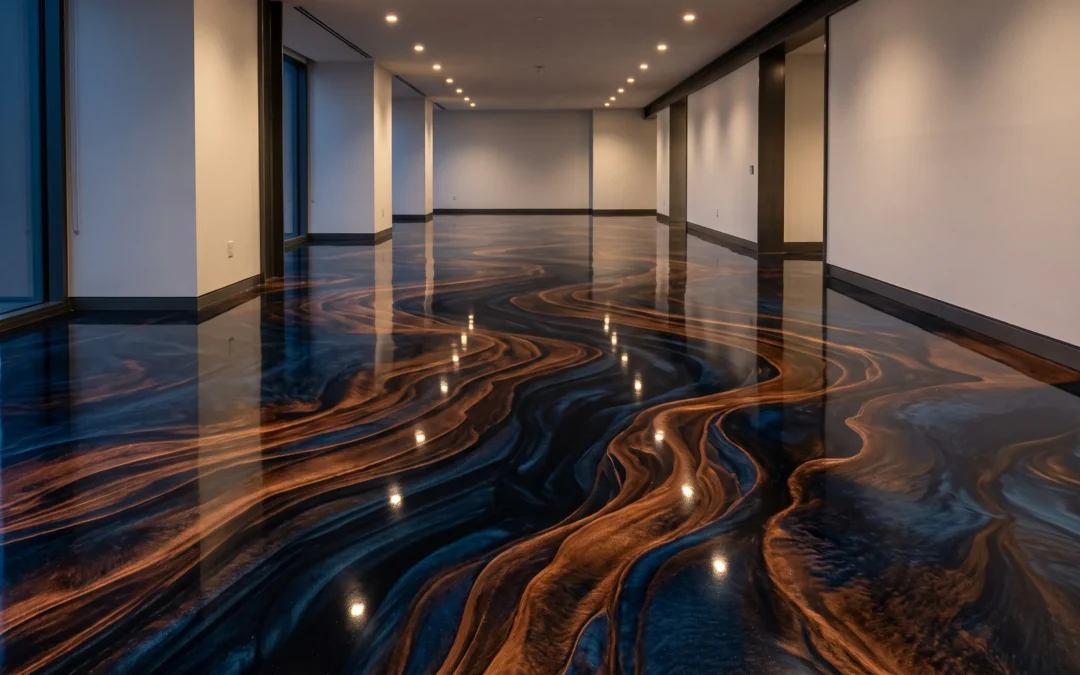
There are two completely different things sold as “3D epoxy flooring,” and you should know which one you’re looking at before you fall in love with a photo. The first is the viral version: a printed mural — dolphins, canyons, ocean waves — laminated under clear resin so the image appears to sit below your feet. The second is dimensional depth created by the coating itself: metallic pigments layered in translucent resin so light literally travels down into the floor. We’ll be straight with you, because we install resin floors every day: the mural version is a niche novelty with real drawbacks, and the pigment version is the 3D effect that actually belongs in homes. Here are the ideas worth pursuing in each camp.
What Mural-Style 3D Floors Really Are
The dramatic photos you’ve seen — sharks circling a bathroom floor, a waterfall pouring through a hallway — are built by adhering a large-format printed vinyl graphic to prepared concrete, then flooding it with layers of crystal-clear resin. The perspective trick works from exactly one viewing angle, the one the photographer stood at. The technique is real and installable; it’s the ownership experience that deserves honesty:
- The illusion is single-angle. Walk around the room and the image distorts. Photos oversell what daily life delivers.
- It’s an image you can’t redecorate around. A gray floor survives every future furniture and paint decision; a life-size ocean scene makes them all for you, forever.
- Taste moves faster than floors wear. The coating will still be sound long after the graphic feels like a 2015 screensaver, and replacing it means grinding off a perfectly good floor.
- Clear resin over a print demands flawless execution. Any trapped bubble, wrinkle or edge-lift sits in full view under glass, magnified.
- Resale is a coin flip at best. Buyers pay for floors they’d have chosen; almost nobody else would choose your mural.
Where do murals genuinely earn a place? Commercial theater: aquarium gift shops, kids’ dental offices, escape rooms, themed retail — anywhere the floor is entertainment and a refresh in five to seven years is a marketing budget line, not heartbreak.
The 3D Effect That Actually Works in Homes
Real dimensional depth doesn’t need a printed picture. When translucent metallic pigment is layered in clear resin, light penetrates the surface, bounces off pigment at different depths and returns to your eye — the floor genuinely reads as inches deep, from every angle, in every light. This is the physics behind our metallic epoxy floors, and it’s what we recommend to nearly everyone who arrives asking about 3D. Design directions that use that depth deliberately:
- Canyon and lava effects — dark base with copper or amber pigment dragged into channels; the bright veins appear to glow up from below.
- Deep-water floors — layered blues and greens with pearl highlights; the closest legitimate cousin to the ocean-mural idea, minus the cartoon dolphin.
- Storm-cloud ceilings, inverted — grays and silver billowed into cumulus movement; hypnotic in large open rooms.
- Molten metal — a single metallic tone worked until it holds ripples of light, like a poured ingot cooling.
- Nebula floors — near-black base with fine pearl scattered like starfields; the one “themed” look that stays sophisticated, because it’s abstract.
Every one of these survives redecorating, viewing angle and the passage of taste, because they’re texture and depth rather than a picture. Installation runs three to four days, and color families are on our color chart.
Subtler Dimensional Ideas Most People Overlook
Not every 3D ambition needs drama. A flake floor in an oversized chip reads as dimensional terrazzo — physical chips at genuinely different depths under the clear coat. Quartz broadcasts do the same with mineral sparkle. And a glassy topcoat over stained concrete creates quiet depth from the slab’s own mottling — the concrete’s history becomes the artwork. These options cost less visual commitment than any statement floor and still give you that “the floor has something going on” quality.
Where 3D Effects Belong in a House
Depth effects are amplified by uninterrupted floor area and good light. Best placements: entries and foyers, open living areas, finished basements (where the reflectivity fights low light), man caves and home bars, and show garages. Think twice in small cluttered rooms — furniture legs chop the effect into fragments — and skip high-drama floors in rooms meant for calm, like bedrooms and offices. The floor is an instrument; play it where it can be heard.
If You Still Want the Mural, Do It Eyes-Open
We’d rather give you the checklist than pretend the option doesn’t exist. Insist on: a printer producing floor-rated, UV-stable graphics at true large-format resolution; diamond grinding and a moisture-vapor-barrier epoxy basecoat beneath the graphic, exactly as any coating requires; self-leveling clear layers poured dust-controlled; and a UV-stable polyaspartic topcoat so the clear layers don’t amber over your artwork. Then ask yourself the ten-year question — will this image still be welcome in this room in 2036? If the answer is yes (or the floor is commercial and the answer doesn’t need to be), proceed with confidence.
Frequently Asked Questions
Are 3D mural epoxy floors worth it in a home?
For most homeowners, no. The perspective illusion works from one angle only, the image locks your decor around it, and tastes change long before the coating wears out. Metallic depth effects deliver a genuine three-dimensional look from every angle without those tradeoffs, which is why we steer residential clients there.
How is depth created in a metallic 3D floor?
Translucent metallic pigments are suspended at different levels within layered clear resin. Light enters the surface, reflects off pigment at varying depths and returns to the eye, so the floor optically reads inches deep. It’s a physical effect, not a printed image, and it holds from any viewing position.
How long do 3D epoxy floors take to install?
Metallic depth floors take three to four days, since each artistic layer cures before the next. Mural-style floors typically take longer — surface preparation, graphic placement, multiple self-leveling clear pours and a final topcoat each add cure windows to the schedule.
Do 3D effects change how durable the floor is?
No. The wear surface is the clear topcoat, the same chemistry protecting our garage systems, so a dramatic floor is exactly as tough as a plain one. Choose a UV-stable polyaspartic topcoat in sunlit rooms so the clear layers stay water-white over the design beneath.
Want depth that outlasts trends? Top Epoxy Flooring creates dimensional metallic floors across Southern California with VOC-free systems we manufacture ourselves, backed by a limited lifetime residential warranty. Call (818) 945-0915 for a free estimate.
Recent Comments