
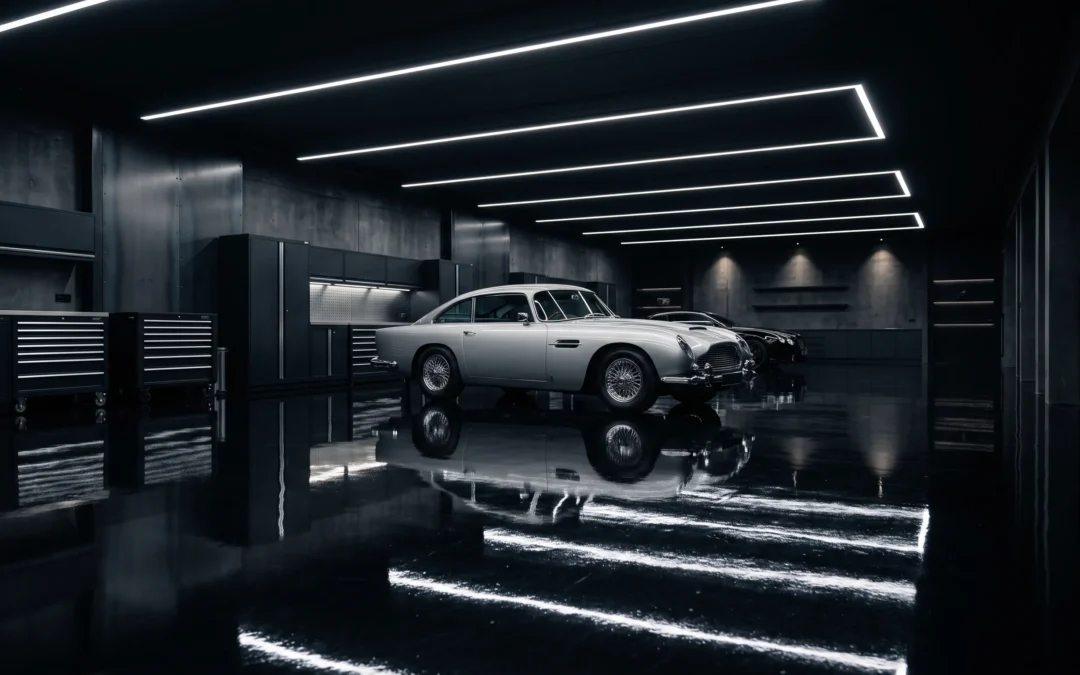
Black is the most dramatic garage floor you can order and the one that most needs its fine print read aloud. Done right — deep gloss under strong lighting, chrome and paintwork floating on the reflection — a black floor is automotive theater; nothing else makes a car look more expensive. Done casually, it becomes the fussiest surface in the house: pale dust, pollen and every dropped washer glow against it, and its mirror finish reports each imperfection in the slab beneath. This guide lays out the black floor ideas that deliver the drama, the ones that tame it, and the realities to accept before committing to the dark side.
The Case for Black: Why People Fall for It
Black floors trade on contrast and reflection. A gloss black surface behaves like still water at night — vehicles, tool chests and lighting double themselves in it, and the room gains apparent depth that no mid-tone can produce. Black also flatters what sits on it: silver, white, red and blue vehicles all pop harder against a dark stage, which is why photography studios and exotic-car dealers shoot on black. And practically, black is the undisputed champion at hiding one specific enemy — dark fluids. Oil seep, brake fluid shadow, tire compound: invisible. If your garage’s mess profile is mostly automotive, black conceals exactly what lighter floors advertise.
The Case Against: What Black Shows Instead
Every floor color picks which mess it reveals, and black reveals the light-colored half of life. In practice that means:
- Dust and pollen sit in plain view. Southern California’s dry seasons drop a fine pale film on everything; on black gloss it reads within days of a cleaning.
- Lint, pet hair, sawdust and drywall powder all photograph themselves against the dark field. Woodworkers and renovators should think twice — or pick the flake route below.
- Dropped hardware disappears. A black screw on a black floor is a five-minute hunt. Mechanics either learn magnet sweepers or learn regret.
- Smooth black magnifies substrate flaws. A mirror finish telegraphs every low spot and old patch through the coating, so slab condition and leveling matter more here than with any other color.
- Dark surfaces run warmer. Where sun falls directly through an open door or on an exterior apron, black absorbs noticeably more heat than pale floors — worth weighing for barefoot thresholds and west-facing openings.
None of these are coating failures; they’re the physics of dark gloss. Design around them and black rewards you.
Idea 1: Jet Solid Gloss — the Showroom Statement
The maximalist version: an uninterrupted field of black at full gloss, built on our solid color epoxy system over a carefully leveled slab. This floor lives or dies on two supporting decisions. Lighting: black eats lumens, so plan roughly double the fixture output of a gray garage — continuous LED strips create the signature reflected-runway look. And discipline: this is a display floor for a display garage, best where cars arrive clean and airflow is filtered rather than wide open to a dusty street. For the owner with a detailing habit, there is no more satisfying surface in the trade.
Idea 2: Obsidian Metallic — Black With a Pulse
Pure black can read flat between reflections; black metallic epoxy fixes that by drifting subtle pigment — graphite, gunmetal, a breath of copper or midnight blue — through the dark base. The floor keeps its depth even in ambient light, like volcanic glass instead of painted panel, and the faint movement disguises dust noticeably better than flat black gloss. This is our usual counter-proposal when a client wants maximum drama but the garage sees real use. The layered pour installs over three to four days.
Idea 3: Blackout Flake — Drama You Can Actually Live On
The practical black floor is a full-rejection broadcast of black, charcoal and gunmetal chips — sometimes with a minority of silver — over a dark basecoat, sealed under clear. From across the room it reads confidently black; up close the micro-pattern is quietly absorbing dust, lint and small scratches the way flat black never could, while the chip texture adds grip that smooth gloss lacks. For households that love the dark look but also use the garage for laundry, tools and kids’ bikes, this is the configuration we recommend without hesitation. Like every flake system we install, it’s a one-day job.
Idea 4: Black as Punctuation
Black’s strongest design role is often partial. A black border framing a gray or silver field sharpens the whole room like eyeliner. A black parking apron under the daily driver — where oil and tire wear concentrate — with lighter floor elsewhere puts each color where it wins. Checkerboards of black against white or silver zones bring motorsport heritage without full-blackout maintenance. And pairing a mid-gray field with black-coated stem walls and steps delivers most of the moody read at a fraction of the visible dust. These layouts add little installation complexity and age better than most single-color commitments.
Specs That Make or Break a Black Floor
Three line items to insist on. A UV-stable polyaspartic topcoat — over black, epoxy-only clears amber into a greenish haze at the sunlit threshold, and hot-tire pickup tests any coating hardest where dark floors soak up afternoon heat. Slab prep beyond the minimum — diamond grinding plus genuine leveling, because the mirror will report whatever’s under it. And a sheen decision made deliberately: satin black hides dust and flaws dramatically better than gloss and reads as sophisticated rather than showy — plenty of clients who came in asking for mirror leave happier with satin. Compare black solids, blackout blends and dark metallic samples on our color chart, ideally viewed in your garage under your lighting. The engineering underneath is the same proven garage floor coating stack whatever the color.
Frequently Asked Questions
Is a black epoxy garage floor hard to maintain?
Harder than gray, easier than its reputation. The surface itself wipes clean effortlessly; the issue is visibility — pale dust and lint show quickly on dark gloss. A blackout flake blend or a satin finish cuts the visible dust dramatically, and a weekly dust mop keeps any black floor sharp.
Does a black garage floor get hot?
Where direct sun hits it — through an open door or on an exterior apron — black absorbs more heat than lighter colors and can be uncomfortably warm barefoot on summer afternoons. Inside a closed garage the difference is minor. West-facing garages and pool-adjacent spaces should weigh lighter blends.
Do black epoxy floors show scratches?
Fine grit scratches show sooner on smooth black gloss than on any patterned floor, because each mark catches light against the dark field. Flake texture, a satin topcoat and a walk-off mat at the door each reduce visible wear substantially — combined, they mostly eliminate the concern.
What’s the best black floor for a working garage?
A full-broadcast blend of black, charcoal and gunmetal flakes under a UV-stable clear coat. It reads black at room scale, hides dust and dropped debris in its pattern, adds slip resistance, and installs in one day — the dark aesthetic without the display-case upkeep of solid gloss.
Considering the dark side? Top Epoxy Flooring installs black solids, blackout blends and obsidian metallics across Southern California — manufacturer-direct, VOC-free systems with a limited lifetime residential warranty. Call (818) 945-0915 for samples and a free estimate.
Recent Comments