
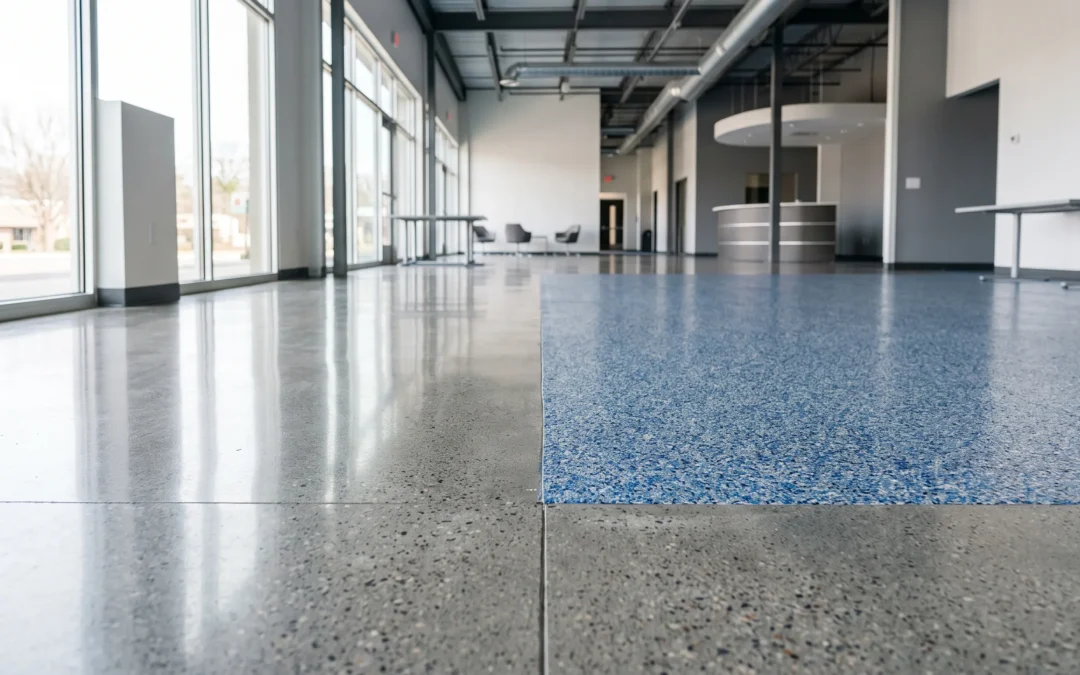
If you’re deciding between epoxy flooring and polished concrete for a garage, workshop, or any space that sees vehicles, chemicals, or moisture, epoxy is the stronger choice — it puts a protective, non-porous wear layer between the slab and everything that lands on it. Polished concrete has real strengths of its own, and for certain large interior commercial spaces it’s genuinely the better call. We install both, so we have no reason to spin this. Here’s the honest comparison.
Two Different Floors That Start With the Same Machine
Both floors begin with diamond grinding. After that, they head in opposite directions.
An epoxy floor coating uses the grinder to open a bonding profile in the concrete — a slightly rough texture the coating can grip. Then material is built up on top of the slab: a moisture-vapor-barrier epoxy basecoat, an optional decorative layer like flake or metallic pigment, and a UV-stable polyaspartic topcoat. The finished floor is a new surface bonded to the concrete.
Polished concrete never adds a surface. The grinder keeps working through progressively finer diamond abrasives, a chemical densifier hardens the surface, and the final passes burnish the concrete itself to a sheen. The slab is the finished floor.
That single difference — added protection versus refined concrete — drives almost everything else in this comparison.
Durability: A Wear Layer vs. a Hardened Surface
Polished concrete is durable the way concrete is durable. It handles foot traffic, cart traffic, even forklifts, and there is no coating to peel because there is no coating. But densified or not, it is still concrete: it can etch when acids sit on it, it can absorb oil if the guard product has worn thin, and any crack or patch in the slab stays visible forever.
A professional epoxy system puts a thick, chemically bonded layer of resin between the slab and the world. Impacts, abrasion, brake fluid, road salt, and dropped tools land on the coating, not the concrete. When people say epoxy “wears out in a few years,” they’re almost always describing thin hardware-store kits, not a commercial-grade system installed over a properly ground slab. Our residential installations carry a limited lifetime warranty; commercial floors carry three years. We wouldn’t offer either on a floor built to fail.
What About Oil, Moisture, and Stains?
This is where the gap opens up for garages and work spaces.
Polished concrete relies on a penetrating guard product to resist staining, and that product wears off in traffic lanes. Miss a resealing cycle and an oil drip has a direct path into the slab. Tire plasticizers can leave permanent shadows under parked cars. In a retail store, none of this matters much. Under a daily-driven vehicle, it does.
An epoxy-coated floor is seamless and non-porous. Oil, coolant, and road grime sit on top until you wipe them up. The moisture-vapor-barrier epoxy basecoat also manages vapor pressure coming up through the slab — a genuine issue in garages and basements. One honest point in polished concrete’s favor: because it doesn’t seal the slab with a film, it lets the concrete breathe, which some older buildings actually need.
Appearance: Understated Gray vs. a Full Design Range
Polished concrete has one look, and it’s a good one — a smooth mineral sheen in the natural tone of the slab, sometimes with exposed aggregate. If you want minimalist and architectural, and your slab is a good candidate, it delivers.
That last part matters. Polishing reveals everything: old patches, plumbing trench repairs, discoloration, poor original finishing. A rough slab makes a rough-looking polished floor, permanently.
Coatings hide all of that. A full-rejection flake broadcast buries slab imperfections under a dense, uniform blend of color chips. Metallic epoxy turns a plain slab into a dimensional, one-of-a-kind surface. Solid-color epoxy gives you a clean single-tone floor in whatever shade suits the space. If the slab under your feet is ugly, a coating is the only route to a floor you’ll actually like.
When Polished Concrete Is Honestly the Better Choice
We polish concrete, and there are jobs where we recommend it without hesitation:
- Large interior retail, office, or warehouse floors — huge square footage, mostly foot and cart traffic, where the light-reflective surface brightens the space and maintenance is a dust mop and periodic burnishing.
- Showrooms and modern interiors going for the raw, architectural concrete look on a slab that’s in good shape.
- Spaces with no chemical or oil exposure, where the main job of the floor is to look clean and stay flat.
- Slabs that need to breathe — buildings where sealing the concrete with a film would trap moisture that has nowhere else to go.
There’s also a middle path worth knowing about: grind and seal, where the slab is diamond ground and then protected with a clear coating. You keep the industrial concrete look but gain real stain protection — often the right answer when someone loves the polished aesthetic but the space sees actual work.
When Epoxy Wins — and Why Garages Aren’t Close
Choose a coating system when the floor has a hard job:
- Garages. Oil, hot tires, road salt, moisture, dropped tools. A coated floor shrugs all of it off; a polished floor collects it.
- Shops and industrial spaces with chemical exposure. Resin chemistry can be matched to the specific chemicals in use.
- Anywhere slip resistance matters. Flake texture and additives give a coated floor real grip; burnished concrete is smooth by design.
- Damaged or patched slabs. Coatings conceal repairs; polishing showcases them.
- Outdoor concrete. Polishing is an interior finish. Patios, driveways, and pool decks need a coating built for sun and weather.
As a company that manufactures its own coating systems and also runs polishing crews, our rule of thumb is simple: polish concrete where the floor’s job is to look good under light use, and coat it where the floor has to survive something.
Frequently Asked Questions
Is polished concrete cheaper than epoxy flooring?
Sometimes, but not reliably — the price of either floor is driven by slab condition, square footage, the level of grinding and repair needed, and the finish you choose, so the same building can quote in either direction. A cracked or patched slab makes polishing more expensive fast, because every flaw must be corrected or lived with. The only accurate comparison is two quotes on your actual slab, which is why we start every project with a free on-site estimate.
Can you polish a garage floor instead of coating it?
You can, but we rarely recommend it. Garage slabs face oil drips, tire plasticizer staining, and road salts that penetrate the surface between resealing cycles, and most residential garage slabs were never finished cleanly enough to polish well. A coating protects the slab instead of exposing it, which is why nearly every garage we see is better served by an epoxy system.
Can epoxy be applied over polished concrete later?
Yes, but the polish has to come off first. A burnished, densified surface is too smooth and too hard for any coating to grip, so the floor must be diamond ground back to an open bonding profile before the basecoat goes down. It’s routine work for a crew with the right equipment — just know that polishing first and coating later means paying for the grinding twice.
Which floor lasts longer, epoxy or polished concrete?
Both can serve for decades — the real difference is what maintenance looks like. Polished concrete needs periodic reburnishing and guard reapplication to keep its sheen and stain resistance, while a professionally installed epoxy system mostly needs cleaning, with a fresh topcoat only after many years of hard use. Our residential coating installations are backed by a limited lifetime warranty.
Top Epoxy Flooring manufactures and installs its own VOC-free coating systems — and polishes concrete too — across Southern California. Not sure which floor fits your space? Call (818) 945-0915 for a free on-site estimate and an honest recommendation.
Recent Comments