
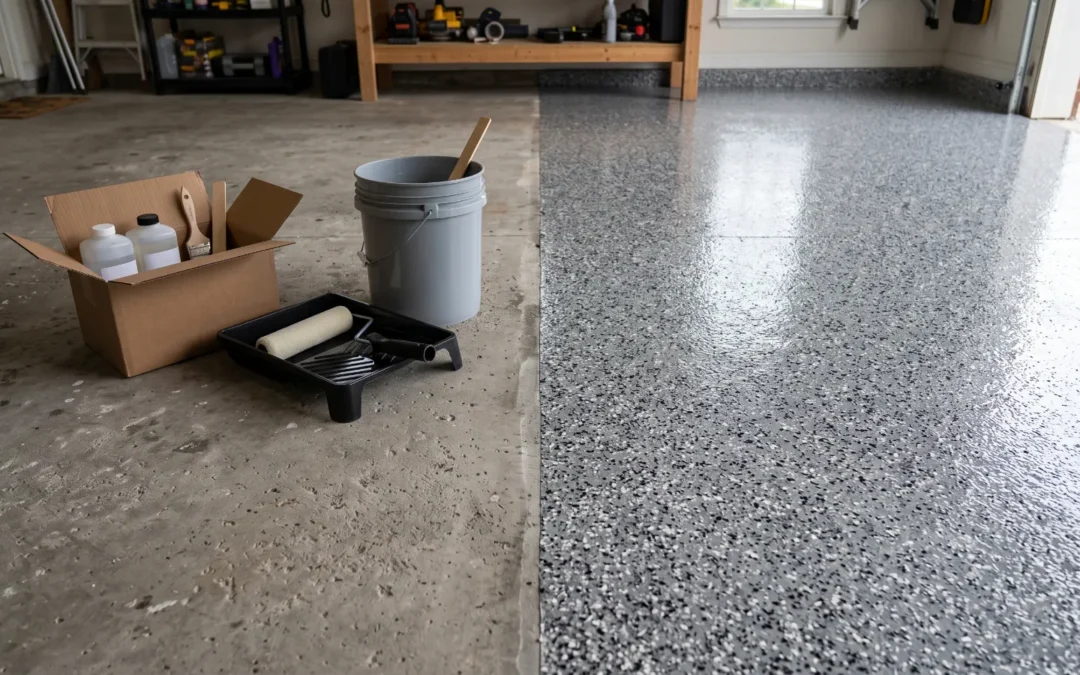
Here’s an answer you don’t expect from a company that installs epoxy floors for a living: sometimes, yes — a DIY kit is worth it. We manufacture professional coatings, so we have no reason to pretend the box-store kit is poison. But we also repair failed kit floors nearly every week, so we know exactly where the line sits between “good weekend project” and “expensive lesson.” This guide draws that line honestly.
What’s Actually in the Box (and What Isn’t)
- Solids content. Most retail kits are water-based epoxies around 40–50% solids: half of what you roll out evaporates. Professional systems run 90–100% solids — everything applied stays on the floor as film. That single number is why a kit floor is a fraction of the thickness of a professional one when both are dry.
- One thin coat vs. a layered system. A kit is typically one pigmented coat and a sprinkle of flakes. A professional floor is a system: penetrating basecoat, a full-rejection flake broadcast, and one or two clear wear topcoats. The wear layer that takes your hot tires simply doesn’t exist in the kit version.
- No moisture answer. Kits assume your slab is dry. Many Southern California slabs aren’t — and rising moisture vapor is the failure the kit can’t see coming and can’t prevent.
Preparation: Where Kit Floors Actually Die
Industry studies put the share of coating failures caused by inadequate surface preparation at over 70% — and prep is precisely where kits compromise. The included etch packet cleans the slab a little; it does not open a bonding profile the way diamond grinding does. Epoxy on smooth or sealed concrete is a sticker, not a bond. It survives foot traffic and fails at the first hot summer of parked cars — usually in tire-shaped strips (if that’s already happened to you, here’s the fix guide).
When a DIY Kit Genuinely Makes Sense
- The space sees no vehicle traffic — a storage room, a shed, a workshop corner where hot-tire pickup can’t happen.
- It’s a short-term cosmetic refresh — you’re selling the house next year and want the garage to show clean, not to last a decade.
- Budget rules everything and you accept a 1–3 year lifespan with a redo later — knowingly renting the look rather than buying the floor.
- You’ll actually do the prep — rent a grinder, fix the cracks, test for moisture. The rare DIYer who preps like a pro gets years more than the label promises.
When It’s the Wrong Tool
- A daily-driver garage. Hot-tire pickup is a physics problem; thin coatings lose that argument every summer.
- Any slab with a moisture history — older homes, slabs that darken after rain, previous coatings that blistered. Kits have no vapor barrier.
- When you’re pricing it as a permanent floor. A kit redone every couple of years costs more over ten years than one professional installation with a lifetime residential warranty — and that math ignores your weekends.
- Anything commercial. Forklifts, customers, code — no.
The Ten-Year View
Kit floors in working garages typically look tired in one to three years: dulling, tire-path peeling, staining where the film wore through. Professional systems in the same garages run ten to twenty years and beyond — not because installers are magicians, but because 100%-solids chemistry over ground, moisture-tested concrete is a different product category, not a better version of the same one. That’s also why we can warranty ours for life on residential floors: the failure modes the kit accepts are the ones our process removes.
The Middle Path Most People Miss
If the kit tempts you because a professional floor feels like overkill, know your actual options: a solid color system costs less than the designer finishes, a garage can be done in a single day, and because we manufacture our own materials, our pricing skips the distributor layer entirely. Get the free estimate before you assume the box is the only affordable answer — the gap is usually smaller than the marketing suggests.
Frequently Asked Questions
How long does a DIY epoxy kit really last in a garage?
With cars parked on it and typical prep: one to three years before visible dulling, wear-through, or tire-path peeling. In no-vehicle spaces with careful prep, considerably longer.
Why do kit floors peel where the car parks?
Hot-tire pickup: heated tires soften thin, marginally bonded coatings, and the cooling rubber pulls the film loose. It’s the signature failure of low-solids coatings over unground concrete.
Can a professional coat over my old DIY kit floor?
Not directly — failed or thin coatings are removed by diamond grinding first, then the system is built on clean concrete. Coating over a kit floor ties the new floor’s fate to the old one’s bond.
Is the kit worth it for a storage room or shed?
Often, yes. No hot tires, low abrasion, cosmetic stakes — a kit is a legitimate fit there, especially if you improve on the included prep.
Top Epoxy Flooring manufactures and installs its own epoxy and polyaspartic systems across Southern California — which is why this comparison can afford to be honest. When you’re ready to price the professional version against the box: free onsite estimates, (818) 945-0915.
Recent Comments