
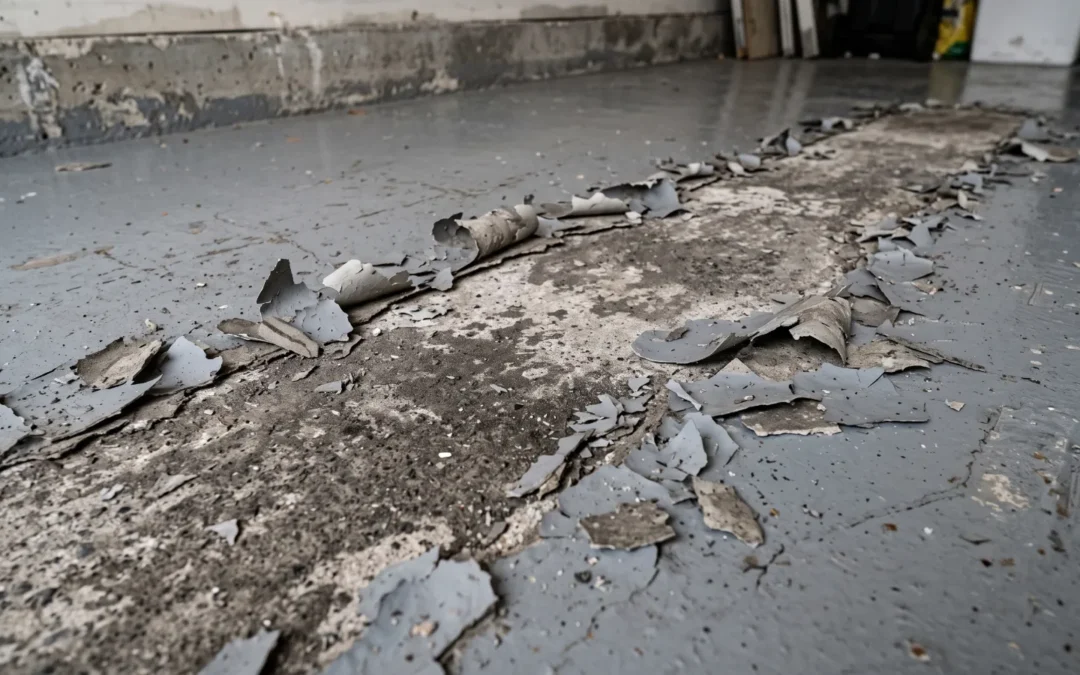
Peeling epoxy is the most common floor complaint we get calls about — and almost every caller asks the same question: “can I just patch it?” Sometimes, yes. But a peeling coating is a symptom, and if you fix the symptom without diagnosing the cause, the new patch peels exactly like the old floor did. This guide walks you through the diagnosis first, then the fix — the same order our own crews work in.
First, Read the Peeling — It Tells You Why It Failed
Where and how a coating peels identifies the cause with surprising accuracy:
- Peeling in tire-width strips where the car parks — that’s hot-tire pickup. Warm tires soften a thin or poorly bonded coating; as the rubber cools, it contracts and pulls the coating with it. This is the signature failure of thin DIY kits and coatings applied over unprepared concrete.
- Lifting in broad sheets or blisters, sometimes with damp or powdery concrete underneath — that’s moisture vapor. Ground moisture rises through every concrete slab; trapped under a coating with no vapor barrier, it builds pressure until the bond lets go. No surface repair survives this until the moisture problem is solved.
- Random flaking and chipping across the whole floor — that’s a preparation failure. The coating was applied over smooth, sealed, or dirty concrete and never had a mechanical bond. Acid etching instead of grinding is the usual culprit: etching cleans a little and profiles almost nothing.
- Chips only at cracks and joints — the slab is moving under the coating, or the cracks were never repaired before coating. The coating is often fine; the concrete needed work first.
Can You Spot-Repair It? The Honest Thresholds
The industry’s practical rule of thumb, and the one we use on estimates:
- Under roughly 20% of the floor affected, with well-bonded coating around it: a spot repair is realistic and can be nearly invisible, especially on flake floors where new broadcast blends into old.
- Past roughly 30–40%: patching costs approach a full removal and reinstall — and the reinstall resets the entire floor’s clock with a warranty. Patching a floor that’s mostly failed is paying twice.
- Any amount of moisture-driven peeling: stop. The fix is not a patch — it’s solving the moisture with a vapor-barrier basecoat after full removal. Recoating over an unsolved moisture problem just schedules the next failure.
How to Fix a Small Peeling Area (the Right Way)
- Remove everything loose — and then some. Scrape and sand past the visible peeling until you reach coating that will not lift with a scraper’s edge. Coating that looks fine but lifts under pressure is next month’s peeling.
- Grind, don’t just scuff. The exposed concrete needs a real bonding profile. A diamond cup wheel on an angle grinder (with dust extraction) beats sandpaper by a mile. Feather the edges of the surrounding coating so the repair doesn’t leave a ridge.
- Clean like it matters — because it does. Vacuum, then solvent-wipe. Dust is the quiet killer of repairs.
- Check for moisture. Tape a square of plastic sheeting to the bare spot for 24 hours. Condensation or darkened concrete underneath means moisture is your real problem — and a bigger conversation than a patch.
- Recoat with compatible material. New epoxy bonds to properly abraded old epoxy, but not all chemistries like each other. If you don’t know what the original coating was, a test patch saves heartbreak.
- Blend and topcoat. On flake floors, broadcast matching flake into the wet repair, then topcoat the repair area — or better, the whole floor, which erases the repair entirely and refreshes everything.
When the Whole Floor Is Failing: Remove and Rebuild
Widespread peeling means the bond failed everywhere — the visible peeling is just where it failed first. The professional fix runs in this order: diamond-grind the entire failed coating off down to sound concrete, repair cracks and spalls, measure the slab’s moisture (never guess), install a moisture-vapor-barrier basecoat if the reading calls for it, then rebuild the system — basecoat, broadcast, topcoats. Done this way, the same floor that failed in two years lasts decades. Skipped steps are why it failed the first time.
This is exactly the process behind our epoxy floor repair service — including the diagnosis, which we do before quoting anything. The grinding step alone is why most homeowners call a pro for full removals: it’s a dust-controlled machine job, not a weekend with a sander.
Why It Won’t Peel the Second Time (If It’s Done Right)
Every cause of peeling has a specific, known prevention:
- Hot-tire pickup → a diamond-ground bonding profile plus a penetrating basecoat and a topcoat with real heat tolerance. On a properly built floor, hot tires are a non-event — our residential installations carry a limited lifetime warranty against exactly this.
- Moisture → test first, then a vapor-barrier epoxy basecoat engineered for the reading.
- Prep failure → mechanical grinding, never acid etching, never coating over sealer.
- Thin coatings → real film build. A full-broadcast flake system with double topcoats puts several times more wear material on the floor than any kit.
Frequently Asked Questions
Can I epoxy over peeling epoxy?
Over the peeling areas, no — anything applied over a failing layer inherits the failure. Over surrounding coating that’s genuinely well-bonded (it resists a scraper), yes, after thorough abrasion. The dividing line is bond, not appearance.
Why is my epoxy floor peeling where the car parks?
Hot-tire pickup: heat softens a marginal coating and the cooling tire peels it. It means the coating was too thin, the prep was inadequate, or both. The patch will repeat unless the redo includes proper grinding and a heat-tolerant system.
How much peeling is too much to repair?
Past roughly a third of the floor, removal and reinstallation is usually the cheaper path over any five-year window — and it comes with a fresh warranty instead of a patchwork.
Will the repaired spot match the rest of the floor?
On flake floors, a matched broadcast plus a fresh topcoat over the whole floor makes repairs effectively invisible. On solid-color floors, plan on topcoating the full floor for a uniform finish.
How do I keep an epoxy floor from peeling in the first place?
Three things: mechanical surface preparation (grinding), a moisture test before coating, and a real multi-coat system instead of a single thin layer. Everything else — including simple maintenance — is easy by comparison.
Top Epoxy Flooring manufactures and installs its own coating systems across Southern California. If your floor is peeling and you’d rather have the diagnosis done for you, our repair service starts with exactly the checks described above — free onsite, (818) 945-0915.
Recent Comments