
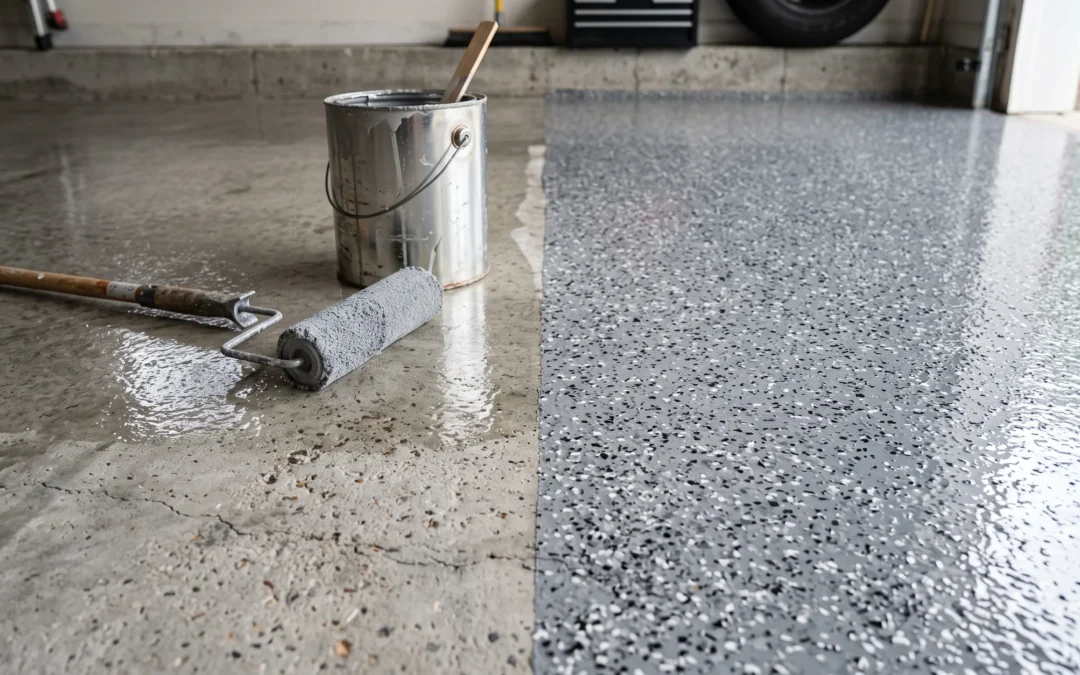
A concrete sealer protects concrete while keeping it looking like concrete. Epoxy flooring builds an entirely new surface on top of the slab. That’s the whole difference in one line: a sealer is sunscreen, a coating is armor. For a low-traffic slab you want to preserve, a quality sealer can be all you need. For a garage, shop, or any floor that lives under vehicles, chemicals, and daily use, a sealer will always be the temporary answer and a coating the permanent one. Here’s how to tell which side of that line your floor is on.
What a Concrete Sealer Actually Does
“Sealer” covers two very different products, and knowing which one you’re looking at matters more than the brand on the pail.
Penetrating sealers — silane, siloxane, and silicate blends — soak into the concrete and react inside the pores. They repel water and de-icing salts, slow staining, and leave no film at all. The floor looks exactly like it did before, maybe slightly darker. They can’t peel because there’s nothing on the surface to peel.
Film-forming sealers — mostly acrylics — leave a thin clear layer on top of the slab. They add a modest sheen, deepen the concrete’s color, and give some resistance to oil and stains. The film is thin, measured in a few thousandths of an inch, and it wears wherever tires roll and feet walk.
Both do a real job. Neither one changes what the floor fundamentally is: exposed concrete with a light layer of defense.
What Epoxy Flooring Actually Is
A professional epoxy floor coating is a multi-layer system, not a product from a can. The slab is prepared by diamond grinding, which opens a bonding profile the resin can lock into. A moisture-vapor-barrier epoxy basecoat goes down and bonds to the concrete itself. Most floors then get a decorative layer — a full-rejection flake broadcast is the garage favorite — and everything is locked under a UV-stable polyaspartic topcoat.
The finished coating is many times thicker than any sealer film, chemically bonded rather than just stuck on, and non-porous from edge to edge. Oil, brake fluid, coolant, and road salts sit on top waiting for a rag instead of soaking in. As the manufacturer of our own VOC-free systems, we formulate the basecoat and topcoat to work as a matched pair — which is a big part of why a real system outlasts anything applied straight from a hardware-store shelf.
Sealer vs. Epoxy, Point by Point
- Thickness: a sealer is a film measured in thousandths of an inch, or no film at all. An epoxy system is a substantial built-up layer — the difference between a coat of wax and a countertop.
- Lifespan: penetrating sealers typically protect for several years before reapplication; acrylic films in traffic areas often need recoating every year or two. A professionally installed epoxy system serves for decades — our residential installations carry a limited lifetime warranty, and commercial and outdoor work carries three years.
- Appearance: sealers preserve the bare-concrete look. Epoxy replaces it entirely — flake blends, metallics, or clean solid colors that hide stains, patches, and discoloration a sealer would only put behind glass.
- Chemical resistance: sealers slow stains down; epoxy stops them. Oil that sits overnight on sealed concrete usually leaves a shadow. On a coated floor it wipes up whenever you get to it.
- Slip resistance: film sealers can actually make smooth concrete slicker when wet. A flake system adds real texture underfoot.
- Failure mode: when a sealer wears out, the floor just goes back to being unprotected concrete — an easy but endless recoat cycle. A quality coating doesn’t have a scheduled failure; with proper prep it stays bonded until you’re tired of the color.
The Middle Option Most Comparisons Skip: Grind and Seal
There’s a third choice sitting between a thin sealer and a full decorative system, and for a lot of floors it’s the sweet spot. Grind and seal means diamond grinding the slab clean and flat, then applying a heavy-bodied clear coating — far thicker and tougher than any off-the-shelf sealer. You keep the industrial bare-concrete aesthetic, but with genuine protection against oil, tires, and traffic. Warehouses, retail spaces, and homeowners who like the raw concrete look choose it constantly. If you’re drawn to sealers mainly because you like seeing the concrete, this is the version of that idea that actually holds up.
When a Sealer Is Genuinely All You Need
We install coatings for a living, and we’ll still tell you a sealer is the right call in these situations:
- Exterior flatwork you want to keep natural — a penetrating sealer on a driveway or walkway repels water and salt without changing the look, and it’s honest protection for concrete in the weather.
- Low-traffic slabs — a storage area or shed floor that never sees a vehicle doesn’t need an armored surface.
- Brand-new concrete in its first year — fresh slabs need to finish curing before a coating goes on, and a breathable penetrating sealer can protect them in the meantime.
- Short-term situations — if you’re selling the house next spring or planning a remodel that will trench the slab, a sealer buys time without committing.
What a sealer can’t do is transform a floor. It won’t hide stains that already exist, won’t add texture, won’t stand up to a daily driver’s hot tires, and won’t ever be the last time you have to think about it.
When Epoxy Is Worth the Step Up
Move up to a coating system when any of these describe your floor:
- Vehicles park on it — hot-tire pickup destroys thin films, and only a properly bonded coating over a ground surface shrugs it off.
- Oil, chemicals, or salts hit it regularly — garages, shops, and work areas.
- Moisture comes up through the slab — a moisture-vapor-barrier epoxy basecoat manages vapor pressure that would blister a film sealer, which matters for garages and basement floors alike.
- The concrete is already stained or patched and you want it to look new, not just protected.
- You want to solve the floor once instead of maintaining a recoat schedule.
For outdoor slabs that work hard — patios, pool decks, driveways — the same logic applies with UV-stable materials built for sun and weather; a driveway coating is to a sealed driveway what a coated garage is to a sealed one.
Frequently Asked Questions
Can I apply epoxy over a floor that’s already sealed?
No — the sealer has to come off first. Sealers are designed to make concrete repel liquids, and an epoxy basecoat is a liquid; it can’t penetrate a sealed surface, so it will sit on top and eventually peel. The fix is mechanical: diamond grinding removes the sealer and opens a fresh bonding profile in one step, which is why grinding is the first stage of every professional installation.
Will a concrete sealer stop oil stains in my garage?
It will slow them, not stop them. A film-forming sealer gives you a window to wipe up a spill, but oil left overnight typically shadows through, and penetrating sealers offer even less against oils because they’re built mainly for water and salts. If oil stains are the problem you’re solving, you’re describing a coating job, not a sealing job.
How often does a concrete sealer need to be reapplied?
Plan on every few years for penetrating sealers and as often as every year or two for acrylic films in traffic lanes — sooner wherever tires turn. The recoat cycle is the real cost of the sealer route: each application is small, but they never end. A coating system inverts that math with one substantial installation that then mostly just needs cleaning.
Isn’t epoxy just a thicker kind of sealer?
Functionally it seals the concrete, but calling it a sealer undersells what’s happening. A sealer conditions or films over the existing surface; an epoxy system is a new bonded floor with its own thickness, color, texture, and chemistry, engineered in layers that each do a job — moisture control at the bottom, decoration in the middle, UV-stable polyaspartic wear surface on top. They’re different categories of product that happen to share the word “protection.”
Top Epoxy Flooring manufactures and installs its own VOC-free coating systems across Southern California — from grind and seal to full decorative floors. Tell us what your slab goes through and we’ll tell you honestly which protection it needs: call (818) 945-0915 for a free on-site estimate.
Recent Comments