
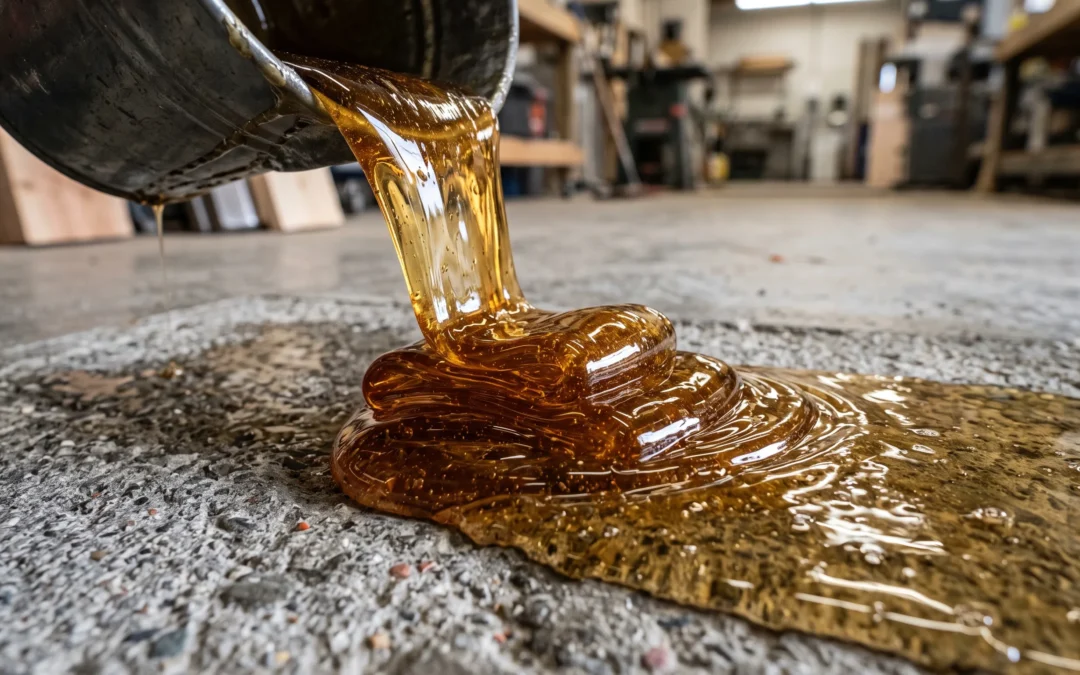
“100% solids” means that everything in the bucket stays on your floor. The coating contains no water and no solvent carrier — nothing evaporates during cure — so the thickness you apply is the thickness you keep, permanently. A water-based epoxy, by contrast, can lose half or more of its applied film as the carrier flashes off. That single specification, printed in small type on every data sheet, predicts more about how long an epoxy floor will last than the brand name, the color, or anything in the sales pitch. Here’s why the number matters and how to use it.
Solids Content: The Number That Predicts Your Floor’s Future
Every liquid coating has two components by volume: the solids — resin and pigment that remain after cure — and the carrier, which exists only to make the product easy to spread and then leaves. Solids content is simply the percentage that stays.
Coating professionals talk in mils — thousandths of an inch — and in two measurements: wet film thickness (what you roll on) and dry film thickness (what you own afterward). The math is blunt. Apply a 50% solids product at 6 mils wet and you own 3 mils of floor. Apply a 100% solids product at 10 mils wet and you own all 10. Same roller, same afternoon, three times the floor.
Because there’s no evaporation, 100% solids epoxy also cures with essentially zero shrinkage — no stress pulling at the bond line as the film contracts, and no solvent vapors filling the building. It cures purely by the chemical reaction between resin and hardener, which is the reaction that makes epoxy epoxy in the first place.
The Three Formulations, Honestly Compared
- 100% solids epoxy. Full-thickness films of 10+ mils per coat, maximum hardness and chemical resistance, zero VOC carrier. The professional standard for floors, and what every basecoat we manufacture is. The trade-off: it’s thick, it has a short working window, and it forgives nothing during application.
- Solvent-based epoxy. Historically valued for penetrating and tolerating marginal surfaces, but a large share of the can evaporates as solvent — much of it as VOCs. Modern air-quality rules, strictest here in California, have pushed it out of general floor use, and the fumes never belonged in an attached garage anyway.
- Water-based epoxy. Easy to roll, low odor, cheap — which is why it fills the retail shelf. It’s real epoxy, but the film that remains is thin, often around 1 to 3 mils. We give it a fair hearing in a separate post; the short version is that its honest uses are narrow.
One more label to decode: “high solids.” It sounds like 100% and isn’t — it’s a marketing-friendly range that can sit anywhere well below full solids. If a data sheet doesn’t state the percentage, that’s your answer.
Why Does Thickness Matter So Much?
Because nearly every property you buy an epoxy floor for scales with film build. Abrasion is a race between wear and material — a 10-mil film simply has more to give than a 2-mil film. Impact resistance depends on mass that can distribute a blow. A thick basecoat bridges hairline cracks and fills the texture left by diamond grinding; a thin one telegraphs every imperfection. And a broadcast system physically requires build: vinyl flakes have to sink into a wet bed deep enough to anchor them, which is why a proper garage floor coating can hold a full-rejection broadcast and a rolled-on kit can only manage a sparse sprinkle.
Thin films are also the engine of the industry’s most common failure. When we’re called to diagnose a peeling floor, the flakes of failed coating that come up are almost always paper-thin — the fingerprint of a low-solids product. We wrote up the whole failure chain in how to fix peeling epoxy flooring.
The Catch: Why Isn’t Everything 100% Solids?
Fair question, and the answer is that full-solids epoxy is a professional’s material. Once mixed, the reaction is running and the pot life is short — the batch generates its own heat and will harden in the bucket if it isn’t spread promptly. It can’t be thinned for easier rolling without wrecking the formulation. It demands correct mix ratios by the gram, a prepared slab, and a crew that has done it enough times to move fast without rushing. Temperature raises the stakes further: on a hot Southern California afternoon the reaction accelerates, shrinking an already short window, while a cold slab slows cure and stretches the schedule — a crew reads those conditions and adjusts batch sizes on the fly. None of that suits a retail box aimed at a weekend applicator, which is precisely why retail boxes are water-based. If you’re weighing that route, read our honest take on whether a DIY garage floor epoxy kit is worth it first.
There’s also a legitimate technical point: solids content describes the basecoat conversation, not the whole system. The clear wear layer over our floors is a UV-stable polyaspartic coating — a different chemistry chosen for sunlight and abrasion, applied over a 100% solids epoxy body. Right material, right layer.
How to Use This Number When You Compare Quotes
You don’t need to become a chemist. Ask three questions of any bid or any box:
- What is the solids content of the basecoat? The answer should be “100%,” stated plainly, not “commercial grade” or “high solids.”
- What is the total dry film thickness of the system, in mils? A real broadcast system totals many times what any paint-grade product can reach.
- How is the concrete prepared? Thickness bonds to profile — a full-solids basecoat over an unground slab is still a failure waiting for a hot tire.
Anyone installing a system worth buying will answer all three without flinching. Since we manufacture our own materials, we’ll happily put the data sheet next to the quote.
Frequently Asked Questions
Is 100% solids epoxy better than water-based epoxy?
For floors, yes, decisively — it cures many times thicker, harder and more chemical resistant, with no VOC carrier evaporating into your home. Water-based epoxy’s advantages are ease of application and price, which matter to the applicator more than to the floor.
Does 100% solids mean the epoxy has no VOCs?
Effectively yes for the formulations we build — with no solvent carrier there is nothing to flash off, and our materials are VOC-free. Always confirm on the specific product’s data sheet, since a few full-solids products still use reactive additives with some VOC content.
How thick is a 100% solids epoxy floor?
A single basecoat typically cures at 10 or more mils — and a full broadcast system with flake and topcoat runs several times that. Retail water-based coatings, for comparison, often finish around 1 to 3 mils total.
Can I apply 100% solids epoxy myself?
Physically possible, honestly inadvisable the first time. Short pot life, strict mix ratios and the need for diamond grinding make it an unforgiving material — the failure mode is expensive, because a botched full-solids pour must be ground off. It’s the one product category where professional installation pays for itself.
Top Epoxy Flooring manufactures its own 100% solids, VOC-free epoxy systems and installs them across Southern California with a limited lifetime residential warranty. Call (818) 945-0915 for a free estimate.
Recent Comments