
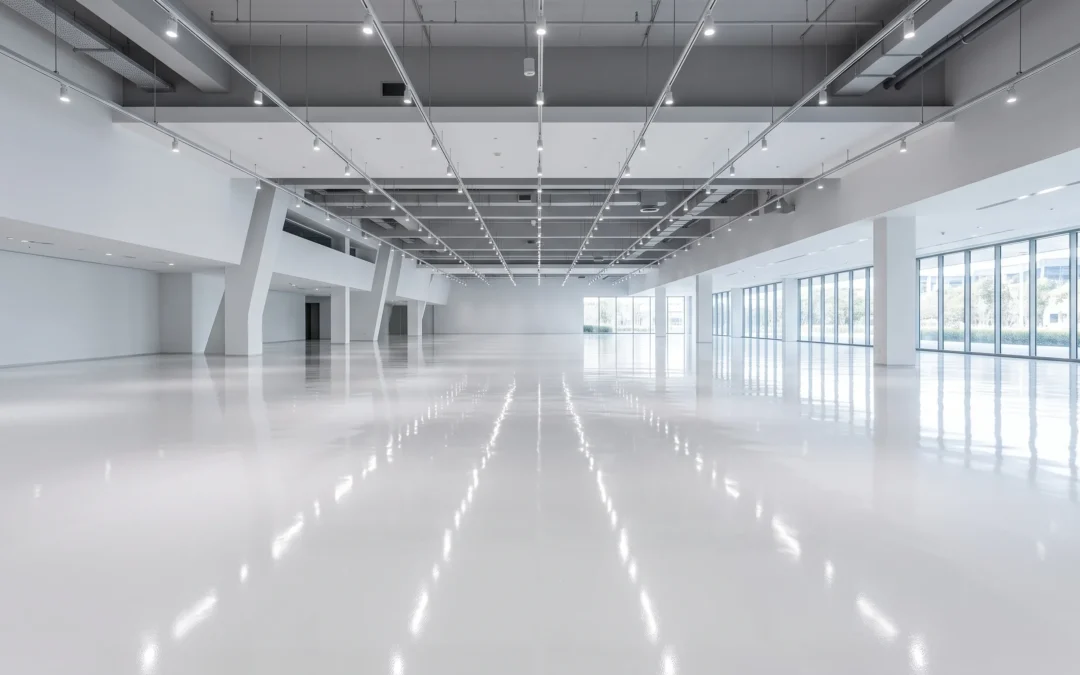
Seamless epoxy flooring is a floor installed as one continuous, unbroken surface — poured and troweled in place so there are no grout lines, no plank edges, no tile joints and no transitions anywhere in the room. Every other floor covering is assembled from pieces; a seamless resin floor is a single piece, chemically bonded to the concrete beneath it. That one difference drives every benefit the category is known for: nowhere for dirt and bacteria to hide, nothing for water to seep through, no edges to lift or chip, and a visual sweep that makes rooms read larger. Here’s what seamless really means, where it pays off most, and the caveats an honest installer will tell you about.
What “Seamless” Actually Means on a Job Site
The floor arrives as liquid. Resin is mixed, poured and spread wall to wall in a continuous operation, flowing around columns, into corners and under toe-kicks as a single monolithic membrane. Where hygiene rules demand it, the same material is carried a few inches up the wall as an integral cove base — floor and baseboard become one waterproof unit with no crack where they meet, which is why health inspectors love resin floors.
One clarification worth making early: seamless doesn’t mean the slab’s engineering disappears. Concrete has control joints, placed deliberately so it cracks where the builder chose. Depending on the setting, those joints are either filled flush and coated over or honored with flexible sealant through the new floor. Everything between joints — which is nearly everything — is one uninterrupted surface.
Why Seams Are the Enemy in the First Place
To appreciate a seamless floor, look closely at a seamed one. Tile grout is porous cement that drinks up spills, harbors bacteria and mold, and demands scrubbing and periodic resealing forever. Vinyl plank edges let water reach the subfloor, where damage happens invisibly. Every joint in any floor is a stress concentration — the place where chips start, edges lift and wear begins. And in commercial settings, seams are a compliance problem: food-code and healthcare cleaning standards are written around eliminating exactly these harborage points. A seam isn’t a neutral line on the floor. It’s the weakest point of the whole assembly, repeated thousands of times.
The Benefits, in Practical Terms
- Hygiene. No pores, no grout, no crevices — nothing for bacteria, mold or pests to colonize. The surface can be sanitized completely because all of it is reachable.
- Effortless cleaning. A dust mop and an occasional wet mop maintain the whole floor; there’s no joint line that needs a brush. Our epoxy floor maintenance guide fits on a page for a reason.
- Liquid containment. Spills stay on top, visible, until they’re wiped up — they can’t travel down through a seam to rot what’s below. On elevated exterior surfaces this same principle becomes true waterproofing, which is the basis of balcony and deck waterproofing systems.
- Durability without weak points. Loads spread across a continuous bonded surface instead of concentrating at edges, so there’s no first-domino joint where deterioration begins.
- The look. An unbroken floor visually enlarges a space — no grid of lines chopping the room. It’s most dramatic in metallic epoxy floors, where veining flows uninterrupted across the entire area like a single slab of stone.
Where Seamless Floors Earn Their Keep
Some spaces merely enjoy these benefits; others are effectively built around them. Commercial kitchens, food processing areas, breweries, medical and veterinary clinics, and labs choose seamless resin floors because sanitation drives the spec — often with the cove base included. Warehouses, showrooms and retail floors choose them for wheel traffic and cleaning speed across big footprints; see our commercial and industrial flooring page for those systems. At home, the same logic scales down: a garage floor coating turns the hardest-working room in the house into a wipe-clean surface, and basements, laundry rooms and modern open-plan interiors trade tile grout for a floor that never asks for it. Anywhere liquid, hygiene or heavy cleaning is part of daily life, seamless is less a style choice than a working spec.
The Maintenance Ledger: Seamless vs. Assembled Floors
Add up ten years of upkeep and the seam question becomes a bookkeeping question. An assembled floor carries recurring line items: grout scrubbing and periodic resealing for tile, replacement planks for swollen vinyl, wax cycles for VCT in commercial buildings, and the slow accumulation of chipped corners that started at an edge. A seamless resin floor’s ledger has two entries: routine mopping, and a topcoat refresh somewhere down the road when heavy traffic has dulled the wear layer. There’s no consumable to restock and no specialist product list — neutral cleaner and water handle the decade. For a business, the difference compounds: cleaning crews cover seamless square footage faster, and there’s no annual floor-strip weekend that closes the space. None of this shows up in a day-one comparison of installed costs, which is exactly why it’s worth writing down.
The Honest Caveats
Three things to know before you fall for the glamour shots. First, the control-joint point above: large slabs keep their movement joints, and a good installer will show you on-site exactly what will disappear and what will remain as a filled line. Second, repairs on decorative seamless floors trade differently than tile — you can’t swap one damaged square, but you can blend or recoat a section, and on flake systems a repair disappears into the pattern far better than a mismatched replacement tile ever does. Third, seamless quality is poured-in, not promised — a monolithic floor is only as monolithic as its bond, which comes back to diamond grinding and a real system underneath. One surface, bonded everywhere, or it’s just a skin with no seams and no grip — the seamless look with none of the seamless substance, and it won’t keep either for long.
Frequently Asked Questions
Is seamless epoxy flooring waterproof?
The cured surface is non-porous and impermeable, so water sits on top rather than penetrating — for interior floors that’s effectively waterproof in daily use. On balconies and elevated decks, dedicated waterproofing systems add reinforcing layers to handle structural movement and protect the space below.
Can seamless epoxy include a cove base up the wall?
Yes — an integral cove carries the floor material several inches up the wall in one continuous membrane, eliminating the floor-wall joint entirely. It’s standard practice in commercial kitchens and medical spaces and available anywhere hygiene or washdown matters.
What happens to the concrete’s expansion joints under a seamless floor?
They’re addressed, not ignored. Depending on slab size and setting, joints are either filled and coated over or maintained through the coating with flexible joint sealant. Your installer should walk the slab with you and identify each one before work begins.
How do you repair a seamless floor if it’s damaged?
Gouges and impact damage are filled and blended, and worn areas are refreshed with a new topcoat over an abraded surface. Flake and quartz patterns camouflage repairs especially well; smooth metallic finishes are the one style where a repair may show, which is worth weighing during design.
Top Epoxy Flooring manufactures and installs seamless VOC-free coating systems for homes and businesses across Southern California — limited lifetime residential warranty, three years commercial and outdoor. Call (818) 945-0915 for a free estimate.
Recent Comments