
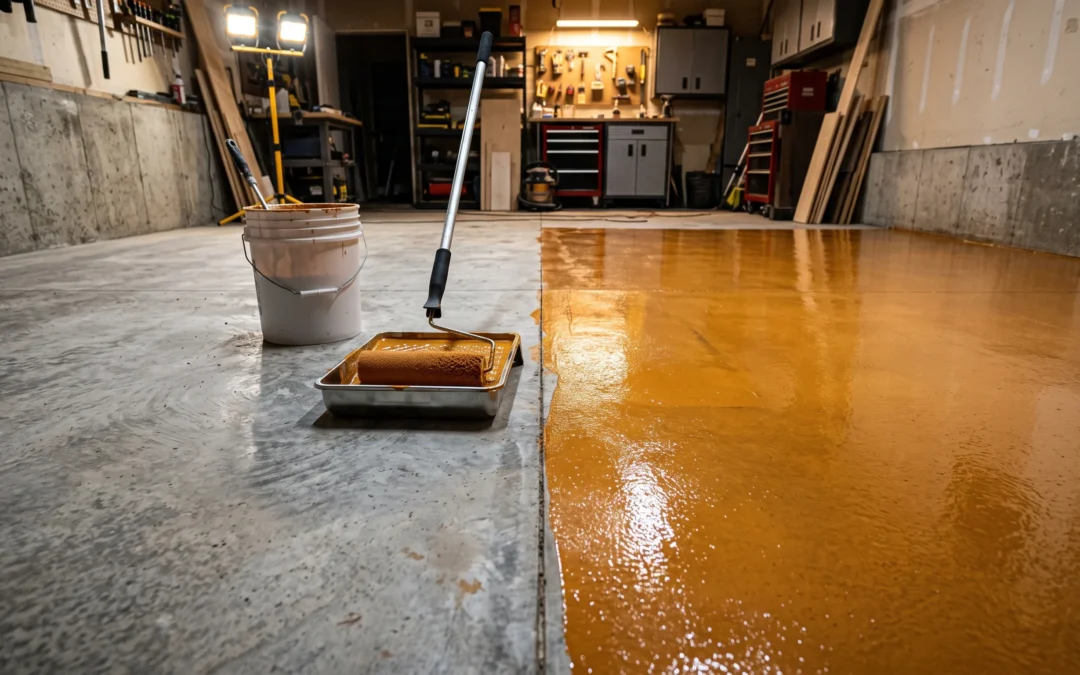
A primer matters because epoxy does not stick to concrete the way paint sticks to drywall — it has to anchor into the slab, and the first coat is the one doing the anchoring. A primer is a thin, low-viscosity epoxy engineered to soak into the pores of prepared concrete, wet out the surface, and give every layer above it something to grip. Skip it, or use the wrong one, and the most expensive topcoat in the world is sitting on a weak foundation. That said, here’s the part most primer articles won’t tell you: on many slabs a basic primer is not enough, which is why our own systems are built on a moisture-vapor-barrier epoxy basecoat instead of a thin primer coat. We manufacture the coatings we install, so we get to make that call at the formulation level — and this article explains why we made it.
What a Primer Actually Does
Think of the first coat on a concrete slab as a translator between two very different materials. Concrete is porous, alkaline, slightly damp and full of microscopic air. Epoxy is dense, viscous and impermeable. A primer bridges the two. Specifically, it does four jobs:
- Penetration. A primer is formulated thinner than a basecoat, so it flows down into the pore structure that diamond grinding opens up. Once cured, it is physically keyed into the slab — a mechanical bond, not a surface film.
- Sealing outgassing. Concrete breathes. As temperatures shift, air trapped in the slab expands and rises. If that happens while a thick basecoat is curing, you get bubbles and pinholes. A primer seals the surface first, so the heavier coats above it cure smooth.
- Even absorption. Bare concrete drinks unevenly — more at soft spots, less over dense aggregate. Priming evens that out, so the basecoat holds a consistent thickness instead of going thin where the slab was thirsty.
- Intercoat adhesion. Epoxy bonds chemically to epoxy applied within its recoat window. A primer gives the basecoat a fresh, compatible surface to fuse with — better than asking it to do all the penetrating and all the building in one pass.
Every one of those jobs assumes one thing: the concrete was mechanically prepared first. A primer is not a substitute for concrete grinding. It cannot penetrate a slab that is sealed by a curing compound, glazed by steel troweling, or coated in old paint. Preparation creates the bonding profile; the primer exploits it. In that order, always.
Why “Do I Need a Primer?” Is the Wrong Question
The question homeowners usually ask is whether they can skip the primer to save a coat. The question professionals ask is different: what is the first coat on this particular slab required to do? On a dry, sound, freshly ground slab, a standard epoxy primer does the job. But garages and basements in the real world throw two problems at the first coat that a basic primer was never designed to solve.
Problem one: moisture vapor
Concrete sits on soil, and soil holds water. That water migrates upward through the slab as vapor, and when it hits an impermeable coating it builds pressure underneath it. This is the failure behind a huge share of peeled floors — the coating didn’t let go of the concrete; the vapor pushed it off. An ordinary primer slows vapor slightly. It does not stop it. If you’ve ever seen a coating blister from below or lift in sheets, our guide on how to fix peeling epoxy flooring shows what that failure looks like — and how often moisture is the culprit.
Problem two: thin first coats on hungry slabs
A primer goes down at a few mils. On older, porous, or repaired concrete, that thin film can starve — absorbed so completely into the slab that too little remains on the surface to bond the next coat properly. The fix is more material in the first coat, not less.
The Manufacturer’s Answer: A Moisture-Vapor-Barrier Epoxy Basecoat
Because we formulate our own systems, we solved both problems in one layer. Instead of a thin primer followed by a separate basecoat, our installations start with a moisture-vapor-barrier epoxy basecoat: a 100% solids epoxy engineered to penetrate the ground slab like a primer, build like a basecoat, and block moisture vapor from below like a dedicated vapor barrier. One layer, three jobs.
This matters most in Southern California’s housing stock more than people expect. Plenty of slabs here were poured decades ago without a vapor retarder underneath, and hillside and coastal lots keep soil moisture moving year-round. A floor that looks bone dry in August can be pushing vapor in February. Building the vapor defense into the basecoat means we don’t have to guess right on installation day — the protection is in the system regardless.
It also changes what the rest of the system can do. With the bond and the vapor barrier handled at the bottom, the layers above are free to specialize: a full-rejection flake broadcast for texture and looks, and a UV-stable polyaspartic topcoat for abrasion, chemical and sunlight resistance. Each layer does one thing well. That’s what a coating system is — and it’s why a professionally built garage floor coating behaves nothing like a one-bucket product.
When a Standard Primer Is Perfectly Fine
Honesty cuts both ways, so here it is: not every slab needs a vapor barrier. A newer interior slab poured over an intact plastic vapor retarder, tested dry, in a conditioned space, can be primed with a standard epoxy primer and coated with confidence. If you’re doing a DIY project on a slab like that, prime it — the improvement in bond and finish quality over an unprimed floor is real and well documented.
The trouble is that you can’t identify that slab by looking at it. Moisture testing — calcium chloride or in-slab relative humidity probes — is how the decision gets made professionally. Guessing “it looks dry” is how a beautiful floor becomes a peeling one eighteen months later.
How to Tell If a Floor Was Built on the Right First Coat
You can’t see a primer under a finished floor, but you can interrogate the process. Whether you’re vetting a contractor or auditing your own plan, ask these:
- How is the slab being prepared? The only acceptable answer is mechanical — diamond grinding. Acid etching does not create a reliable bonding profile, and no primer can compensate for that.
- Is moisture being tested, and what happens if it’s high? A pro should name a moisture-mitigating basecoat or barrier product, not shrug.
- What is the solids content of the first coat? Water- and solvent-carried primers shrink as they dry. 100% solids material stays at the thickness it was applied.
- Is the first coat within the system’s recoat window when the next layer goes down? Chemical intercoat bonding depends on timing, and a good installer schedules around it.
A contractor who answers those four questions crisply is building you a floor. One who says “we don’t need primer, our epoxy is self-priming” without a word about grinding or moisture is building you a problem.
Frequently Asked Questions
Do I really need a primer for epoxy flooring?
On properly ground, dry concrete, yes — a primer measurably improves adhesion, reduces bubbles and evens out absorption, and the only floors that safely skip a separate primer are those using a penetrating 100% solids basecoat engineered to do the primer’s job. What no floor can safely skip is mechanical preparation; a primer complements diamond grinding, it never replaces it.
What is the difference between an epoxy primer and a moisture-vapor-barrier basecoat?
A standard primer is a thin epoxy that improves bond and seals outgassing, but only slows moisture vapor. A moisture-vapor-barrier epoxy basecoat is a heavier 100% solids layer formulated to penetrate like a primer while blocking vapor pressure from beneath the slab — the failure mode that peels coatings off otherwise sound concrete.
Can primer fix concrete that wasn’t ground first?
No. Primer needs open pores to penetrate, and sealed, troweled or contaminated concrete doesn’t have them. Diamond grinding creates the bonding profile first; the primer then locks into it. Applied to unprepared concrete, primer becomes just another layer waiting to peel.
How do I know if my slab has a moisture problem before coating it?
Test, don’t guess. Calcium chloride tests and in-slab relative humidity probes give real numbers, and a taped-down plastic sheet left for 24 hours is a crude but telling home check — condensation or darkened concrete underneath means vapor is moving. Any positive result calls for a vapor-blocking basecoat, not a standard primer.
Top Epoxy Flooring formulates, manufactures and installs its own VOC-free coating systems across Southern California — every residential floor starts with a moisture-vapor-barrier epoxy basecoat and carries a limited lifetime warranty. Call (818) 945-0915 for a free on-site estimate.
Recent Comments