
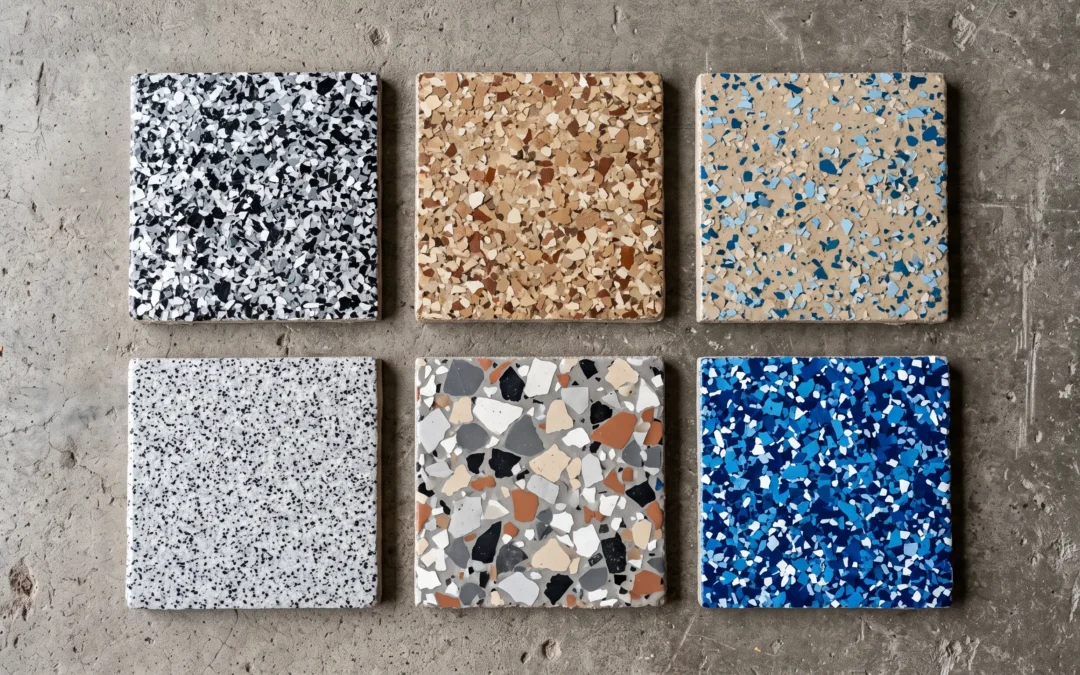
Flake epoxy design comes down to three choices: the color blend, the chip size, and where the floor lives. Get those three right and a broadcast floor can pass for granite, terrazzo, beach stone or confetti — all from the same installation process. This is a pure design tour: the blend families that keep proving themselves in real houses, the effect chip size has on a room, and the pairings that make a flake floor look intentional instead of default. (If you want the engineering story — layers, broadcast method, durability — that’s covered on our flake flooring page. This post is about the look.)
The Five Blend Families
Almost every flake floor we install falls into one of five aesthetic families. Knowing which family you’re drawn to narrows hundreds of blends to a handful.
- Tonal grays. Two to four gray values, sometimes a whisper of blue. The most-chosen family for a reason: it reads as engineered stone, matches every car color, and never argues with the rest of the house.
- High contrast. Black, white and a bridging gray. Crisp, graphic, slightly retro — think diner-floor energy tuned down to sophistication. Strongest in garages with bright lighting and clean walls.
- Earth and canyon tones. Tans, browns, terracotta, buff. These warm blends belong to Spanish-style and ranch homes, and they’re the best liars in the lineup — dust and dirt simply vanish into them.
- Coastal mixes. Sandy beige threaded with slate blue or seaglass green. Popular near the water and in beach-adjacent neighborhoods, where the palette echoes what’s outside the door.
- Statement colors. A saturated blue, red or green base flecked with neutrals. Rare in living spaces, fantastic in game rooms, gyms, and brand-colored commercial floors.
Chip Size Changes the Room More Than Color Does
Two floors in the identical blend can look unrelated if their chip sizes differ. Small chips read as fine texture from standing height — the floor becomes a quiet, even field, almost a solid color with depth. Large chips read as individual shapes; the floor becomes a pattern you notice. As a design rule:
- Fine (1/16″–1/8″) — subtle, contemporary, almost sandstone. Suits interiors, offices and anyone who “doesn’t want it too busy.”
- Standard (1/4″) — the classic garage scale, balanced between texture and pattern. When in doubt, this is the answer.
- Oversized (1/2″–1″) — bold and terrazzo-like, each chip visible from across the room. Spectacular in large spaces; overwhelming in small ones.
The scale rule mirrors tile: big rooms carry big chips, small rooms flatter small ones.
Designs That Elevate a Broadcast Floor
A flake floor doesn’t have to be one uniform field wall to wall. A few composition moves we’ve built for clients:
- A solid-color border. A smooth pigmented band around the room’s perimeter frames the broadcast field like a rug. Sharp in garages and commercial lobbies alike.
- Zone changes. One blend under the parking bays, a different one — or a solid color — in the workshop corner. The seam lands under a wall line or control joint so it looks architectural.
- Matched verticals. Carrying the broadcast up stem walls and steps makes the whole room feel machined from one material — a detail most bids skip and most eyes notice.
- Custom blends. Because we manufacture our own systems, chips can be blended to order — matching a team color, a company palette, or the exact taupe of your cabinetry. Standard blends live on our color chart; custom starts with a conversation.
Pairing Blends With Rooms
Where the floor lives should steer the design. For a garage, mid-tone tonal grays and earth blends stay presentable between cleanings and flatter every vehicle finish. Basements love warmer, lighter blends that fight the below-grade gloom — pure cool gray down there can feel like a parking structure, which is why we often nudge basement floor coating clients one step warmer than their first instinct. Laundry and mudrooms take the busiest blends you like, since camouflage is the whole job. Outdoors, on a patio or pool surround, choose blends that harmonize with your hardscape and skew lighter — dark broadcasts get noticeably hot barefoot in full Southern California sun.
What About Sheen?
Design conversations fixate on color and forget finish. The clear topcoat over the chips comes in gloss or satin, and the difference is real: gloss maximizes depth and makes chips sparkle under LED shop lights; satin softens reflections and reads more like honed stone — increasingly the pick for interior living spaces. Outdoors, texture enters the finish equation too, since grit in the topcoat both cuts glare and adds barefoot-safe grip.
How to Choose Without Second-Guessing Yourself
Three steps. First, collect the fixed colors in and around the space — cabinets, garage doors, hardscape, trim — and pick a blend family that shares their undertone. Second, view physical sample chips in the room itself, at night under your actual lighting, because garage LEDs shift colors dramatically. Third, when torn between two finalists, take the one with more colors in the mix and the middle value — more colors hide more life, and mid-tones age most gracefully. A blend you barely notice in month one is usually the one you’re gladdest about in year ten.
Frequently Asked Questions
What is the most popular flake epoxy design?
Tonal gray blends at the standard 1/4-inch chip size lead every year — they read as speckled granite, hide everyday mess, and complement any vehicle or cabinet color. High-contrast black-and-white mixes are the most requested alternative for modern garages.
Can flake floors be two different designs in one space?
Yes. Blends can change between zones — parking bays versus workshop, field versus border — with the transition placed along a control joint or wall line so it looks deliberate. Solid-color borders around a broadcast field are the most popular two-design layout.
Does chip size affect anything besides looks?
Slightly. Larger chips build marginally more surface texture and show individual shapes at a distance, while fine chips produce a smoother, quieter finish. Durability comes from the resin system and broadcast density rather than the chip dimension, so choose size on aesthetics.
Can I get a custom flake color blend?
Yes — chips come in a wide color range and can be blended to order, matching cabinetry, hardscape or a brand palette. Because we manufacture our own coating systems, custom blends are a normal request rather than a special order, and we pour a sample before committing the floor.
Browse blends, then see them in person: Top Epoxy Flooring installs custom flake designs across Southern California with VOC-free materials we make ourselves and a limited lifetime residential warranty. Call (818) 945-0915 for samples and a free estimate.
Recent Comments