
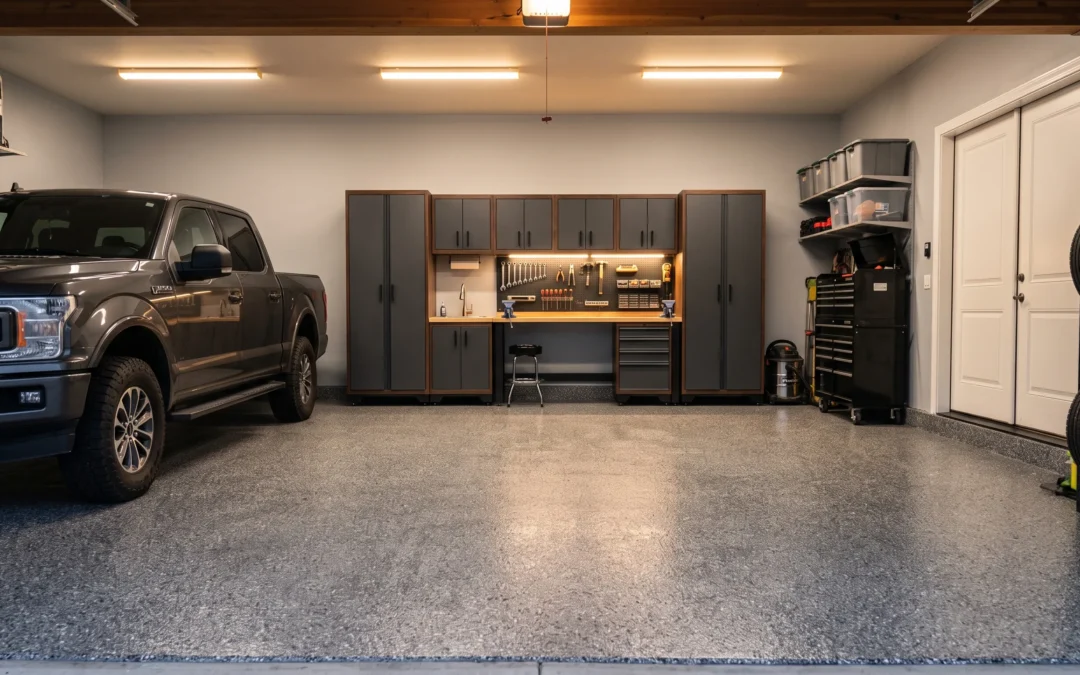
Gray is the most installed garage floor color in America, and that’s not a failure of imagination — it’s the verdict of decades of garages actually being lived in. Gray hides concrete dust, brake dust, and California’s endless fine grit; it matches every vehicle, cabinet line and house trim ever made; and it forgives the months when nobody feels like mopping. The interesting question isn’t whether gray, it’s which gray and in what form — solid or flake, warm or cool, silver-light or storm-dark. The choice changes the room more than most people expect, so here’s the working guide to getting gray right.
Why Gray Earned the Default Slot
Understand why gray wins and you’ll pick a better gray. First, camouflage physics: the mess a garage generates — tire dust, dry-leaf crumble, cement fines — is itself mostly gray and tan, so a gray floor is hiding like with like. Second, temperature neutrality: garages open onto driveways, and concrete-adjacent grays make the transition seamless instead of jarring. Third, pigment stability: grays hold their appearance through years of sun exposure at the door threshold better than saturated colors, especially under a UV-stable polyaspartic topcoat. None of this makes gray boring; it makes gray the color that’s still right in year twelve. Everything below is about spending that reliability wisely, on a garage floor coating built to match it.
Pick Your Value First: Light, Medium or Charcoal
Shade matters more than any other gray decision:
- Light silver-gray brightens like white at a fraction of white’s upkeep. Best in dim garages and under warm lighting, where pure white would glare. It shows dark drips soonest of the three.
- Medium gray is the bullseye — bright enough to reflect useful light, dark enough to swallow dust and tire shadow. If you asked us to coat a garage with no input at all, this is what you’d get, and you’d be happy.
- Charcoal skews dramatic and modern, flattering light-colored cars and crisp white walls. It hides oil beautifully and shows pale dust more readily — the mirror image of light gray’s tradeoff.
A quick field trick: look at your driveway and your garage walls at midday, then choose a floor one to two steps darker than the driveway. The garage will read intentional from the curb instead of like a continuation of the slab.
The Flake Blends That Elevate Gray Beyond Basic
Where gray becomes a design choice rather than a default is in a full-broadcast flake system. Multi-tone gray blends layer three to five chip colors into a surface that reads as engineered granite, and each recipe has a distinct personality:
- Salt-and-storm — white, silver and black chips over a medium base; the crispest, most modern read.
- Tonal slate — three neighboring grays with no contrast spike; from standing height it’s a calm stone texture, the choice for owners who want quiet.
- Gray warmed with taupe — a few tan or greige chips shift the floor friendly, bridging beautifully to wood-tone cabinets and beige stucco.
- Gray with a blue thread — a minority of steel-blue chips wakes the mix up without becoming a blue floor; popular in coastal neighborhoods.
Beyond looks, the broadcast earns its keep functionally: chip texture adds wet-weather grip at the threshold, and the pattern camouflages small repairs forever. A gray flake garage installs in one day, and the blend cards on our color chart are the right place to shortlist.
Solid Gray: The Showroom Discipline
A smooth, unbroken gray field — our solid color system — is the minimalist’s pick, and in gloss it does a convincing impression of a dealership service bay. Solids demand a bit more of both slab and owner: the uniform surface shows imperfections and drips that a broadcast would eat, so it suits garages that stay tidy and slabs in good condition. Two upgrades worth considering with solid gray: a satin topcoat, which reads as honed concrete and hides squeegee streaks, and a contrasting border or bay-line layout, which turns one color into a composed design. Solid installations run two to three days.
Pairing Gray With the Rest of the Garage
Gray’s neutrality means the rest of the room decides the mood. Black cabinets and stainless tools over medium gray flake read industrial-professional. White cabinetry over light silver-gray reads bright and domestic — the “garage as bonus room” look. Wood workbenches over warm greige blends read craftsman. If the garage connects to a coated driveway or patio, carrying related gray tones across both surfaces makes the whole approach to the house feel master-planned — one of the cheapest curb-appeal multipliers there is.
The Few Ways to Get Gray Wrong
Gray is forgiving, not foolproof. The common misses: choosing from a phone screen (grays shift blue or brown under different lighting more than any hue — always view physical samples in your own garage, day and night); matching the floor exactly to the wall color, which flattens the room into a single dull envelope; going charcoal in a garage with no windows and builder-grade lighting, then wondering why it feels like a cave; and forgetting the topcoat spec — even neutral grays need UV-stable protection at a sun-facing threshold to avoid the subtle ambering that makes old coatings look tired. Get those four right and gray is the closest thing to a guaranteed outcome in this business.
Frequently Asked Questions
What shade of gray is best for a garage floor?
Medium gray is the safest all-around answer — bright enough to reflect light, dark enough to hide dust and tire marks. Go lighter to brighten a dim garage, or charcoal for a modern look with light-colored cars. Viewing physical samples in your own garage settles it quickly.
Is solid gray or gray flake better?
Flake for most homes: the multi-tone broadcast hides daily mess, adds slip-resistant texture, camouflages future repairs and installs in one day. Solid gray suits display-oriented garages and owners who prefer a clean, uniform field and don’t mind wiping drips promptly.
Do gray epoxy floors fade in sunlight?
Gray pigments are among the most stable, and under a UV-stable polyaspartic topcoat the color holds for the long term even at a sun-facing garage door. Fading complaints almost always trace to budget coatings with epoxy-only clear coats, which amber and dull with UV exposure.
Can I match my garage floor gray to my driveway or house?
Yes — blends can be chosen or custom-mixed to coordinate with driveway concrete, stucco and trim. The designer’s rule: relate, don’t duplicate. A floor one to two shades off your fixed surfaces looks intentional, while an exact match tends to flatten everything together.
Gray done right is anything but plain. Top Epoxy Flooring installs solid and flake gray systems across Southern California using VOC-free coatings we manufacture ourselves, with a limited lifetime residential warranty. Call (818) 945-0915 for blend samples and a free estimate.
Recent Comments