
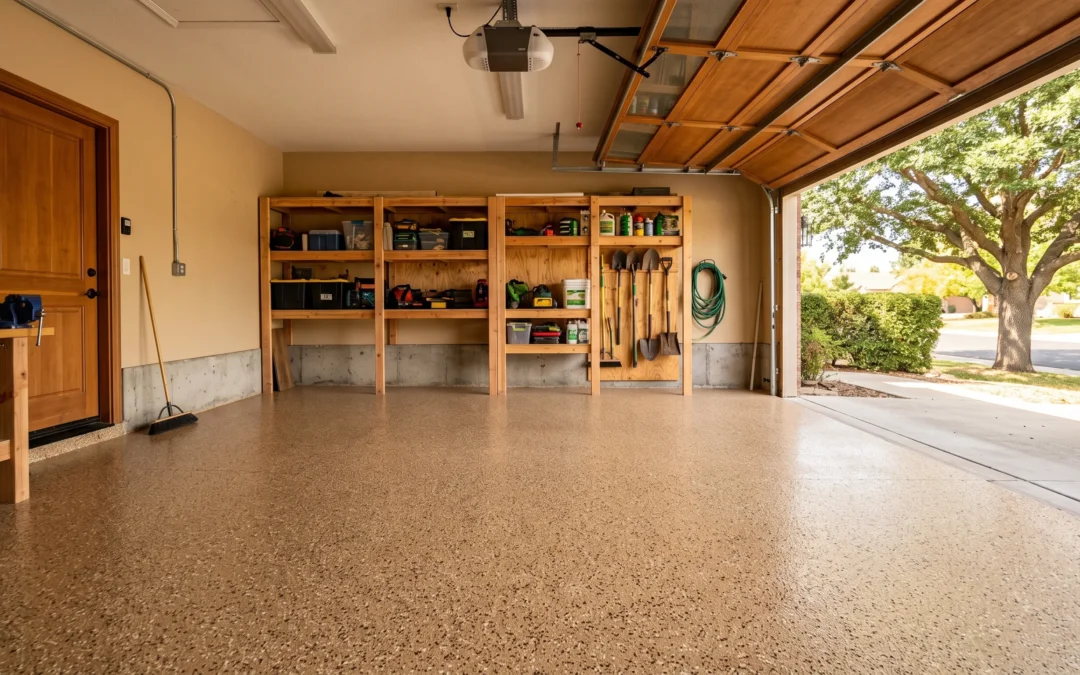
Tan is the quiet overachiever of garage floor colors. It doesn’t turn heads like red or metallic blue — it just hides Southern California’s dust better than any other shade, matches the beige-and-earth-tone exteriors most SoCal homes already wear, and makes a garage feel warm instead of clinical. If gray feels cold and bold colors feel like a commitment, tan is almost certainly your answer. Here’s how to spec a tan floor that looks like sandstone instead of beige paint, from a company that manufactures its own coatings and has installed this family of colors more times than any other.
Why Tan Wins in Southern California
The dirt here is tan. That’s the whole argument, and it’s a good one. Inland and valley garages collect a constant film of light-brown dust — from dry hillsides, Santa Ana winds, and the street itself. On a dark gray or black floor that film is visible within days. On a tan flake floor it simply disappears into the blend. The same goes for dried water spots, pollen, and the fine grit that blows in every time the door opens. A tan floor isn’t cleaner than a gray one; it just never looks dirty, which in practice is what most homeowners actually want.
There’s a design argument too. Southern California housing runs heavily to stucco in sand, cream, and adobe tones, with brown roof tile and warm-toned pavers. A tan garage floor continues that palette instead of fighting it — when the door is open, the floor looks like it belongs to the house. Gray floors can look borrowed from an office park; tan looks native.
Tan Flake Blends: Sandstone, Not Beige Paint
The difference between a rich tan floor and a flat beige one is the blend. A single-tone tan looks like paint; a multi-tone flake blend looks like stone. The flake system builds that depth from three or four chip colors over a tinted basecoat, applied as a full-rejection flake broadcast so coverage is total and the texture is even. Blends we install constantly:
- Saddle tan — tan, brown, and cream. The bestseller: warm, cozy, and perfect with wood cabinets and shelving.
- Desert sand — tan with beige and a whisper of gray. The most neutral option; goes with literally any wall color.
- Tan and chocolate — higher contrast, reads richer and slightly more formal. Great with dark trim and bronze fixtures.
- Tan with black flecks — the pepper-in-the-sand look. The black flecks sharpen the floor and hide dropped debris even better.
- Tan-gray transitional — for homes with cool-toned interiors and warm exteriors, this blend bridges both.
Every blend in the family is on our color chart, and a flake installation is done in one day — cars back in the garage the next.
Solid Tan and Warm Metallics
A solid color epoxy floor in tan is the cleanest version of the warm-neutral idea — a smooth, uniform surface that brightens the space the way a light floor does without the glare of white or the chill of light gray. It shows debris more than flake does, so it suits tidier garages, workshops with dust collection, or converted spaces. Solid installations take 2–3 days.
At the luxury end, warm metallics — bronze, caramel, latte swirled with cream — bring the tan family into showpiece territory. A metallic pour in these tones looks like polished travertine or flowing caramel, and no two floors ever come out alike. If the garage doubles as a gym or entertaining space, this is the warm floor that gets comments. Metallic floors take 3–4 days.
Matching Tan to the Rest of the Property
Tan’s superpower is continuity, so use it. Pull a chip from your stucco, your pavers, or your interior tile and match the floor’s base tone to it — because we manufacture our own coatings, tinting a basecoat to sit correctly against your exterior isn’t a special order, it’s a Tuesday. Many clients extend the same warm palette outdoors with a coordinated driveway coating or patio coating, so garage, driveway, and patio read as one continuous surface instead of three unrelated slabs. One note for those outdoor extensions: the warranty differs — residential garage floors carry a limited lifetime warranty, while outdoor and commercial coatings carry three years.
Keeping Warm Tones True
Ironically, the biggest threat to a tan floor is turning more tan — the wrong kind. Standard epoxy clear coats amber under UV, and over a warm base that ambering reads as yellowing and unevenness, especially in the sun-washed strip near the door. Our system prevents it structurally: the slab is diamond ground to open a bonding profile, a moisture-vapor-barrier epoxy basecoat locks out vapor from below, and a UV-stable polyaspartic topcoat seals the color under a clear layer that doesn’t yellow. Materials are VOC-free throughout. The result is a warm floor that stays exactly the warmth you chose.
Frequently Asked Questions
Does tan epoxy really hide dirt better than gray?
In Southern California, yes. The dust that settles in SoCal garages is itself light brown, so it vanishes against a tan blend while it shows plainly on dark gray or black. Tan flake also disguises water spots, pollen, and fine grit. No color hides motor oil forever, but tan keeps a floor looking clean longer between sweepings than any other family.
What is the most popular tan flake blend?
Saddle tan — a mix of tan, brown, and cream chips — is the most requested. It reads as warm speckled sandstone, pairs naturally with wood shelving and cabinetry, and sits comfortably against the stucco exteriors common across Southern California. Desert sand, which adds a slight gray note, is the runner-up for homes with cooler interiors.
Will a tan epoxy floor yellow over time?
The pigment won’t, but a cheap clear coat can. Standard epoxy topcoats amber with UV exposure, which over a tan base looks like blotchy yellowing near the garage door. A UV-stable polyaspartic topcoat doesn’t amber, so the tone you picked stays consistent across the whole slab for the life of the floor.
Can I match my garage floor to my driveway and patio?
Yes. Because we manufacture our own coatings, the same warm palette can be carried across the garage, driveway, and patio in coordinated systems, so all three surfaces read as one design. Note the warranty difference: residential garage floors carry a limited lifetime warranty, while outdoor coatings carry a three-year warranty.
Top Epoxy Flooring manufactures and installs its own coating systems across Southern California, and the tan family is our most-installed palette for a reason. Call (818) 945-0915 for a free estimate — we’ll hold the sample chips against your stucco.
Recent Comments