
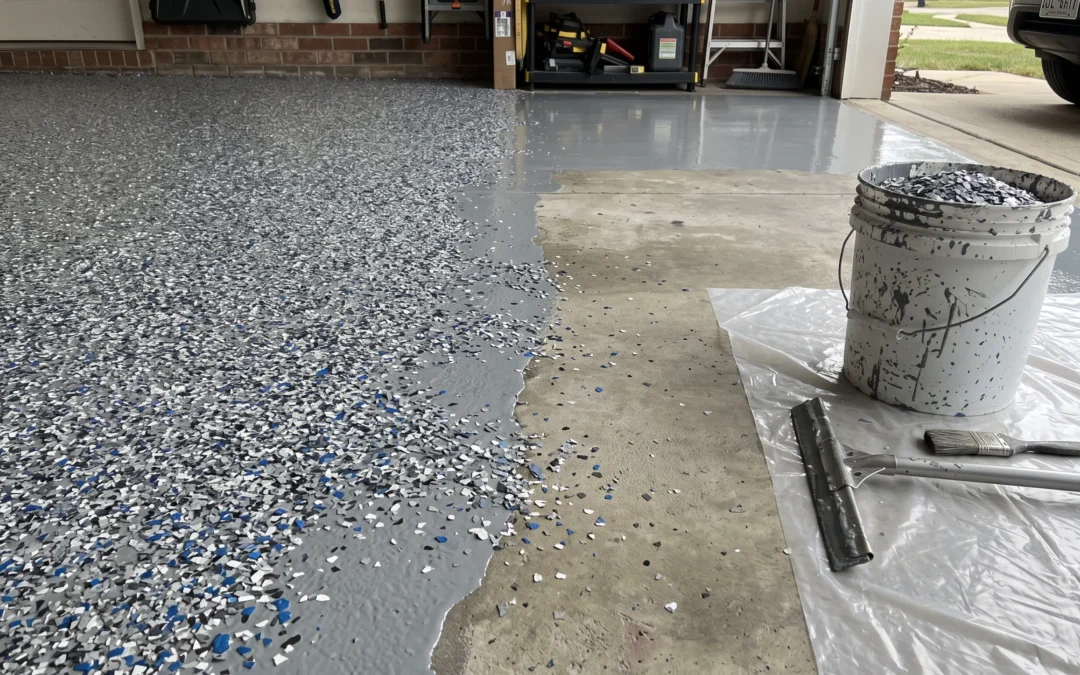
Paint chip epoxy flooring — also sold as chip flooring, flake flooring, or color chip epoxy — is a coating system in which small vinyl chips are scattered into a wet epoxy basecoat and then sealed under a clear topcoat. The “paint chips” aren’t paint at all: they’re thin, irregular flakes of colored vinyl, and once they’re locked under the clear coat the floor looks like speckled granite and wears like industrial armor. If you’ve seen a new garage floor with a confetti-granite finish, this is that system. Here’s exactly how it works, layer by layer, and how to judge whether it’s the right floor for your space — from a Southern California company that manufactures the system it installs.
What the “Paint Chips” Actually Are
The name confuses everyone, so let’s fix it up front. The chips are die-cut or shredded flakes of pigmented vinyl — dry, solid, and about as thick as a business card. They come in sizes from a fine 1/16 inch up to inch-wide jumbo flakes (1/4 inch is the garage standard) and in nearly any color, which installers combine into blends of three to five colors. Because the color is solid vinyl rather than a surface tint, chips can’t fade individually or rub off; whatever blend goes down is the blend you keep. One naming note: paint chips, color chips, color flakes, and vinyl flakes are the same product — different suppliers, same thing. The finished system is what we call epoxy flake flooring.
How the System Goes Together, Layer by Layer
A chip floor is a sandwich, and every layer has a job:
- Preparation — diamond grinding. The bare concrete is mechanically ground with diamond tooling to remove old sealers and laitance and open a bonding profile — the slightly porous texture the coating grips into. This step, not the chips, decides whether the floor lasts. Coatings fail from the bottom, never the top.
- Repairs. Cracks, spalls, and divots are filled and ground flush so the finished surface is continuous.
- Basecoat. A pigmented, moisture-vapor-barrier epoxy basecoat is rolled on. It’s tinted to complement the chip blend and blocks slab moisture from pushing the coating off from below — a real issue on Southern California slabs poured without vapor barriers.
- The broadcast. While the basecoat is wet, chips are thrown high into the air by hand so they rain down evenly — and in a proper install they’re thrown to full rejection, meaning the wet coat is saturated until it physically can’t hold another chip.
- Scrape and vacuum. Once the basecoat cures, the loose excess is scraped off and vacuumed up, leaving a dense, uniform chip surface.
- Clear topcoat. A UV-stable polyaspartic topcoat is applied over the chips, locking them in a glass-clear wear layer that resists chemicals, abrasion, and hot-tire pickup — the failure where hot tires soften cheap coatings and peel them on contact.
The whole sequence, grind to topcoat, is a one-day installation with our polyaspartic-topped system — cars roll back in the next day.
Why This System Dominates Garage Flooring
Chip floors are the most-installed decorative coating in America for stackable reasons. The multi-color speckle hides dust, tire marks, and dropped debris better than any solid surface. The chip layer adds thickness and impact absorption. The texture gives natural slip resistance while staying easy to squeegee clean. The finish looks like stone but installs in a day. And the format scales from garages to laundry rooms, basements, and commercial back-of-house. It isn’t the flashiest option — metallic epoxy takes that crown — but it’s the one that makes the most sense for a floor that works for a living, which is why it anchors most of our garage floor coating projects.
Where Paint Chip Flooring Isn’t the Answer
Honest limits. If you want a seamless, minimalist single-color surface, you want solid color epoxy, not chips. If you want a dramatic, one-of-a-kind marbled showpiece, that’s metallic. If the floor is an industrial kill zone — forklifts, thermal shock, heavy chemical spills — a broadcast sand or urethane system built for that abuse beats a decorative chip floor. And if an existing coating is already peeling, chips won’t rescue it; the old coating has to come off and the slab re-ground, or the new floor inherits the old failure. Chips are a finish, not a repair.
What Separates a Good Chip Floor From a Cheap One
Every chip floor looks similar in week one. The differences show up in year three, and they’re all invisible at install time: whether the slab was diamond ground or just acid-etched, whether the basecoat has a real moisture barrier, whether the broadcast went to full rejection or a light sprinkle, and whether the clear coat is a UV-stable polyaspartic or a bargain epoxy that ambers and peels. Because we manufacture every layer ourselves — VOC-free across the board — we control all four variables, and that’s why our residential installs carry a limited lifetime warranty instead of a business card and best wishes. Chip colors and blends are on our color chart.
Frequently Asked Questions
What is paint chip epoxy flooring made of?
It’s a three-part system: a pigmented epoxy basecoat bonded to ground concrete, a broadcast of colored vinyl chips (the “paint chips”) saturated into the wet basecoat, and a clear protective topcoat sealing the chips in. The chips themselves are solid pigmented vinyl flakes, so their color runs all the way through and can’t wear off.
Is paint chip flooring the same as flake flooring?
Yes. Paint chip, color chip, color flake, and vinyl flake flooring are different trade names for the same system — vinyl chips broadcast into a resin basecoat and sealed clear. Suppliers brand the chips differently, but the material and installation method are identical.
How long does a paint chip epoxy floor take to install?
One day with our system: diamond grinding, repairs, the moisture-vapor-barrier basecoat, the full-rejection chip broadcast, scrape-back, and the polyaspartic topcoat all happen in a single visit, with cars back on the floor the next day. Traditional all-epoxy versions can stretch to several days because each layer cures slowly.
Is paint chip epoxy slippery?
Less than smooth epoxy, because the chip layer leaves a light texture under the clear coat. For most garages that texture is enough; for wet areas or extra caution, an anti-slip additive can be mixed into the topcoat for more grip without changing the look.
Top Epoxy Flooring manufactures and installs its own chip flooring systems across Southern California — chips, basecoat, and topcoat from one source, installed in one day. Call (818) 945-0915 for a free estimate.
Recent Comments