
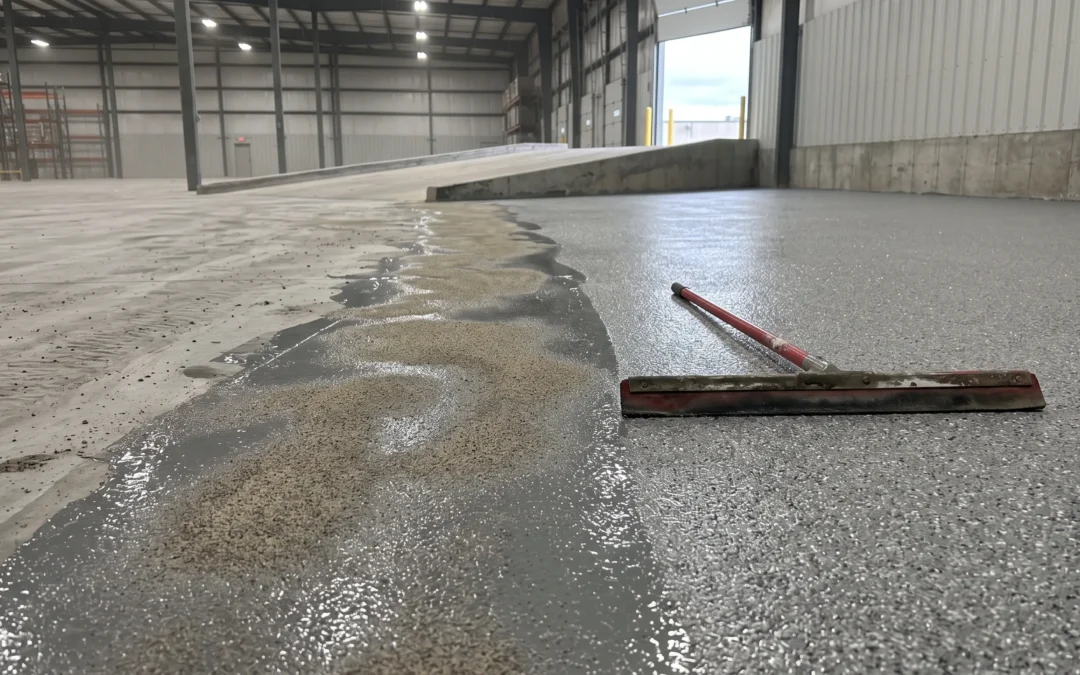
Sand goes into an epoxy floor for two reasons: grip and build. Broadcast into the wet coating, graded silica sand turns a glassy surface into a slip-resistant one; mixed through the resin, it thickens the system into a harder, higher-build wear layer that shrugs off forklifts and rolling steel. If your floor is a residential garage, you almost certainly don’t need it — the standard flake system already carries enough texture. But for ramps, wet process areas, loading docks, and manufacturing floors, sand is the difference between a coating and a work surface. Here’s when it belongs, how it’s applied, and where to draw the line — from a company that manufactures its own epoxy, polyaspartic, and urethane systems.
The Two Ways Sand Gets Into an Epoxy Floor
People say “epoxy with sand” and mean two different constructions:
- Broadcast sand. Graded silica is scattered into the wet basecoat — either lightly, for texture alone, or to full rejection, where the coat is saturated until it can’t hold another grain. After cure, the excess is swept and vacuumed off and the surface is locked under one or more topcoats. This is the same choreography as a flake floor, with aggregate playing the role of the chips: the result is a uniformly textured, sandpaper-like profile with real bite.
- Sand-filled (slurry) systems. Sand is blended directly into the epoxy before application, producing a mortar-like coat that goes down thick. This adds compressive strength and build — it can flatten minor slab imperfections and take point loads, impact, and abrasion that would chew through a thin-film coating.
Both can be combined: a slurry body coat for strength, a broadcast on top for grip, and a sealing topcoat to tune how aggressive the final texture feels.
When Sand Is the Right Call
Sand earns its place wherever traction or toughness is a liability question rather than a preference:
- Ramps and slopes — any coated incline that vehicles or carts travel needs broadcast aggregate. Smooth coatings on ramps are incidents waiting for rain.
- Wet process areas — wash bays, breweries, commercial kitchens, food processing — where water, grease, or product is on the floor as a matter of routine.
- Loading docks and forklift lanes — sand-filled systems take the pounding of hard wheels and dropped pallets that would fracture thin coatings.
- Manufacturing and warehouse floors — where durability outranks looks and the floor is part of the equipment.
- Exterior walkways and stairs — outdoor surfaces that see morning condensation or irrigation overspray.
These are the environments our commercial and industrial flooring systems are built for, and sand broadcast is one of the standard tools in that toolbox. For the most brutal service — thermal shock from hot washdowns, heavy chemical exposure — the answer often steps up from sanded epoxy to urethane cement, which carries aggregate in a cementitious urethane matrix.
When to Skip the Sand
Sand is a trade, not a free upgrade, and the cost is cleanability and feel. An aggressive sand profile grabs dirt, holds mop strings, and scuffs knees — fine in a warehouse, miserable in a home. In a residential garage, the standard flake system already provides moderate texture from the chip broadcast itself, and if a client wants extra grip we’d reach for a fine anti-slip additive in the topcoat before we’d reach for sand — same traction goal, far friendlier surface. Skip sand too for showroom and decorative floors, where the whole point is a smooth, reflective finish, and for interior spaces cleaned by hand. The rule of thumb: if the floor’s biggest risk is boredom, no sand; if its biggest risk is a slip-and-fall claim or a forklift, sand.
How a Broadcast Sand Floor Is Built
The system only works on top of proper preparation, and the sequence mirrors every coating we install: diamond grinding to open a bonding profile in the slab, crack and spall repairs, then a moisture-vapor-barrier epoxy basecoat. The sand broadcast goes into that wet coat, excess is reclaimed after cure, and the grout/seal coats go over the top — with the number and thickness of sealing coats deciding the final texture, from coarse industrial bite to a moderated commercial profile. On floors that see sunlight or need color stability, the final coat is a UV-stable polyaspartic topcoat. Materials are VOC-free throughout, and commercial installations carry a three-year warranty.
Quartz: The Decorative Cousin
Worth knowing before you commit to gray sand: colored quartz systems are broadcast floors too, but the aggregate is pigmented quartz granules instead of plain silica. You get the same slip resistance and build with a finished, stone-like look — which is why quartz is the pick for pool decks, locker rooms, restrooms, and customer-facing wet areas where raw industrial sand would look unfinished. Quartz installs in 1–2 days. If your project needs grip and has to face the public, quartz is usually the better answer; if it needs maximum toughness at minimum cost in a back-of-house space, sand wins.
Frequently Asked Questions
Why do installers put sand in epoxy flooring?
Two reasons: traction and strength. Broadcast into the wet coating, sand creates a slip-resistant texture for ramps, wet areas, and work floors; mixed into the resin as a slurry, it builds a thicker, harder coat that withstands forklifts, impact, and abrasion far better than thin-film epoxy alone.
Does a garage floor need sand in the epoxy?
Usually not. A residential flake floor already carries moderate texture from the chip broadcast, and that’s enough grip for parking and foot traffic. If extra traction is wanted — say, a steep driveway apron or a wash area — a fine anti-slip additive in the topcoat delivers it without the harsh, dirt-catching feel of true sand broadcast.
Is sand broadcast epoxy hard to clean?
It’s harder than a smooth floor — the texture that grips shoes also grips dirt and mop fibers, which is why aggressive profiles belong in facilities cleaned with deck brushes or floor machines rather than household mops. The sealing coats can be built up to moderate the texture, trading a little grip for easier cleaning.
What’s the difference between sand and quartz epoxy floors?
Both are broadcast aggregate systems, but plain silica sand is utilitarian and gray — chosen for strength and grip in back-of-house and industrial spaces — while colored quartz granules give the same performance with a finished, decorative stone look for pool decks, restrooms, and customer-facing wet areas. Quartz is the choice when the floor faces the public; sand wins on pure toughness in utility spaces.
Top Epoxy Flooring manufactures and installs its own epoxy, quartz, and urethane systems across Southern California, from garage floors to full industrial builds. Call (818) 945-0915 for a free estimate and a straight answer on whether your floor needs sand at all.
Recent Comments