
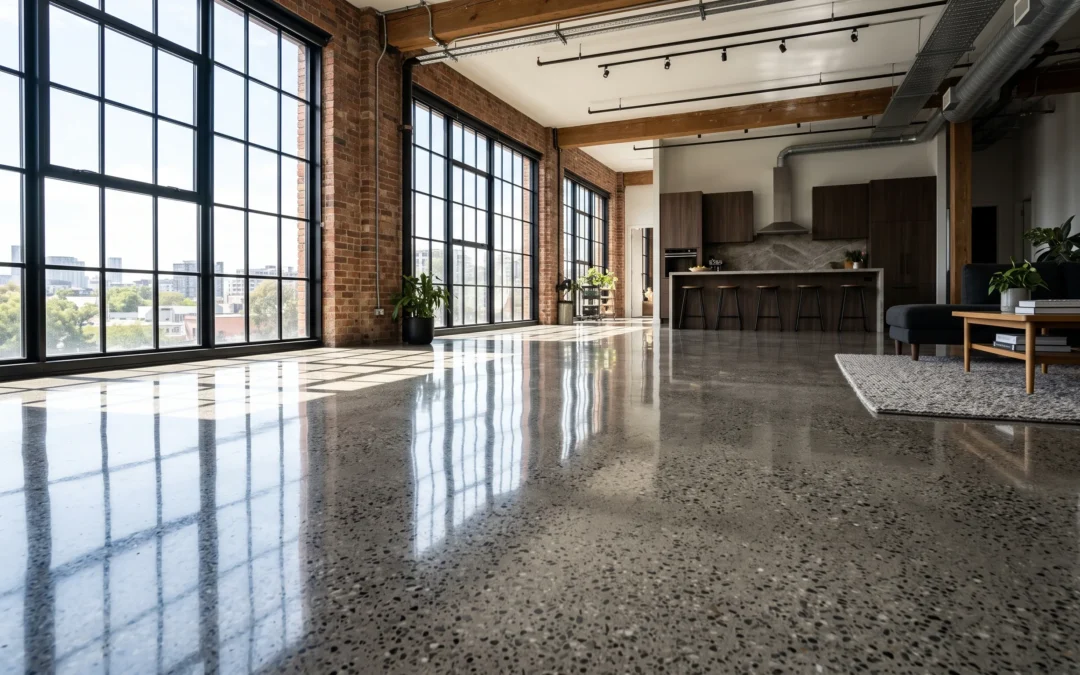
Clear epoxy flooring means coating concrete with transparent resin instead of a pigmented one — the slab stays visible and becomes the design. It’s the right choice when the concrete underneath is worth showing off: honed aggregate, acid-stained color, or the clean industrial character of a well-finished slab. It’s the wrong choice when the concrete is patched, stained by decades of oil, or when you assumed “clear” meant “invisible protection with no downsides.” The honest ledger below covers both columns, including the yellowing problem that clear coatings suffer more visibly than any colored floor — and the chemistry that solves it.
What a Clear Coat Is Actually For
A pigmented floor covers the slab; a clear system celebrates it. Three foundations make the transparent route worthwhile. First, grind and seal: the slab is diamond-ground to expose a fresh, uniform surface — sometimes down to the pebbled aggregate — then capped with clear resin. This is the backbone of the loft-industrial look. Second, stained concrete: reactive stains or dyes color the slab itself in organic, mottled tones, and the clear coat locks that artwork in while adding depth and sheen. Third, decorative encapsulation — clear resin flooded over flake broadcasts, quartz, or a metallic design, where “clear” is the final layer of a bigger system. In all three, the transparent coat contributes gloss, wear resistance and stain-proofing while taking zero credit visually.
The Pros: Where Clear Systems Genuinely Shine
- The concrete’s character survives. Every slab has a fingerprint — trowel swirls, aggregate, stain mottling. Clear resin turns that fingerprint into the finish. No manufactured floor can imitate it, because it’s not an imitation of anything.
- Stain-proofing without color commitment. Bare concrete drinks oil, wine and rust into permanence. Sealed concrete wipes clean. You gain the protection of a coating while keeping the option to go pigmented later — a clear-sealed slab is a legitimate coating substrate down the road.
- Dust, ended. Uncoated slabs shed fine cement dust forever; it’s why unfinished basements feel perpetually gritty. A clear coat binds the surface completely.
- Depth and light. A gloss clear coat over ground or stained concrete adds wet-look depth and bounces light around dark spaces — the cheapest square footage of brightness a basement can buy.
- Speed and simplicity. With no broadcast or artistic layers, grind-and-seal work moves quickly, making it a favorite for commercial spaces on tight closures.
The Cons: Read These Before You Commit
- Clear hides nothing — including what you’d rather hide. Patches, cold joints, old adhesive ghosts, moisture rings: a transparent coat displays them all at full resolution, often glossier than before. A pigmented or flake system exists precisely to solve ugly slabs; clear is a reward for good ones. An honest installer will tell you at the walkthrough which category yours is in.
- Standard epoxy yellows, and clear shows it worst. Epoxy chemistry ambers under UV exposure. On a gray pigmented floor you might never notice; on a water-clear coat over pale concrete, the drift toward yellow is obvious near every window and door. The fix is choosing the right chemistry for the light exposure — a UV-stable polyaspartic clear coat holds water-white where epoxy won’t. If a bidder quotes “clear epoxy” for a sun-washed room without raising this, they’ve either never watched their work age or hoped you wouldn’t.
- Gloss magnifies wear patterns. Fine scratching from grit traffic shows sooner on transparent gloss than on busy patterns. Satin clears and walk-off mats manage it; expecting a forever-flawless mirror in a working garage invites disappointment.
- Slickness when wet. Smooth clear coats get slippery under water or oil, like any smooth resin. Anti-slip additives solve it at the cost of a little clarity — a tradeoff to decide per room, not discover afterward.
- Preparation still costs full price. “Just a clear coat” sounds minimal, but the slab still needs diamond grinding, crack repair and moisture management. Clear over a lazily prepped floor peels exactly as fast as color does — and you’ll watch it happen through the coating.
Clear Coat vs. Concrete Sealer: Not the Same Product
Hardware-store “concrete sealers” are thin penetrating or film-forming liquids measured in fractions of the thickness of a resin coat. They darken the slab slightly and slow staining, but they wear through in a few years, offer little gloss and no impact protection. A true clear resin system builds a measurable wear layer bonded into a ground surface profile. If your goal is a decade-scale floor rather than a weekend refresh, the distinction is the whole conversation — and it’s why quotes for “sealing concrete” can describe two entirely different products.
So When Is Clear the Right Call?
Choose clear when the slab is sound and attractive (or will be after grinding), when the design brief says industrial, organic or minimal, and when you’ll match the chemistry to the sunlight. Loft conversions, retail floors, stained patios and clean newer garage slabs are natural fits. Choose pigment or broadcast instead when the slab is scarred, when you want color as a design element, or when maximum camouflage of daily mess matters more than showcasing concrete. And if you’re torn, remember the sequence works in one direction: you can always coat color over a clear-sealed slab later, but you can’t un-pigment a colored floor back to bare concrete. Colors and finishes, when you’re ready to compare, live on our color chart.
Frequently Asked Questions
Does clear epoxy flooring turn yellow?
Standard epoxy does amber over time with UV exposure, and a transparent coat over pale concrete shows that shift clearly. The solution is chemistry, not hope: a UV-stable polyaspartic clear topcoat stays water-white in sunlit rooms, which is what we specify for any clear system near windows, doors or outdoors.
Is a clear coat cheaper than a colored epoxy floor?
Often, since there’s no pigmented basecoat or broadcast stage — but preparation is identical, and prep is the largest share of any quality job. The real cost question is what your slab needs before coating. Get an on-site assessment rather than assuming clear means minimal; we provide free estimates for exactly this reason.
Can clear epoxy go over old, stained concrete?
Yes mechanically, but think hard aesthetically — the coating will showcase every old oil shadow and patch at high gloss. If your slab carries history you don’t love, diamond grinding removes some of it, and a stained-concrete treatment or a pigmented system hides the rest. Clear is best reserved for slabs worth framing.
What sheen options exist for clear floor coatings?
Gloss and satin are standard, with gloss maximizing depth and light reflection, and satin softening glare while hiding fine wear longer. Anti-slip additives can be blended into either for wet areas at a slight cost to glassiness. Sheen is chosen per room during the estimate, not dictated by the product.
Thinking clear coat? Top Epoxy Flooring grinds, stains and seals concrete across Southern California with UV-stable, VOC-free systems we manufacture — limited lifetime residential warranty, three years commercial and outdoor. Call (818) 945-0915 for a free slab assessment.
Recent Comments