
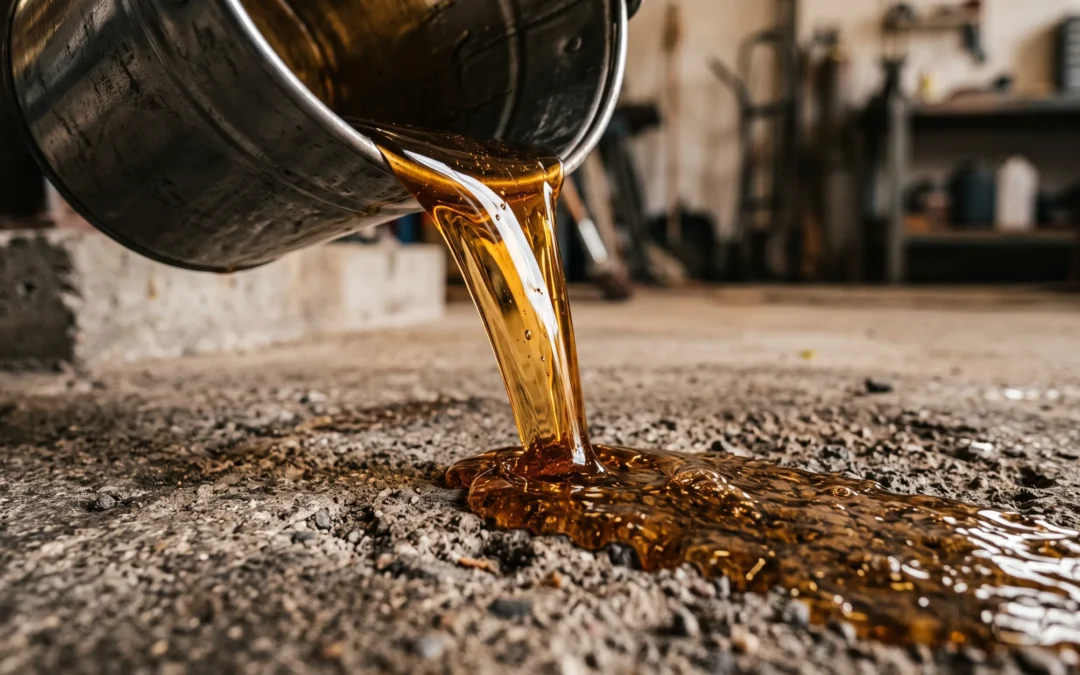
Here’s the short answer that clears up most of the confusion around this search: in an epoxy floor, there is no separate adhesive. The epoxy is the adhesive. The same two-part resin chemistry that holds airplane wings together and anchors bolts into bridge decks is what you’re spreading across the entire slab — a structural glue applied wall to wall, with the concrete as one surface and the finished floor as the other. Once you see it that way, everything about how epoxy floors succeed and fail starts making sense. As a company that manufactures its own epoxy systems and installs them across Southern California, we spend our days on both sides of that chemistry, so let’s unpack what the “adhesive” in epoxy flooring actually does.
Three Things People Mean by “Epoxy Flooring Adhesive”
Search this phrase and you’ll land on three different products, so it’s worth sorting them out before going further:
- The floor coating itself. This is the big one. Two-part epoxy — resin plus hardener — cures into a rigid thermoset layer that is chemically identical in principle to structural epoxy glue. Your floor coating is a giant, pigmented adhesive bond between concrete and the world.
- Epoxy adhesives for gluing flooring down. Some installers use two-part epoxy adhesives to bond sheet vinyl, rubber tiles or wood to concrete. That’s a legitimate product category, but it’s a glue for other flooring — not an epoxy floor.
- Epoxy repair adhesives. Injectable epoxies and epoxy mortars used to weld cracks and rebuild spalled concrete before coating. We use these constantly during epoxy floor repair work — they’re the reason a cracked slab doesn’t need to be replaced to be coated.
The rest of this article is about the first meaning, because that’s where the stakes are. When an epoxy floor performs for twenty years or peels in two, the difference is almost always in how well the adhesive — the coating — was allowed to do its job.
Why Epoxy Bonds Like a Structural Glue
Epoxy’s adhesive power comes from its cure. Mix the resin with the hardener and the molecules crosslink into a dense three-dimensional network — a reaction, not a drying process. While that reaction is underway, the liquid is doing something crucial: flowing into every pore, scratch and irregularity of the surface beneath it. When it hardens, it hardens inside the concrete’s texture, not just on top of it.
That produces two kinds of grip working together:
- The mechanical bond. Cured epoxy locked into millions of microscopic pores acts like millions of tiny anchors. This is the dominant bond in a floor system, and it is entirely dependent on the concrete’s surface texture — what the industry calls the bonding profile.
- The chemical bond. Epoxy also forms molecular-level attraction with the surface it wets, and it bonds chemically to other epoxy layers applied within the recoat window. This is how a basecoat, broadcast coat and topcoat fuse into one monolithic slab covering instead of a stack of separate films.
Pull-off tests tell the story in numbers. A properly bonded epoxy on prepared concrete doesn’t fail at the glue line at all — the concrete itself tears first, leaving a layer of slab stuck to the back of the coating. When the adhesive is stronger than the thing it’s holding, you’ve done it right.
The Bond Is Made Before the Epoxy Ever Touches the Floor
Here is the part that separates floors that last from floors that fail: an adhesive can only grip a surface that’s ready to be gripped. Concrete straight from the finisher’s trowel is smooth, dense at the surface, and usually contaminated — curing compounds, sealers, oil, tire residue. Epoxy applied to that surface has nothing to key into. It cures into a strong film sitting on a weak connection.
That’s why professional installation starts with diamond grinding. Grinding strips off the weak surface paste and contamination and leaves the slab uniformly textured — an open bonding profile the liquid epoxy can flood into. It’s the same logic as sanding wood before gluing a joint, scaled up to an entire floor. Our page on concrete grinding covers the process itself; the point here is that the grinder, not the bucket, is where the bond is won.
Acid etching, the shortcut recommended on bargain kits, roughens the surface chemically but leaves the weak paste layer in place and adds a rinse-water problem to a material that hates moisture during application. It’s the main reason so many weekend coatings fail at the bond line.
What Makes the Adhesive Let Go
Epoxy almost never fails as a material — cured epoxy is absurdly tough. Floors fail at the interface, and nearly every case traces to one of four causes:
- No bonding profile. Coated over smooth, sealed or unground concrete. The bond was never really formed.
- Contamination. Oil, silicone, dust or old sealer between the epoxy and the slab. Adhesives bond to what they touch — and they were touching the contamination, not the concrete.
- Moisture vapor pressure. Water vapor migrating up through the slab builds pressure under an impermeable coating and pushes it off. This is why our systems go down over a moisture-vapor-barrier epoxy basecoat rather than relying on the decorative layers to resist vapor.
- Heat cycling at the surface — hot-tire pickup. Hot tires expand a cheap, thin coating, then contract as they cool and literally peel it where they sit. It’s a bond failure triggered by heat and solved by proper preparation plus quality material thickness — which is why it plagues paint-like kits and not professional garage floor coatings.
If your current floor is already lifting, the pattern of the failure tells you which of these happened — we walk through that diagnosis in how to fix peeling epoxy flooring.
How the Adhesive Idea Shapes a Whole Floor System
Once you understand that every layer is glue, a professional system reads like an engineering diagram. The ground slab presents the bonding profile. The basecoat — the adhesive with the hardest job — penetrates it and locks on while blocking vapor from below. Into that wet adhesive we broadcast media, like a full-rejection flake broadcast, so the decorative layer is not stuck onto the floor but embedded in it. Then the topcoat, applied within the chemical bonding window, fuses over everything. The result is one continuous, crosslinked structure from the pores of the concrete to the wear surface.
Compare that with any flooring that relies on a separate glue line — vinyl planks, glued carpet, rubber tile. Those systems have a distinct weak interface where the flooring meets the adhesive meets the slab. An epoxy floor doesn’t have a weak interface, because the adhesive and the floor are the same material.
Frequently Asked Questions
Is epoxy flooring adhesive different from regular epoxy glue?
Chemically they’re close cousins — both are two-part thermoset resins that cure by crosslinking. Floor-grade epoxy is formulated to flow, self-level, resist abrasion and accept pigments and broadcast media, while hardware-store epoxy glue is formulated for small, fast, gap-filling bonds. You can’t substitute one for the other, but the bonding principle is identical.
Do I need to buy a separate adhesive to install an epoxy floor?
No. The epoxy coating bonds itself directly to prepared concrete — that self-bonding is the defining feature of resinous flooring. What you do need is preparation: diamond grinding to create the bonding profile the epoxy anchors into. A separate adhesive only enters the picture when gluing down a different flooring product, like vinyl or rubber, which is a different job entirely.
How strong is the bond between epoxy and concrete?
On properly ground concrete, stronger than the concrete itself. In pull-off adhesion testing, a well-installed system typically fails in the slab — chunks of concrete come up still attached to the coating — rather than at the bond line. That’s the benchmark professionals build to, and it’s why preparation matters more than any single product choice.
Why did my epoxy floor peel up if epoxy is such a strong adhesive?
Because the bond was never given a fair chance. Peeling almost always traces to unground or contaminated concrete, moisture vapor pushing up from below the slab, or a thin bargain coating surrendering to hot-tire pickup. The cure is mechanical preparation, moisture control in the basecoat, and adequate material — not stronger glue.
Top Epoxy Flooring is a Southern California manufacturer-installer: we formulate the VOC-free epoxy and polyaspartic systems we put on the floor, and we back residential installs with a limited lifetime warranty. Call (818) 945-0915 to book a free estimate.
Recent Comments