
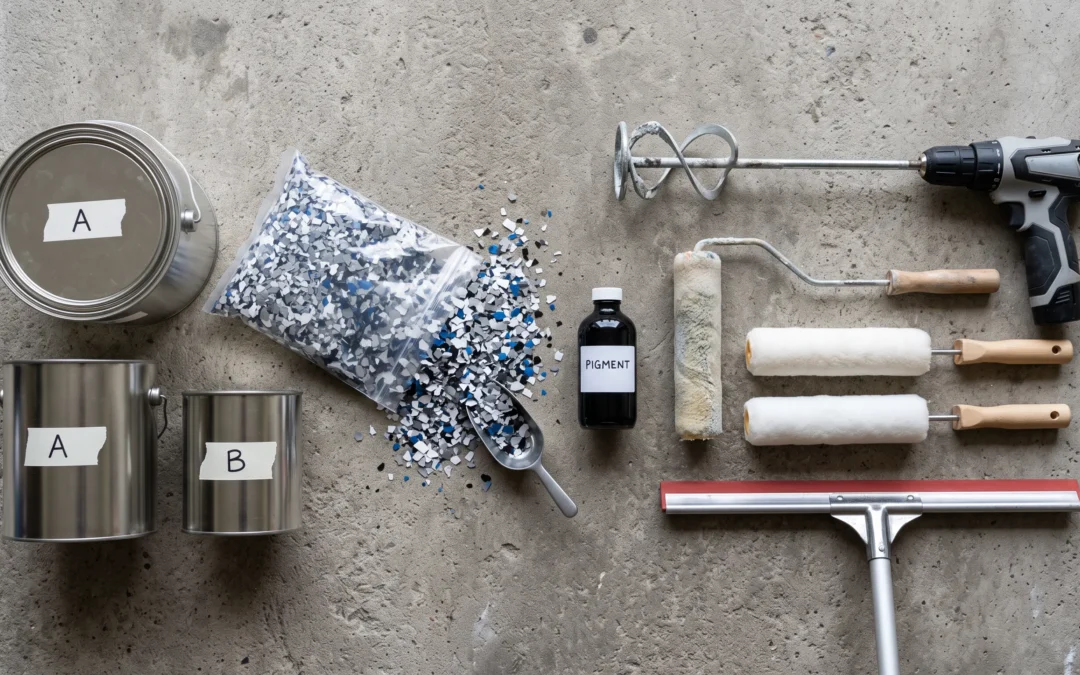
A typical epoxy flooring kit contains four things: a can of epoxy resin (Part A), a smaller can of hardener (Part B), a packet of decorative color flakes, and a surface prep pouch — usually citric or another mild acid for etching. Bigger kits add a clear topcoat, an anti-slip additive, and sometimes a roller and mixing stick. That list looks complete on the box. It isn’t. The materials a kit leaves out — and the concentration of the materials it includes — are exactly where a weekend floor and a professional floor part ways. We manufacture the materials our crews install, so we can walk you through both bills of materials honestly: what’s in the box, what each item actually does, and what the box doesn’t tell you.
The Core Materials, One by One
Part A: the epoxy resin
The body of the coating — a viscous liquid, usually pre-pigmented in kits. The number that matters here never appears in big print: solids content. Consumer kits are commonly water-based at roughly 40–60% solids, which means nearly half the liquid you roll out evaporates. Apply it at 6 mils wet and you’re left with about 3 mils of actual floor. Professional basecoats are 100% solids: every drop you put down stays down, curing at full applied thickness. Same word on the label — “epoxy” — dramatically different amount of material protecting your slab.
Part B: the hardener
The activator, typically an amine, that triggers the crosslinking cure. Its ratio to Part A is fixed by chemistry, and the formulation sets your working time — the minutes you have between mixing and the material stiffening in the bucket. Kits use slow, forgiving hardeners so first-timers don’t panic; the tradeoff is longer waits between coats and a softer early cure.
Decorative flakes
Vinyl color chips broadcast onto the wet basecoat for texture and appearance. Here the difference is sheer quantity. Kits include enough flake for a light sprinkle — the “confetti on gray” look. A professional flake floor uses a full-rejection flake broadcast: flakes are thrown until the wet basecoat physically cannot accept any more, covering the surface completely. That’s not just aesthetics. Full coverage adds thickness, hides slab imperfections, builds slip texture, and shields the basecoat itself. You can see the coverage difference on our epoxy flake flooring page.
The prep pouch: acid etch
The most misleading item in the box. Kits include acid because nobody buying a weekend kit owns a floor grinder, but etching is a poor substitute for mechanical preparation — it leaves the weak surface paste in place, struggles against sealers and contamination, and soaks the slab with rinse water right before you apply a moisture-sensitive coating. Professionals prepare with diamond grinding instead, and no professional bill of materials includes etching acid.
The clear topcoat (in better kits)
A sacrificial wear layer over the color coat. Kit topcoats are usually thin water-based epoxy or urethane. Professional systems finish with a UV-stable polyaspartic topcoat — a different resin family that cures fast, resists abrasion and chemicals harder than epoxy does, and doesn’t yellow in sunlight. On a garage that gets afternoon sun through the door, that last property alone decides how the floor looks in year five. More on that chemistry on our polyaspartic floor coating page.
Anti-slip additive
A small jar of fine aluminum oxide or polymer grit stirred into the topcoat for traction. Worth using — a smooth coated floor is slick when wet. On full flake floors much of the texture comes from the flake itself, with additive fine-tuning the grip.
What Professional Systems Add That No Kit Includes
Now the second list — the materials on our trucks that never appear in a box, because they solve problems a kit pretends don’t exist:
- Moisture-vapor-barrier epoxy basecoat. Ground moisture rising through the slab as vapor is the number-one killer of coated floors. Our systems start with a basecoat formulated to block it. Kits don’t address moisture at all — read the fine print and you’ll find it listed as a warranty exclusion instead.
- Crack and spall repair materials. Epoxy mortars, patching compounds and crack weld resins to rebuild damaged concrete before coating. Real slabs have real damage; coating over it just prints the damage through.
- Vertical coating material. Stem walls and step faces get coated too on a professional job — a detail that makes the finished space look built-in rather than painted-in.
- Pigment systems. We batch color rather than shipping one pre-tinted can, which is why a professional install offers dozens of flake blends and solid tones — browse the color chart — instead of the three or four SKUs on a shelf.
- Quantity headroom. Kits state coverage for perfectly smooth, non-porous concrete. Porous or freshly ground slabs drink more material. Pros carry surplus; kit users discover the shortfall at 8 p.m. with half a floor coated.
Reading a Kit Label Like a Manufacturer
If you’re evaluating a kit — or a low quote that’s really just kit material with labor attached — five checks tell you most of what you need to know:
- Solids percentage. 100% solids is the professional standard. “Water-based” or “high solids” without a number means thin.
- Stated film thickness. Look for dry mils, not wet. A durable garage system builds to many times the 3 mils typical of one-coat kits.
- Prep instructions. If the answer to preparation is an acid pouch, the manufacturer has priced the product for failure rates they can absorb.
- Moisture language. Search the warranty for the word “moisture.” Finding it under exclusions tells you what the coating can’t handle.
- Topcoat chemistry. No topcoat, or an unspecified “clear coat,” means the color layer is also the wear layer — it will scratch, stain and dull on schedule.
None of this means a kit can never work. A dry, sound slab, honestly prepared, coated by a careful owner who accepts a shorter service life — that’s a legitimate project, and we’ve said so plainly in our breakdown of whether a DIY garage floor epoxy kit is worth it. The mistake isn’t buying a kit; it’s expecting box materials to deliver system results.
Why Manufacturing Our Own Materials Changes the Math
Most installers buy coatings from a distributor, mark them up, and install what they bought. We formulate and manufacture our own — which does three things for the person whose floor it is. The materials are matched to each other, so basecoat, broadcast and topcoat are designed as one system rather than assembled from brands. The warranty has no finger-pointing gap between material maker and installer — we’re both, so our limited lifetime residential warranty covers the whole floor. And everything we make is VOC-free, so a garage floor coating install doesn’t gas out into the house attached to it.
Frequently Asked Questions
What materials are included in a standard epoxy floor kit?
Epoxy resin (Part A), hardener (Part B), a bag of decorative vinyl flakes, and an acid-etch prep pouch — with larger kits adding a clear topcoat, anti-slip grit and basic applicators. What kits omit is just as defining: no moisture-vapor barrier, no crack repair materials, and rarely a UV-stable topcoat.
What does “100% solids epoxy” mean and why does it matter?
It means the entire liquid volume cures into solid floor — nothing evaporates away. Water- and solvent-based kit epoxies can lose close to half their applied thickness as they dry, so a 100% solids basecoat leaves several times more protective material on the slab from the same wet coat. Thickness is durability in this business.
Are the flakes in epoxy kits just decoration?
No — at full coverage they’re structural. A full-rejection flake broadcast adds build thickness, hides trowel marks and repairs, creates slip-resistant texture, and shields the basecoat from UV and abrasion. The light sprinkle a kit’s flake bag allows delivers the look without most of those benefits.
Can I upgrade a kit with professional materials?
Partially. You can buy 100% solids products and better topcoats from specialty suppliers, but the two materials that matter most are hardest to source and use: mechanical preparation equipment and a true moisture-vapor-barrier basecoat. Without diamond grinding and moisture control, upgraded top layers are still standing on a kit-grade foundation.
As Southern California’s manufacturer-installer, Top Epoxy Flooring builds every floor from its own VOC-free materials — vapor-blocking basecoat to UV-stable polyaspartic finish — with a limited lifetime residential warranty behind it. Call (818) 945-0915 for a free estimate.
Recent Comments