
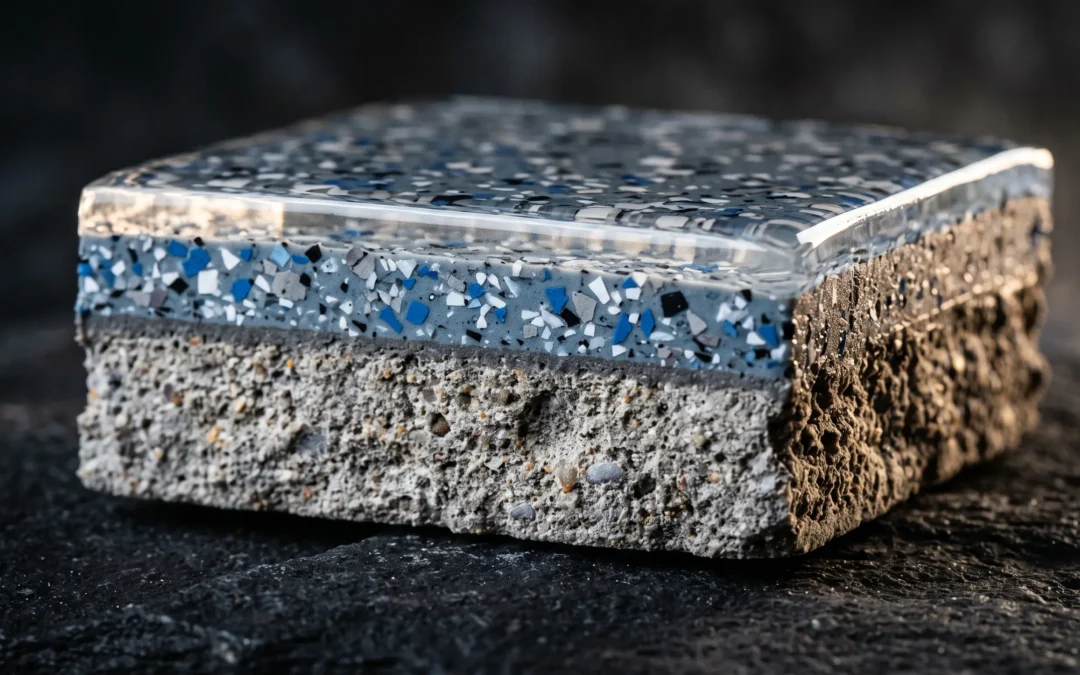
An epoxy flooring system is a stack of layers engineered to work together — prepared concrete at the bottom, a bonding basecoat, an optional broadcast or build layer in the middle, and a clear protective topcoat on top. Each layer has one job, and the system is only as good as its weakest one. This is the single most useful idea in the entire industry, because almost every epoxy horror story traces back to somebody treating a system as a product: buying “epoxy” in a can and skipping the layers that make it a floor. We’ve covered the finish types elsewhere; this post is about the anatomy underneath any of them.
A Floor Built in Layers, Like a Roof
Nobody nails shingles to bare rafters. A roof is decking, underlayment, flashing and shingles, each catching what the layer above lets through. An epoxy floor works the same way: the topcoat takes wear, the broadcast builds thickness and texture, the basecoat grips the slab and blocks moisture, and the prepared concrete gives everything something to hold. Take out any layer and the ones remaining inherit a job they weren’t designed for. As a manufacturer, we formulate each layer for its specific role — which is exactly why “one thick coat of the good stuff” is never the answer, no matter how good the stuff is.
Layer Zero: The Concrete Itself
The slab isn’t under the system; it’s part of it. Three things have to be true before any resin comes off the truck.
It must be open. Cured concrete has a hard, smooth skin of laitance, often with old sealers on top. Diamond grinding cuts that skin away and leaves a bonding profile — a fine, uniform roughness the basecoat keys into mechanically. This is a machine-and-dust-extraction operation; our concrete grinding page shows what’s involved.
It must be sound. Cracks, spalls and pitting get cut out, filled and profiled flush during prep, so the finished system is continuous.
It must be measured for moisture. Every slab passes water vapor upward; the question is how much. That reading decides whether the standard basecoat is enough or the system needs its moisture-defense version. Guessing here is how coatings get pushed off from below a year later.
The Basecoat: Where the System Grips
The basecoat is the structural heart of the stack — a 100% solids epoxy that flows into the ground surface, wets out the pore structure and cures into the slab rather than onto it. It carries the pigment on solid-color floors and acts as the glue bed for broadcast systems. On slabs where testing shows vapor drive, we install a moisture-vapor-barrier epoxy basecoat: same role, plus a rated defense against the vapor pressure that destroys ordinary coatings. Thickness here is not cosmetic. The basecoat’s cured film is what distributes loads, bridges hairlines, and gives the broadcast something to sink into — which is why formulations that dry down thin undermine everything above them.
The Build Layer: Broadcast Media and Body
Between basecoat and topcoat lives the layer that gives a system its name and its character. In a flake system, vinyl chips are broadcast to full rejection — thrown into the wet basecoat until it cannot hold another flake — then the cured excess is scraped and vacuumed off. In a quartz system, graded colored sand plays the same role with more bite. In self-leveling and slurry systems, the build layer is more resin itself, poured thick to flatten a worn slab. And in the simplest builds, this layer is skipped entirely on purpose — a legitimate choice for low-abuse spaces, as long as everyone knows that thickness and texture were traded away. The build layer is where a floor gets its grip, its camouflage and most of its mass.
The Topcoat: The Only Layer You Ever Touch
Everything you will ever see, walk on, spill on or drive over is the topcoat. Its job description: abrasion resistance, chemical resistance, UV stability, cleanability. Epoxy itself is a mediocre topcoat — tough but slow to cure and prone to ambering in sunlight — so a well-designed system switches chemistry at the finish line. We top our systems with a UV-stable polyaspartic floor coating: faster curing, clearer, and far more resistant to sun and scuffing. The topcoat is also the system’s renewable part. Years down the road, a worn floor usually doesn’t need replacing — it needs a fresh topcoat over an abraded surface, and the system underneath keeps working.
How the Layers Combine into Named Systems
Every product name you’ll hear in a quote is just a recipe from these ingredients:
- Thin-film system — prep + basecoat + topcoat. Clean and economical for storage rooms and light-duty space.
- Broadcast system — prep + basecoat + flake or quartz + topcoat. The standard garage floor coating and the backbone of most commercial work.
- Self-leveling / slurry system — prep + thick poured body + topcoat, for slabs that need a new flat surface, not just protection.
- Grind and seal — prep + clear sealer only, keeping the exposed-concrete look. Not an epoxy build at all, but priced against them constantly; see concrete grind and seal.
The recipe also sets the calendar. A broadcast flake garage is a one-day install; quartz runs one to two days; solid color two to three; metallic three to four, because its design layers each cure before the next goes down. When a bid promises a dramatically shorter schedule than the system it claims to include, one of the layers is quietly missing.
So when you compare quotes, don’t compare prices — compare recipes. Ask what prep method, what basecoat and at what thickness, what broadcast, what topcoat chemistry. Two “epoxy floors” with the same finish color can be entirely different systems, and the recipe is where the difference hides.
Frequently Asked Questions
How many layers does an epoxy floor have?
Typically three to four applied layers over prepared concrete: a basecoat, an optional broadcast or build layer, and one or two topcoats. Light-duty floors may run two layers; heavy industrial slurries may run more. The count matters less than each layer being the right material at the right thickness.
What is the most important layer in an epoxy system?
The one nobody sees: surface preparation. Diamond grinding determines whether the basecoat bonds into the slab or merely rests on it, and no topcoat can rescue a system that never gripped the concrete. After prep, the basecoat’s thickness and moisture handling matter most.
Why use a polyaspartic topcoat instead of epoxy all the way up?
Because chemistries have specialties. Epoxy is the superior basecoat — strong bond, high build — while polyaspartic is the superior finish: UV-stable, faster curing and more abrasion resistant. Using each where it wins is what lets a flake garage install in one day and stay clear in sunlight.
Can a worn epoxy system be renewed without replacing it?
Usually, yes. If the base layers are still bonded, the floor is abraded and a new topcoat is applied — restoring gloss, texture and protection at a fraction of a new system. That renewability is one of the strongest arguments for building a real system in the first place.
Top Epoxy Flooring manufactures every layer of its own systems — VOC-free basecoats, broadcasts and polyaspartic topcoats — and installs them across Southern California with a limited lifetime residential warranty. Call (818) 945-0915 for a free estimate.
Recent Comments