
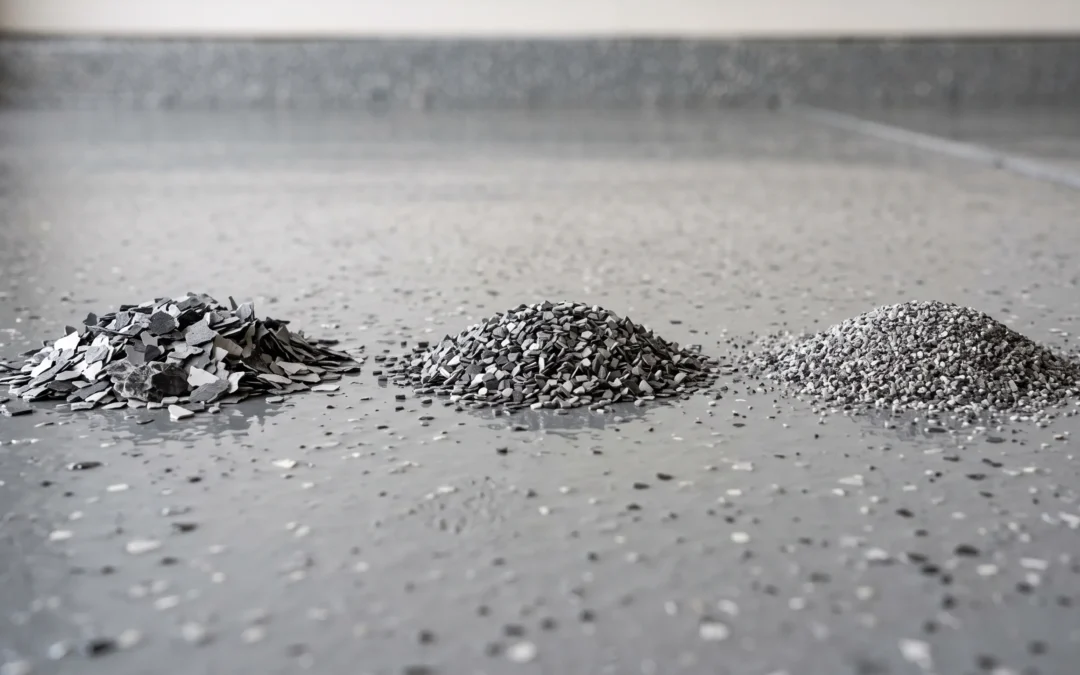
For most garages, the best epoxy chip style is a 1/4-inch multi-color blend applied as a full broadcast — it’s the size that balances texture, coverage, and camouflage, and the application style that guarantees a uniform, fully protected surface. But “most garages” hides real choices: chip size changes how the floor feels underfoot and how it cleans, blend style changes how it reads from the curb, and broadcast density changes almost everything about performance. We manufacture the coatings these chips ride on, so here’s the complete comparison — sizes, blends, and broadcast styles — without the catalog fog.
Chip Sizes Compared: 1/4″, 1/8″, and Fine
Vinyl chips come in a range of cuts, and the size drives both look and function:
- 1/4-inch — the standard. Bold, visible speckle that reads as terrazzo or granite from standing height. It gives the surface a light, pleasant texture, hides debris best because the pattern is large enough to break up shapes, and covers efficiently in a full broadcast. If you don’t have a strong reason to deviate, this is the size.
- 1/8-inch — the refined middle. A tighter, more uniform speckle that looks a touch more formal, like fine stone. Slightly smoother underfoot and a little easier to squeegee clean. Popular in garages that double as living or gym space.
- Fine (1/16-inch and smaller) — the quiet one. At normal viewing distance the floor reads almost as a textured solid color, with the speckle only apparent up close. Smoothest to clean; hides the least because the pattern is too small to disguise larger debris.
- Jumbo (1/2-inch to 1-inch) — the statement. A chunky, hand-scattered look with real visual drama. It suits showpieces, but big chips telegraph any unevenness in scatter and are the most texture-forward underfoot.
A useful rule: the bigger the chip, the better the camouflage and grip; the smaller the chip, the sleeker the look and the easier the cleaning. Mixed-size blends — 1/4″ with 1/8″ and fine chips together — split the difference and are increasingly what we install.
Blend Styles: How the Colors Are Built
Beyond size, chips are assembled into blends, and the blend architecture sets the floor’s character:
- Classic tri-color blends (gray/black/white, tan/brown/cream) — balanced, timeless, and the easiest to match to any garage. The bulk of residential installs.
- Dark-base accent blends — a charcoal or navy field with brighter accent chips flashing through. Reads sophisticated and hides workshop wear hardest.
- High-contrast blends — black-and-white or bold two-color mixes. Graphic and modern; shows a bit more dust than mid-tone mixes.
- Monochrome blends — several shades of a single hue. The most subtle style; the floor reads as rich texture rather than confetti.
Because we manufacture our own systems, blends aren’t locked to a supplier’s catalog — chips can be combined to order, and the basecoat is tinted to complement the blend so the micro-gaps between chips disappear. The standing lineup is on our color chart.
Full Broadcast vs. Partial Scatter — This One Isn’t Close
Chips can be applied two ways. A partial scatter sprinkles chips sparsely over a colored basecoat, leaving most of the coating exposed — it’s faster and uses a fraction of the material, which is why budget installs favor it. A full-rejection flake broadcast throws chips into the wet basecoat until the surface physically cannot accept any more, then the excess is scraped and vacuumed off before topcoating.
We install full rejection exclusively, and the reasons are structural, not aesthetic. A full broadcast builds a thicker, more impact-resistant wear layer; it makes the pattern perfectly uniform with no thin patches or “birthday cake sprinkle” look; and it means minor surface wear never exposes a naked basecoat, because there’s chip mass all the way through the profile. It’s the difference between a decorated coating and an engineered flake flooring system — and it still installs in one day.
What Sits Under and Over the Chips Matters More Than the Chips
Chip style is the visible decision; the sandwich around it is the durable one. Under the chips: concrete prepared by diamond grinding to open a bonding profile, then a moisture-vapor-barrier epoxy basecoat that anchors the chips and blocks slab moisture. Over them: a UV-stable polyaspartic topcoat that locks the broadcast in glass-like clear, resists hot-tire pickup, and never ambers in the Southern California sun. All materials are VOC-free and manufactured by us, and residential garage floor coating installs carry a limited lifetime warranty. A perfect chip blend over a skipped grind is a beautiful floor for about two summers; the stack is what makes it permanent.
So Which Style Is Best for You?
Fast answers: family garage with daily drivers — 1/4″ tri-color blend, full broadcast. Garage that doubles as living or gym space — 1/8″ or a mixed-size blend for a sleeker read. Heavy workshop — 1/4″ dark-base blend. Showpiece — jumbo chips or a high-contrast blend. When in doubt, look at physical samples on your own slab; chip blends shift with lighting just like paint, and we bring samples to every free estimate.
Frequently Asked Questions
What size epoxy chips are best for a garage floor?
1/4-inch chips are best for most garages — they hide debris well, give comfortable texture, and cover uniformly in a full broadcast. Choose 1/8-inch or a mixed-size blend for a sleeker, easier-to-clean surface in garages used as living space, and reserve fine chips for floors where a near-solid look matters more than camouflage.
What is the difference between full broadcast and partial chip application?
Full broadcast throws chips into the wet basecoat until it can’t accept more, creating a uniform, thicker, fully covered wear surface; partial scatter sprinkles chips sparsely and leaves most of the basecoat exposed. Full rejection costs more material but eliminates thin patches and adds impact resistance, which is why it’s the only method we install.
Do bigger epoxy chips make the floor rougher?
Slightly, yes. Larger chips leave more surface texture, which improves wet grip but catches a little more dirt in cleaning; smaller chips produce a smoother floor that squeegees clean faster. The topcoat moderates both — a properly applied polyaspartic clear rounds the texture so even 1/4-inch floors feel pleasant barefoot.
Can I customize my own chip blend and colors?
Yes. Because we manufacture our own coating systems, chip blends can be assembled from individual colors and sizes rather than picked from a fixed catalog, and the basecoat is tinted to complement the blend. Most clients start from a standard blend on our color chart and adjust the accent colors from there.
Top Epoxy Flooring manufactures and installs its own flake systems across Southern California — chips, basecoat, and topcoat all from one source, installed in a day. Call (818) 945-0915 for a free estimate and a side-by-side look at the blends.
Recent Comments