
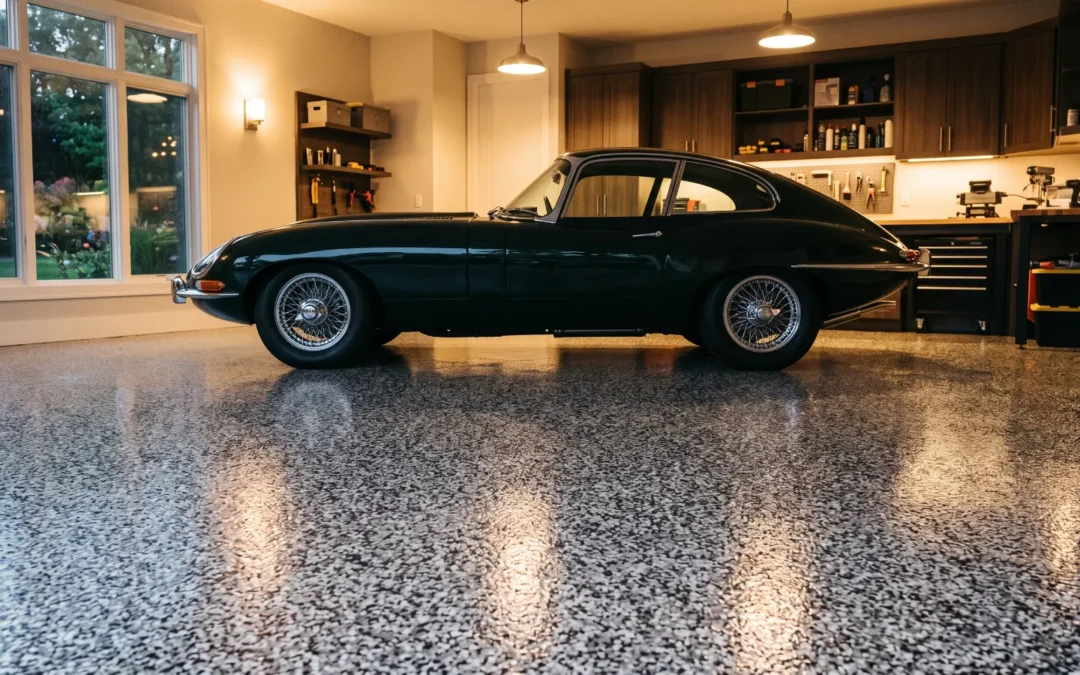
Ask ten flooring websites how long epoxy lasts and you’ll get the same vague answer: “10 to 20 years.” True — and useless, because the gap between a floor that dies in year two and one still glossy in year twenty-five isn’t luck. It’s five specific decisions made before and during installation. As a company that manufactures the coatings it installs, here’s the honest breakdown of what actually sets an epoxy floor’s expiration date.
The Short Answer, With the Ranges That Matter
- Big-box DIY kits in a working garage: 1–3 years before dulling, wear-through, or tire-path peeling.
- Professional multi-coat systems, residential garages: 15–20+ years — and the floor usually still looks good when it hits those numbers.
- Commercial and industrial floors: 8–15 years under real traffic, longer with scheduled topcoat refreshes.
- Outdoor coated surfaces: tied to the topcoat chemistry — UV-stable polyaspartic and urethane systems hold color and film for many years; ordinary epoxy ambers outdoors within one.
The Five Decisions That Set the Expiration Date
1. Surface preparation — the biggest one
Most coating failures trace to preparation, not products. Diamond grinding opens the slab into a bonding profile the coating can key into; skipping it (or acid-etching instead) means the floor’s lifespan was decided before the first coat dried.
2. Solids content and film build
100%-solids epoxy leaves everything you apply on the floor as thickness; water-based kit epoxy evaporates half away. Thickness is lifespan: it’s the sacrificial material between the world and your concrete.
3. The topcoat — your floor’s actual wear surface
The epoxy body gives build; the clear topcoat takes the abuse. A UV-stable polyaspartic topcoat resists hot tires, sunlight, chemicals and abrasion far beyond bare epoxy — it’s the single biggest upgrade in system longevity. Our residential flake floors carry two of them.
4. Moisture handling
Ground moisture destroys coatings from below, and no maintenance can save a floor installed over an unaddressed damp slab. A moisture test before installation — and a vapor-barrier basecoat when the numbers call for it — is the difference between decades and months on many Southern California slabs.
5. Maintenance — small, but real
Epoxy asks almost nothing: dust-mop the grit, use pH-neutral cleaners, skip the citrus and abrasives. Done, that’s the whole program — and it’s worth years. The one professional habit that extends life indefinitely: a topcoat refresh when gloss finally dulls, which renews the wear layer for a fraction of any reinstall.
How Floors Actually Age (So You Know What You’re Seeing)
A quality floor’s aging is boring: years of nothing, then a slow satin-ing of the gloss in the traffic lanes. That dulling is the topcoat doing its sacrificial job — and the signal to schedule a refresh, not a replacement. What aging should NOT look like: peeling, blistering, or chips spreading from cracks. Those aren’t age — they’re failures with diagnosable causes, usually prep or moisture, and they show up early, not late.
Epoxy vs. the Alternatives, on Lifespan Alone
- Garage floor paint: 1–2 years. Not comparable — different product category.
- Interlocking tiles: the tiles last, but they shift, stain beneath, and trap moisture against the slab.
- Bare sealed concrete: reseal every couple of years, forever.
- A professional coating system: installed once, warrantied — ours for the life of the residential floor — and refreshed, not replaced, when the decades finally show.
Frequently Asked Questions
Does epoxy flooring last longer than tile or paint in a garage?
Dramatically longer than paint (years vs. decades) and more gracefully than tile, which shifts and traps moisture. A professional coating is the only option in the group that’s warrantied for life on residential floors.
What shortens an epoxy floor’s life the most?
Skipped surface preparation, followed by untreated slab moisture. Both are invisible on day one and decisive by year three.
Can an old dull epoxy floor be renewed without replacing it?
Yes — if the coating is still bonded, a professional clean, light abrasion, and a fresh topcoat restore gloss and reset the wear layer in about a day.
How long does epoxy last outdoors?
Standard epoxy ambers in sunlight within a year — outdoors belongs to UV-stable chemistry. Our exterior systems finish in polyaspartic and urethane topcoats built for full sun.
Top Epoxy Flooring manufactures and installs its own coating systems across Southern California, with a limited lifetime warranty on residential installations — because when you control every one of the five decisions above, you can afford to. Free onsite estimates: (818) 945-0915.
Recent Comments