
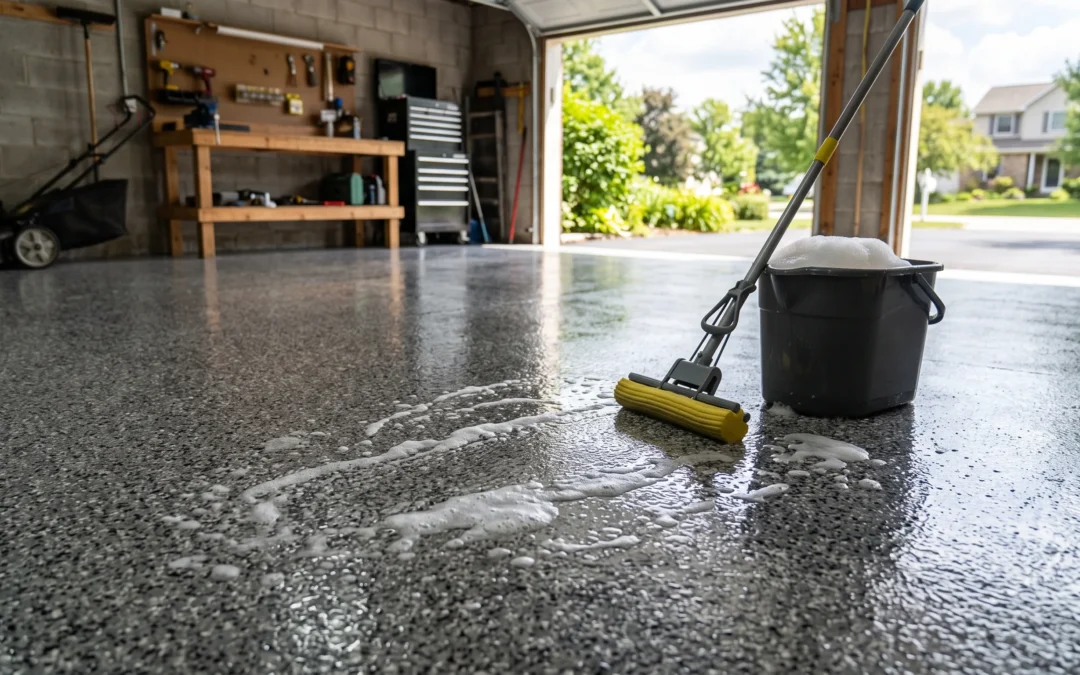
Cleaning garage floor epoxy comes down to three habits: dust-mop or blow out the grit weekly, wet-mop with a pH-neutral cleaner in warm water when the floor looks dull, and wipe automotive fluids up the day they drip. That’s genuinely the whole program — a coated garage is the easiest floor in your house to keep clean, because it’s seamless, non-porous, and nothing soaks in. What deserves more explanation is the garage-specific stuff this floor is up against: engine oil, tire compounds, brake dust, and the road grime a daily driver drags in. We install garage floor coatings across Southern California using systems we manufacture ourselves, so below is the cleaning advice we actually give our customers at handoff — including the short list of products that will damage the finish.
Why a Garage Floor Gets Dirty Differently
A garage isn’t a kitchen. The soil load here is abrasive and automotive: sandy grit off tires that acts like loose sandpaper underfoot, fine black brake dust that shadows the parking area, oil and coolant drips, rubber transferred by hot tires, and — for anyone who drives to the snow in winter — road salt and de-icer residue carried home in the wheel wells. None of these can penetrate a properly sealed epoxy surface. All of them sit on top of it, which is exactly where your mop can reach them. The goal of a cleaning routine is simple: get the abrasives off before traffic grinds them against the topcoat, and get the chemicals off before they build into a film.
The Weekly Two-Minute Pass
Grit removal is the highest-value cleaning you can do, and it’s the fastest:
- Run a wide dust mop or soft-bristle push broom across the parking lanes and walk paths, or
- Blow the floor out with a leaf blower — open the garage door, start at the back, done in ninety seconds. On a textured flake floor this beats a broom, since a full-rejection flake broadcast has a pebbled surface that grit likes to sit down into, and moving air pulls it out of the texture better than bristles do.
A shop vacuum with a floor brush is the third option and the best of all for corners and along the stem walls where debris collects.
The Deeper Wash, When the Floor Needs It
Once a month for a working garage — less often for a showpiece — give it a wet clean:
- Clear and dry-clean first. Move the cars out, then dust-mop or blow the loose debris so you’re not pushing mud around.
- Mix a pH-neutral solution. A few ounces of pH-neutral floor cleaner per gallon of warm water. Old-school alternative: about a half cup of clear ammonia per gallon. Either is safe for the finish.
- Mop with microfiber or foam. Work in overlapping passes. For a heavily soiled floor, a soft-bristle deck brush on a pole handles the texture of a flake surface without scratching.
- Rinse. A garden hose is the garage’s advantage — rinse toward the door, and the residue leaves the building. Skipping the rinse leaves a soap film that dulls gloss and gets slippery.
- Squeegee dry. A floor squeegee pushes the water out in a minute and prevents mineral spotting from hard water — a real consideration in most of Southern California.
The Garage Stain Playbook
Oil, transmission fluid and coolant
The best news about epoxy: these can’t soak in the way they do into bare concrete. Fresh drips wipe up with a paper towel. For a drip that’s sat for a week, wet the spot with your neutral cleaner solution, let it sit a few minutes, scrub with a nylon pad and rinse. A dedicated degreaser is fine for chronic drip zones — choose one labeled safe for coated floors and rinse it thoroughly.
Tire marks and rubber transfer
Black scuffs where the tires sit or turn are transferred rubber, not damage. Most come off with concentrated neutral cleaner and a stiff nylon brush. Stubborn marks respond to a soft cloth with a small amount of degreaser. What you should not see is the coating itself moving with the tire — actual hot-tire pickup, where the coating delaminates under a warm tire, is an installation failure of thin coatings, not a cleaning problem, and no cleaner causes or cures it.
Brake dust shadow
The gray-black haze that builds near the wheels wipes off with the standard wash. It shows sooner on light solid-color floors than on flake, which is one reason flake blends are the default recommendation for daily-driver garages.
Road salt and de-icer residue
After a trip to the mountains, the white crusty film that dries off the car onto the floor is salt. It won’t attack the epoxy the way it attacks bare concrete — no spalling, no pitting — but leaving it invites it to be ground in by traffic and tracked into the house. Mop with warm water, rinse, squeegee. Done.
Battery acid and harsh chemicals
Epoxy resists brief chemical contact far better than concrete, but nothing improves by marinating. Neutralize and rinse any battery electrolyte, pool chemicals or solvent spills promptly.
What Never Touches an Epoxy Garage Floor
- Vinegar and citrus cleaners — the acids slowly haze and dull the gloss.
- Abrasive pads, steel wool, scouring powder — they scratch the topcoat; nylon is the hardest scrubbing material the floor should meet.
- Soap-based mop products — they leave a film that kills the shine and turns slick when wet.
- High-pressure washing at close range — a garden hose is plenty; concentrated pressure at a chip or seam edge can find a weakness you didn’t know was there.
- Solvent soaks — wiping a spot with a solvent-damp rag is fine; pouring solvent to “deep clean” is not.
Cleaning Is Also Your Early-Warning System
The monthly wash doubles as an inspection. While the floor is bare and wet-shiny, look for the things worth catching early: a chip at the door threshold, a dull track forming where the tires roll, a spot where water suddenly behaves differently. A coating under our limited lifetime residential warranty is built to shrug these years off, but any coated floor lasts longer when small damage is dealt with small. For the bigger picture beyond cleaning — inspection habits, recoat timing and repair triggers — see our epoxy floor maintenance page, and if you’ve spotted damage rather than dirt, start with epoxy floor repair instead of the mop.
Frequently Asked Questions
What is the best cleaner for an epoxy garage floor?
A pH-neutral floor cleaner diluted in warm water — or roughly half a cup of clear ammonia per gallon of water as a pantry alternative. Both lift automotive grime without attacking the topcoat. Avoid vinegar, citrus and soap-based products: the acids dull the finish and the soaps leave a slippery film.
How do I get oil stains off garage floor epoxy?
Wipe fresh drips with a paper towel — they can’t penetrate the coating. For older spots, soak the area with pH-neutral cleaner solution for a few minutes, scrub with a nylon pad and rinse. A coated-floor-safe degreaser handles chronic drip zones. If a stain has genuinely discolored the coating, that patch of topcoat is damaged, not dirty — a repair question rather than a cleaning one.
Can I pressure wash my epoxy garage floor?
A garden hose with a spray nozzle is all a coated garage needs, and it’s the safer choice. Moderate pressure washing won’t hurt an intact floor, but concentrated close-range pressure can exploit any chip or edge and start lifting a coating you’d rather keep sealed. Hose, deck brush, squeegee — that combination cleans everything a garage produces.
Why does my epoxy floor look dull even after cleaning?
Usually residue, not wear: soap film from the wrong cleaner or hard-water minerals from skipped rinsing both flatten the gloss. Re-wash with fresh pH-neutral solution, rinse well and squeegee dry. If the dullness survives that and sits in the traffic lanes, it’s honest abrasion of the topcoat — the signal to ask about a refresh coat rather than scrub harder.
Top Epoxy Flooring manufactures and installs VOC-free garage coating systems across Southern California, finished with UV-stable polyaspartic topcoats and backed by a limited lifetime residential warranty. Call (818) 945-0915 for a free estimate.
Recent Comments