
Installing epoxy over concrete succeeds or fails on the concrete, not the epoxy. Before any coating goes down, the slab has to pass four checks: it must be fully cured, dry enough (or coated with a moisture-rated basecoat), free of sealers and contamination, and structurally sound. Resin chemistry has been reliable for decades — when a floor over concrete peels or blisters, the substrate almost always wrote that ending before the first bucket was opened. So this guide runs in the order a professional actually thinks: read the slab first, then coat it.
Check 1: Is the Concrete Cured Enough to Coat?
New concrete needs a minimum of 28 days before coating — that’s the industry-standard cure benchmark, and on thick slabs or in cool weather, longer is safer. Green concrete is still releasing large amounts of water as it hydrates, and epoxy applied over it gets pushed off from below or traps moisture that clouds the film. New pours also carry laitance: a weak, chalky skin of fines that floats to the surface during finishing. It looks like solid concrete and it is not — coat over laitance and the coating bonds beautifully to a layer that itself isn’t bonded to anything. Diamond grinding removes it entirely, which is one more reason grinding is the professional standard; our concrete grinding page covers the process.
Check 2: Moisture — the Silent Coating Killer
Concrete is a sponge connected to the ground. On slabs without an intact vapor barrier beneath them — common in older Southern California homes — water vapor migrates upward constantly, and a non-breathable coating becomes the lid it pushes against. This is how you get blisters, milky patches, and coatings that release in sheets a year in.
Test before you coat. In rough order of rigor:
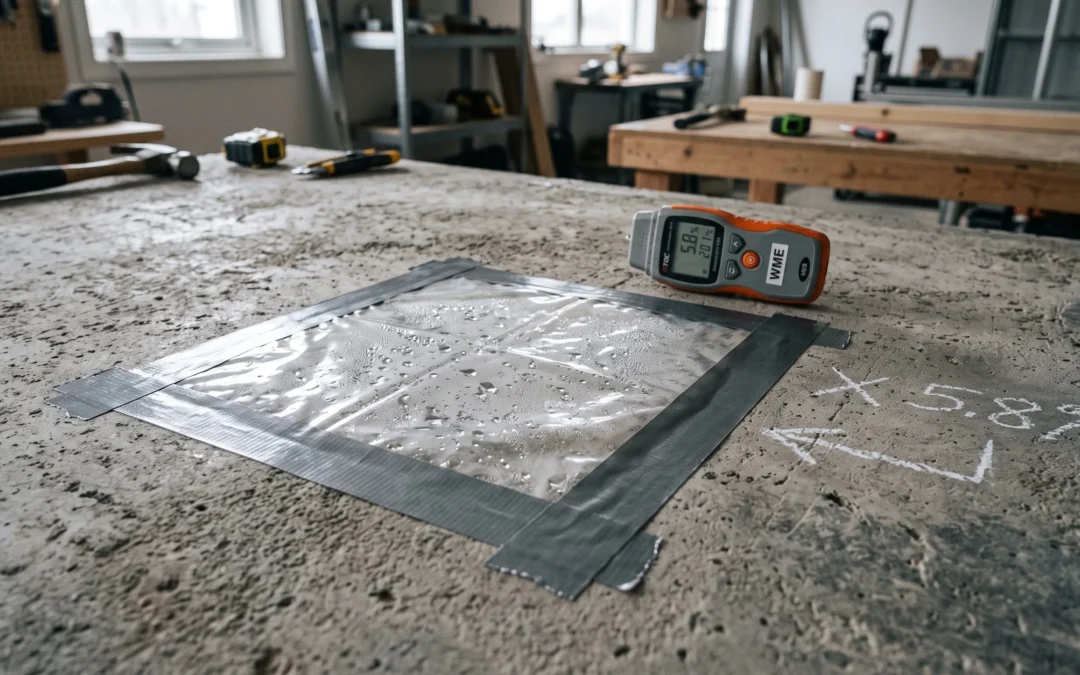
- Plastic-sheet test: tape a square of plastic sheeting tightly to the slab and wait 24 hours. Condensation or a dark damp spot underneath means active vapor drive.
- Calcium chloride test: a sealed dish of desiccant measures how many pounds of moisture a thousand square feet emits in 24 hours — the number coating spec sheets actually reference.
- In-slab RH probes: the commercial-grade answer, reading relative humidity inside the concrete itself.
A moisture reading is not a rejection — it’s a specification. It means the system starts with a moisture-vapor-barrier epoxy basecoat engineered to hold back vapor pressure, rather than a standard basecoat that can’t. Because we manufacture our own systems, this swap is routine on our installs; with a store kit, there is no such option in the box.
Check 3: Sealers, Curing Compounds and Old Coatings
Many slabs were treated at pour time with a curing compound, or sealed years later — and nothing bonds well to a sealer. The test takes ten seconds: pour water on the bare concrete. If it soaks in and darkens the slab, the surface is open. If it beads or sits, something is on there, and every trace has to be ground off before coating. The same goes for old paint and previous coatings: a new floor is only ever as attached as whatever it’s sitting on, which is exactly how the failures in peeling epoxy floors usually start.
Check 4: Cracks, Spalls and Slab Condition
Concrete defects come in three grades, and each gets different treatment:
- Hairline and shrinkage cracks — cosmetic and stable. Routed, filled with rigid repair material, ground flush, then coated over. Invisible in the finished floor.
- Spalls, popouts and surface erosion — patched individually, or on badly weathered slabs, corrected across the whole surface with concrete resurfacing or self-leveling concrete so the coating goes over a uniform plane.
- Active structural cracks — cracks that are still moving, with vertical displacement between the sides. No coating bridges a moving crack; the movement reprints through. These need the underlying cause addressed first, and honest contractors say so at the estimate rather than after the failure.
The Installation Itself, Once the Slab Passes
With the substrate verified, the install is the straightforward part: grind the entire surface to open a bonding profile, vacuum meticulously, make the repairs, roll the basecoat (moisture-rated where the tests said so), broadcast flake or quartz into the wet resin, scrape and vacuum once cured, and seal it all under a UV-stable polyaspartic topcoat. On our crews that’s a single day for a flake system over a sound slab — because all the uncertainty was eliminated before coating day, not discovered during it.
The Honest Summary
Epoxy over concrete is the most proven resinous flooring pairing there is — when the concrete is treated as a substrate to be qualified, not just a surface to be covered. If you take one thing from this page: test for moisture and test for sealer before you commit a weekend or a contract. Both tests cost almost nothing, and both failures cost the entire floor. If your slab raises questions you can’t answer, that’s precisely what a free professional evaluation is for.
Frequently Asked Questions
How long should new concrete cure before epoxy is installed?
At least 28 days is the standard benchmark, and cool or damp conditions justify more. Coating green concrete traps hydration moisture under the film and is one of the most reliable ways to blister a brand-new floor.
How do I know if my concrete slab has a moisture problem?
Tape a square of plastic sheeting to the bare slab for 24 hours — condensation or darkened concrete underneath means vapor is rising. White mineral deposits (efflorescence) and musty, damp-smelling concrete are the same warning. A calcium chloride test puts a number on it.
Can epoxy be installed over previously sealed concrete?
Yes, but only after the sealer is completely ground off — epoxy will not form a reliable bond to any cure-and-seal, densifier film, or old paint. If water beads on your slab instead of soaking in, plan on grinding before anything else.
Does cracked concrete need to be replaced before coating?
Rarely. Stable cracks and spalls are routine repairs that disappear under the finished system, and worn surfaces can be resurfaced or self-leveled. Replacement only enters the conversation when the slab is actively moving or structurally failing.
Top Epoxy Flooring manufactures its own moisture-vapor-barrier basecoats and VOC-free coating systems and installs them across Southern California — limited lifetime residential warranty. Call (818) 945-0915 for a free slab evaluation and estimate.
Recent Comments