
Installing epoxy flooring means the same five phases wherever you do it: prepare the concrete mechanically, repair its defects, apply a bonded basecoat, build the decorative layer, and seal it under a clear wear coat. What changes is not the sequence but the engineering around it — a basement install is a moisture problem, a kitchen install is a chemistry problem, a commercial install is a downtime problem. Most guides only ever describe a garage. This one covers how the install actually adapts to each space, because we manufacture our own coating systems and put them into all of them, every week.
The Five Phases Every Epoxy Install Shares
Whatever the room, a legitimate installation walks through the same gates, in the same order:
- Mechanical preparation. Diamond grinding removes the slab’s weak surface layer and opens a bonding profile. Coatings fail from the bottom up, and this phase is the bottom.
- Repairs. Cracks, spalls, and gouges get filled with rigid patch material; badly worn slabs may need concrete resurfacing before any coating is sensible.
- Basecoat. The pigmented structural layer, bonded directly into the ground concrete. On slabs with moisture readings, this becomes a moisture-vapor-barrier epoxy basecoat.
- Decorative build. Flake broadcast, metallic pigment work, quartz, or simply more solid color, depending on the system.
- Topcoat. A clear UV-stable polyaspartic layer that takes all the wear. Skipping it is the most common corner cut in cheap installs.
Hold any quote — or any DIY plan — against those five phases. Whichever one is missing is where the floor will fail.
Installing Epoxy in a Garage
The garage is the classic case and the most forgiving room: open access, easy ventilation, nothing to mask off but the walls. The specific demands are hot-tire pickup resistance and abrasion, which is why garage floor coating systems lean on full-thickness basecoats and polyaspartic topcoats. A flake system here installs in a single day.
Installing Epoxy in a Basement
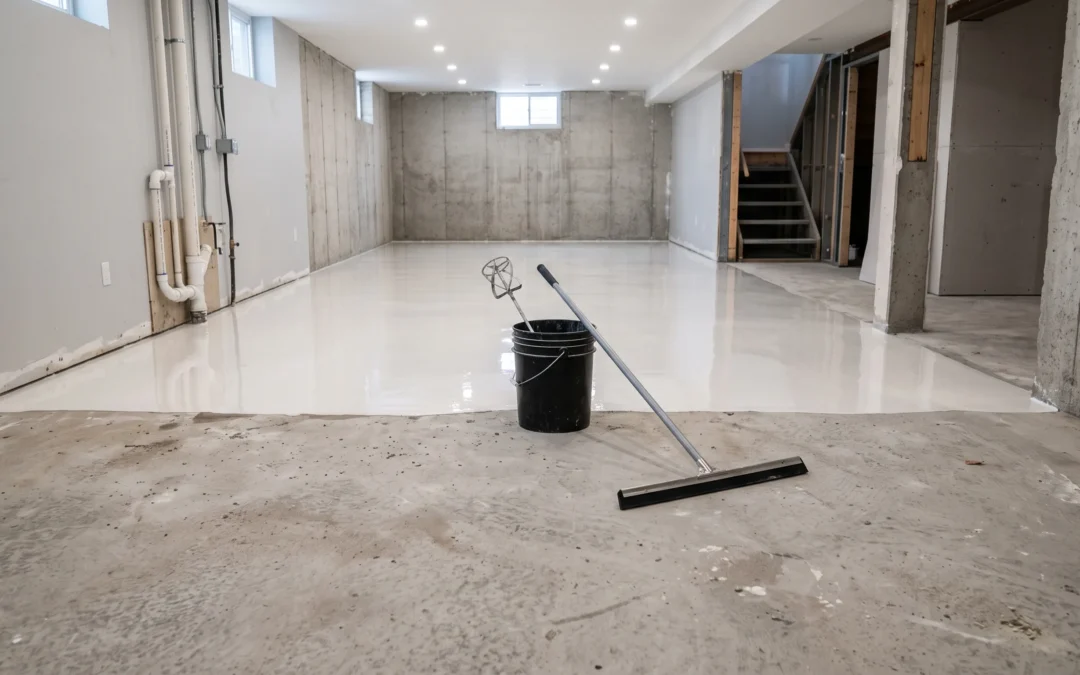
Below grade, the enemy is water vapor pushing up through the slab. Basements skip the “is there moisture?” question — assume there is, test to confirm how much, and spec the basecoat accordingly. This is the room where a moisture-vapor-barrier epoxy basecoat earns its name, and where a coating chosen by price alone blisters within a year. The upside: a seamless, non-porous basement floor coating is one of the few finished floors that shrugs off the occasional water heater leak instead of being destroyed by it. Ventilation planning matters more here too; our materials are VOC-free, which is not a small thing in a room with two window wells.
Installing Epoxy in a Kitchen or Living Space
Interior living areas flip the priorities: appearance first, with durability assumed. This is where metallic epoxy floors live — hand-worked pigments in clear resin that finish like polished stone — and where flatness becomes visible in a way a garage never shows. Waves and dips telegraph straight through a glossy finish, so uneven slabs get self-leveling concrete before coating. A kitchen epoxy floor adds its own demands: resistance to hot spills, oils, and constant washing, with no grout lines to harbor anything. Expect these installs to run longer than a garage — a metallic system takes 3 to 4 days because each poured layer needs its cure before the next.
Installing Epoxy in Commercial and Industrial Spaces
Commercial installs are scheduled around the business, not the coating. Warehouses, showrooms, and shop floors need thicker builds, line striping, sometimes slope-to-drain work — and above all a fast return to service, which is why polyaspartic and quartz systems dominate: a quartz floor installs in 1 to 2 days. Substrate condition is usually the wild card; decades of forklifts and unknown past coatings mean the grinding phase runs heavier equipment for longer. Details are on our commercial and industrial flooring page. Warranty differs here too: our residential work carries a limited lifetime warranty, commercial carries three years.
Should You Install It Yourself?
An honest split: a garage is a realistic DIY project for a patient homeowner with a rented grinder and a quality kit — the results won’t match a manufactured system, but they can be respectable. A basement is riskier because moisture failures don’t show up until the coating is on. Kitchens, living rooms, and metallic finishes are craft work; the pigment manipulation and dead-flat prep are not first-timer territory. And commercial floors carry consequences — downtime, liability, warranty — that make professional installation the only serious option. Wherever you land, the five phases don’t change; only who executes them does.
Frequently Asked Questions
Can epoxy flooring be installed over tile or wood?
Epoxy wants concrete. Coating over tile is occasionally done commercially with heavy preparation, but grout lines telegraph through and adhesion is a gamble; wood subfloors flex too much and are not a candidate. The right path is usually removing the old floor and coating the slab beneath it.
How long after installation can you walk on epoxy flooring?
Light foot traffic is typically fine 12 to 24 hours after the topcoat, depending on the chemistry — polyaspartic topcoats are on the fast end. Furniture and heavy use wait for the full cure on the product’s data sheet, usually two to seven days.
Which rooms are a poor fit for epoxy flooring?
Rooms without a concrete substrate, and slabs with unresolved structural movement. Bedrooms over wood framing, for example, are out. Nearly every room over a sound slab — garage, basement, kitchen, laundry, living areas — is a legitimate candidate once moisture and flatness are addressed.
Do I need to leave the house during an epoxy installation?
Not with modern VOC-free materials — occupied-home installs are routine. The practical constraint is simply keeping people and pets off the wet room and giving it airflow, not evacuating the building the way old solvent-heavy coatings once required.
Top Epoxy Flooring manufactures its own VOC-free epoxy and polyaspartic systems and installs them in garages, basements, kitchens and commercial buildings across Southern California. Call (818) 945-0915 for a free estimate on any room.
Recent Comments