
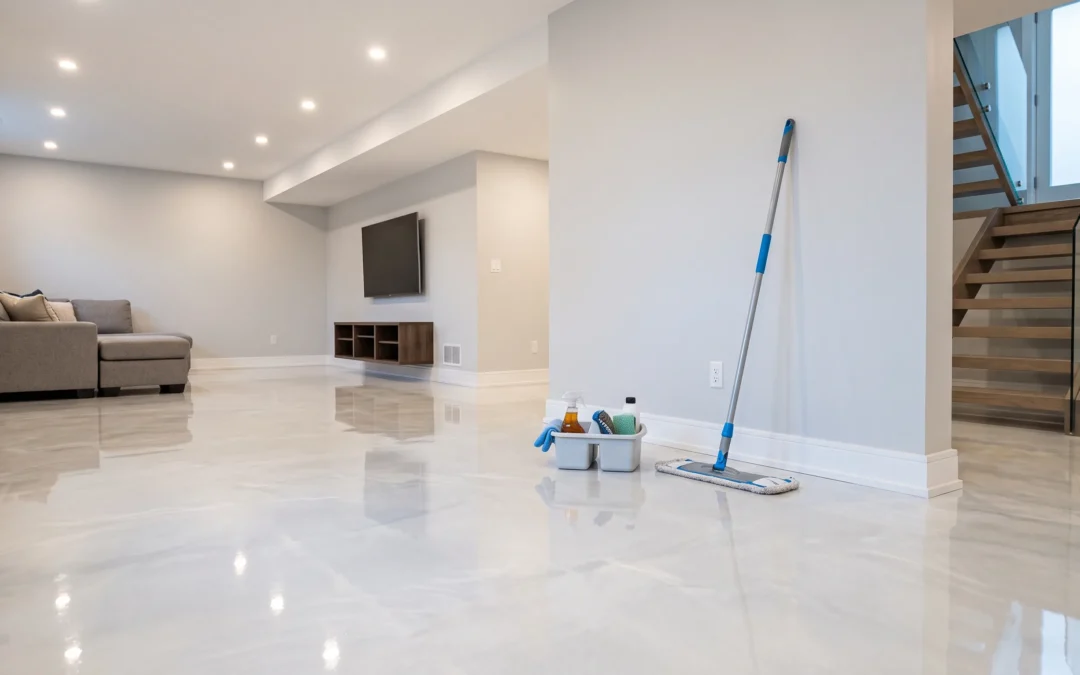
Maintaining epoxy flooring takes a schedule, not a product: keep grit off it often, wash it gently and occasionally, protect it at its contact points, and refresh the topcoat when wear finally shows — years out. That four-part program is the same whether the epoxy is in a garage, a kitchen, a basement or a warehouse aisle; only the frequency changes with traffic. This guide lays out the full program the way we hand it to customers: a maintenance calendar first, then the adjustments for each space in a home, then the additions that commercial floors demand. We manufacture the coating systems we install across Southern California, so this is maintenance advice from the people who formulated the surface you’re maintaining.
The Maintenance Calendar
Daily to weekly: manage the abrasives
Nothing wears a resinous floor faster than hard grit ground underfoot. A microfiber dust mop in living spaces, a soft push broom or vacuum in utility spaces — frequency scales with how much traffic carries debris in. This single habit protects the gloss more than everything else on the calendar combined.
Weekly to monthly: the gentle wash
Warm water with a pH-neutral cleaner, applied with a microfiber mop, then rinsed. High-traffic floors earn a weekly pass; a guest-room-adjacent basement might need it monthly. Two rules carry across every space: no acidic cleaners (vinegar, citrus — they haze the finish over time) and no soap-heavy products (they film over the gloss and get slick).
Immediately, always: spills
Epoxy’s non-porous surface means spills sit on top waiting to be wiped — the floor gives you all the time you need with water and most household spills. Chemistry with an attitude — solvents, battery acid, concentrated pool chlorine — should still come up promptly and get a rinse.
Quarterly: walk the floor
Four times a year, look at the floor deliberately. Chips at thresholds, hairline lines telegraphing from the slab, gloss going flat in a traffic lane, any spot where the coating sounds hollow under a tap. Every major epoxy problem was once a minor one; the quarterly walk is how you meet them while they’re minor. Our epoxy floor maintenance page has the full inspection list.
Every few years: the professional refresh
Topcoats are sacrificial by design — they take the abrasion so the structural layers never do. When gloss loss and fine scratching accumulate, a professional recoat renews the wear surface without disturbing the system underneath. This cycle is what turns a good floor into a decades-long one, and it’s far cheaper in effort than ever replacing a floor.
Room by Room: Maintaining Epoxy Through a Home
Kitchens
The busiest interior epoxy in the house sees dropped cookware, splashed oil and constant foot traffic. Maintenance advantage: a seamless kitchen epoxy floor has no grout lines, so there’s nothing to seal, bleach or scrub with a toothbrush — the entire cleaning program is the dust mop and the neutral wash. Put felt pads under stools and use a mat at the sink where dropped items and standing drips concentrate.
Living areas
Decorative floors — especially metallic finishes in living room epoxy flooring — are maintained like fine furniture: felt pads under every chair and table leg, lift rather than drag when rearranging, and a walk-off mat at exterior doors so shoe grit never reaches the finish. The gloss on these floors is the design, so grit control is the whole game.
Basements
The maintenance issue here isn’t traffic — it’s water. A coated basement handles humidity and minor moisture events far better than any flooring it replaced, but maintenance means watching the slab’s behavior: efflorescence at the perimeter, condensation patterns, a musty edge. A properly built basement floor coating over a moisture-vapor-barrier epoxy basecoat is designed for this environment; your job is just to keep gutters, grading and any leaks from changing the environment the system was built for.
Outdoor coated concrete
Patios, pool decks and driveways add sun and weather to the equation. The maintenance additions are modest: hose off leaf litter before it stains, rinse pool chemical splash, and let the UV-stable polyaspartic topcoat do its job — it’s the layer that keeps outdoor color from chalking and ambering. Outdoor systems carry a 3-year warranty and appreciate a seasonal rinse the way indoor floors appreciate a dust mop.
Commercial Floors: The Same Program, Professionalized
Everything above applies to a showroom or warehouse — then the traffic multiplies it. Commercial and industrial epoxy floors add four disciplines:
- Mechanized cleaning. Auto-scrubbers with soft brushes or red pads and neutral detergent replace the mop at scale. The machine’s pads matter: aggressive stripping pads are for tile, not resinous coatings.
- Wheel management. Forklifts and carts concentrate wear into lanes. Keep wheels clean and debris-free — a chip of steel embedded in a polyurethane wheel machines a groove into any coating it rolls over. Hard nylon casters get swapped for softer non-marking ones where possible.
- Zone-based recoat cycles. Traffic aisles wear years faster than the space under racking. Smart facilities recoat lanes on their own schedule instead of waiting for the whole floor to age to the worst zone’s condition.
- Documentation. Logging cleanings and inspections isn’t bureaucracy — in food, beverage and healthcare spaces it’s compliance, and everywhere it converts “the floor seems duller?” into data you can plan a recoat around.
The Three Maintenance Mistakes That Shorten a Floor’s Life
- Treating the finish as invincible. Epoxy is the most durable finished floor most people will own — and it’s still a finish. Dragging a loaded toolbox or letting sand pile at a doorway wears anything.
- Wrong chemistry, repeated. One vinegar mopping does nothing visible. A year of weekly vinegar moppings turns gloss to haze. Cleaner choice is a compounding decision.
- Ignoring small damage. A chip is cosmetic on Monday and a moisture path under the coating by summer. Sealing small damage promptly is the cheapest maintenance you’ll ever do — epoxy floor repair covers when to patch and when to call.
Do the opposite of those three things and the numbers get boring in the best way: our residential systems are warrantied for the floor’s lifetime, and the maintenance program above is the entire ask.
Frequently Asked Questions
How often should epoxy flooring be professionally serviced?
For most homes, a professional look every few years — timed to when topcoat gloss visibly flattens in traffic paths — is enough, with a recoat renewing the wear layer when needed. Commercial floors run faster cycles, often recoating traffic lanes on their own schedule while low-traffic zones wait. Between visits, homeowner maintenance is just grit control and neutral washing.
Do epoxy floors need waxing or polishing?
No — and most wax products actively hurt them by building a soft, slippery film that dulls the engineered gloss and complicates future recoats. An epoxy floor’s shine comes from the topcoat itself; if the shine fades, the answer is a professional refresh coat, not a consumer polish.
Is maintaining epoxy different in a kitchen than a garage?
The chemistry of care is identical — grit removal, pH-neutral washing, prompt spills. What changes is the threat profile: kitchens fight cooking oils and dropped cookware, garages fight automotive fluids and tire grit, basements fight moisture. Match the protective measures (mats, pads, moisture watch) to the room and the same simple program covers all of them.
What maintenance do commercial epoxy floors require that homes don’t?
Scale and discipline: auto-scrubbers with coating-safe pads instead of mops, wheel and caster management to stop concentrated lane wear, zone-based recoat planning, and written cleaning logs where health codes apply. The underlying rules — neutral chemistry, abrasive control, early repair — are the same ones a homeowner follows.
Top Epoxy Flooring installs and maintains the VOC-free epoxy and polyaspartic systems it manufactures — homes, businesses and industrial facilities across Southern California, with a limited lifetime residential warranty and 3-year commercial coverage. Call (818) 945-0915 for a free estimate.
Recent Comments