
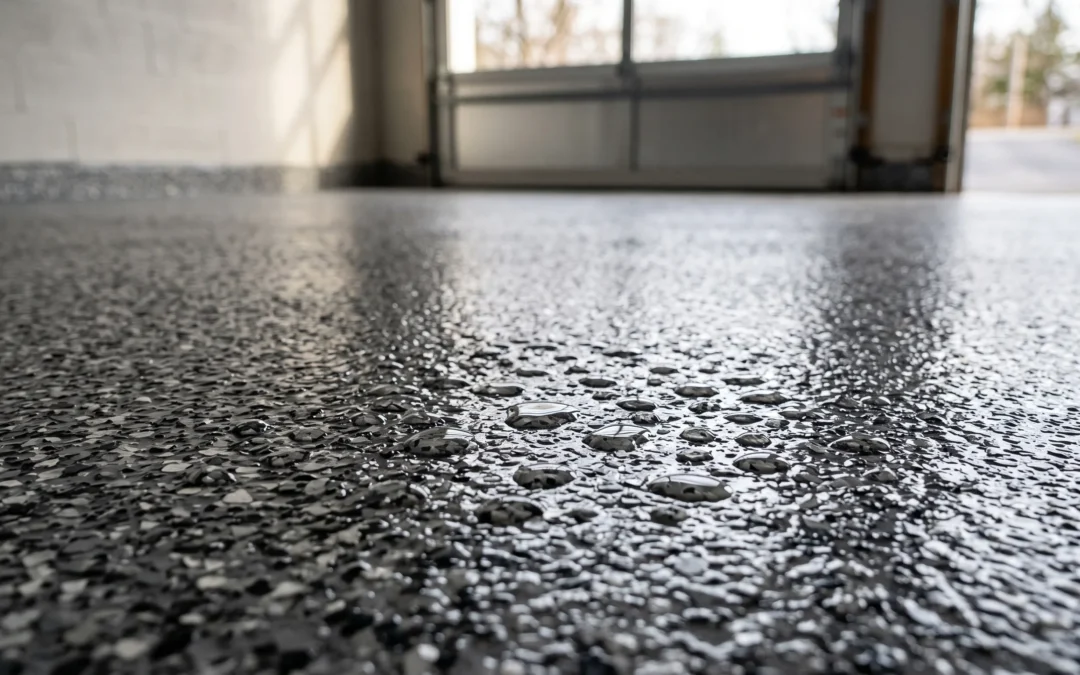
Dry epoxy flooring is not slippery — a cured epoxy surface actually offers grip comparable to finished concrete, and the textured flake systems installed in most garages grip better than the bare slab did. The honest caveat: a smooth, high-gloss epoxy with water or oil sitting on it can get slick, the same way polished tile or sealed concrete does. The good news is that slip resistance is a design decision, not a gamble. An installer chooses how much texture a floor gets, and the right system for a wet area is genuinely non-slip. Here’s how that works.
Why a Glossy Floor Isn’t Automatically a Slick Floor
Shine and grip are two different properties, and people constantly confuse them. Gloss is how the surface reflects light. Traction is friction between the surface and a shoe sole — what engineers measure as coefficient of friction. A mirror-flat surface can still grip well when dry, and a dull surface can be treacherous under a film of oil.
What changes the equation is liquid. On a perfectly smooth floor, water or oil forms an unbroken film between sole and surface, and friction drops fast. On a floor with even slight texture, the high points punch through that film and keep contact. That’s the whole science of slip resistance in one sentence: texture breaks the film.
So the real question isn’t “is epoxy slippery?” It’s “how much texture does this particular floor have, and does that match how the space gets used?”
What Actually Makes an Epoxy Floor Slippery?
In practice, slips on coated floors trace back to a handful of conditions:
- Standing water — rain tracked in under a car, snowmelt, a hosed-down floor that hasn’t dried.
- Oil and automotive fluids — a fresh drip on any smooth surface is a hazard until it’s wiped, which on epoxy takes seconds.
- Fine dust or powder — sawdust and dry clay act like ball bearings on smooth floors of every kind.
- A full-gloss, zero-texture topcoat in the wrong room — beautiful in a showroom, wrong beside a pool.
Notice that none of these are unique to epoxy. They make tile, stone, polished stone, and sealed concrete slippery too. Epoxy’s actual advantage is that spills sit on top of a seamless, stain-proof surface where you can see them and remove them completely — they don’t soak in and resurface later.
How We Build Traction Into the Floor
Because we manufacture our own coating systems, slip resistance gets engineered in at the topcoat stage rather than sprinkled on as an afterthought. There are three main tools:
- Full-rejection flake broadcast. Vinyl flakes are broadcast into the wet basecoat until the resin can’t accept any more, then sealed under a clear topcoat. The overlapping chips leave a subtle orange-peel texture across the entire surface — enough to break a liquid film underfoot without feeling rough. This is why flake flooring is the default recommendation for garages.
- Anti-slip additives in the topcoat. Aluminum oxide or fine polymer grit mixed into the final clear coat raises grip on any system, including smooth solid-color and metallic floors. The grit size is a dial: light texture for a home interior, aggressive texture for a wet commercial area.
- Quartz broadcast systems. For pool surrounds, locker rooms and commercial kitchens, colored quartz sand broadcast into the resin produces a dense, sandpaper-like surface that stays grippy even underwater.
Matching Grip to the Space
The right amount of texture depends on what lands on the floor:
- Garage: standard flake texture handles wet tires and the occasional drip. A garage floor coating rarely needs added grit unless the garage doubles as a wash bay.
- Pool deck: always a textured system — this surface is wet by definition, and barefoot grip is the whole job. See our pool deck coating page.
- Patio and driveway: exposed to rain and sprinklers, so we finish patio coatings with texture appropriate for outdoor foot traffic.
- Commercial and industrial: traction here is a liability question. Grease-exposed kitchens and wet process areas get aggressive broadcast textures; dry warehouses and showroom floors can run smoother.
- Interior living space: light or no added texture — indoor floors stay dry, and homeowners prioritize the seamless look and easy mopping.
The Honest Trade-Off: Texture vs. Easy Cleaning
More texture means more grip and slightly more effort with a mop, because a deeply textured surface holds onto grime the way smooth gloss doesn’t. A pool deck with heavy quartz broadcast will never wipe clean with one pass the way a glossy showroom floor does. That’s not a flaw; it’s a spec choice, and it’s exactly the conversation to have before installation rather than after. Most residential floors land in the middle: flake texture that grips reliably and still cleans up with a dust mop and the occasional wet mop, per our epoxy floor maintenance guide.
One more honest note: no floor surface of any kind is slip-proof under motor oil. Grip buys you reaction time; it doesn’t repeal physics. Wipe spills when you see them — on epoxy, at least, you always can.
Keeping the Grip You Paid For
Traction isn’t only installed — it’s maintained, and the floor’s enemies here are residues rather than wear. The most common one we see is soap film. Mopping with sudsy household cleaners leaves a microscopic layer that stays slick when damp, on epoxy and on every other hard floor. The fix costs nothing: use a neutral cleaner, go easy on it, and rinse. The second is polish — never wax or “restorer” products on a coated floor; they replace an engineered surface with a soft, slippery one and complicate future recoats.
A simple habit worth adopting: once in a while, wet a small patch near the door and test it with the shoes you actually wear in that space. If a decade of traffic has burnished the texture down — it takes roughly that long — the answer is a fresh topcoat with the grit level you want, not a new floor. That renewability is one of the quiet advantages of a layered system: the traction layer is the one layer designed to be replaced.
Frequently Asked Questions
Is epoxy flooring slippery when wet?
A smooth high-gloss epoxy can be, just like wet tile. A textured system — flake broadcast, quartz, or a topcoat with anti-slip additive — maintains traction when wet, which is why wet areas are always specified with texture built in.
Can an existing slippery epoxy floor be fixed?
Yes. The usual fix is a new clear topcoat with anti-slip additive blended in, applied after the existing surface is abraded for adhesion. It’s a fraction of the cost of a new floor and takes a day in most homes.
Are flake epoxy floors safe for kids and older adults?
Flake floors are among the safer hard surfaces for a household because the full-rejection broadcast leaves consistent texture across every square foot — no slick spots, no loose rugs, no grout lips to catch a toe. They’re also seamless, so there are no transitions to trip over.
Does anti-slip texture make the floor look worse?
No — fine polymer grit in a clear topcoat is essentially invisible. You keep the color and depth of the finish; the surface just reads slightly satin instead of wet-look gloss. Heavier textures for commercial wet areas are visible, but those spaces choose function first.
Top Epoxy Flooring manufactures and installs its own VOC-free coating systems throughout Southern California, with slip resistance matched to every space and a limited lifetime residential warranty. Call (818) 945-0915 for a free estimate.
Recent Comments