
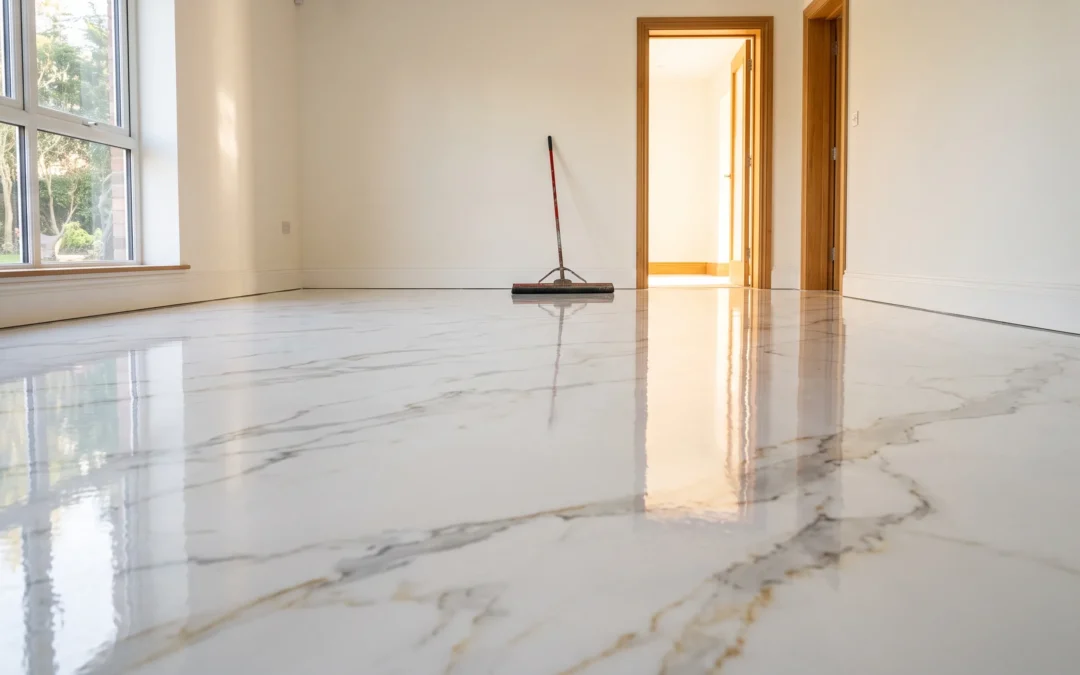
A marble look epoxy floor is created by layering translucent metallic pigments over a solid base color, then manipulating them — with brushes, solvents, air and gravity — into the veins, clouds and drifts of natural stone. It isn’t printed, stenciled or faked with film: the depth is real, produced by light passing through suspended pigment at different densities, which is why a well-executed pour is routinely mistaken for slab marble. This guide covers how the effect is actually built, the color recipes that convince the eye, where marble floors make sense in a home, and the honest comparison with quarried stone.
How Installers Actually Build the Marble Effect
The convincing part of faux marble isn’t the color — it’s the structure. Real marble has a base tone, cloudy secondary movement, and sharp mineral veins, all at different visual depths. A resin floor recreates each layer physically:
- The base pour. A pigmented coat establishes the stone’s ground color — bright white for Calacatta-style looks, soft gray for something closer to Carrara, near-black for dramatic Marquina-style floors.
- The body layer. Metallic-pigmented clear resin goes over the base and gets moved — rolled, dragged, blown — until it forms soft clouds and directional drift. This is what gives the floor its sense of geological depth.
- The veining pass. While the body is workable, contrasting pigment is trailed in thin, wandering lines, then teased with a brush tip or a controlled solvent drop so each vein feathers, branches and varies in weight. Straight or evenly spaced lines are the tell of an amateur; real veins meander and fork.
- The clear topcoat. A protective wear layer — UV-stable polyaspartic where sunlight reaches — seals the artwork and supplies the glassy, polished-stone reflection.
The full build takes three to four days, since each layer must cure before the next is worked. The underlying system is our metallic epoxy floor — “marble look” is a technique within it, not a different product.
The Palettes That Actually Read as Stone
You can pour any colors you like, but only some combinations trigger the brain’s “that’s marble” response. The proven recipes:
- White with gray veining — the universal choice. Add sparse gold threads and it shifts from Carrara-adjacent to Calacatta-adjacent luxury.
- Warm ivory with taupe movement — reads as travertine or cream marble; the most forgiving palette for daily dust.
- Black with white or silver lightning veins — high drama, best in powder rooms and entries where it’s a moment rather than a mile.
- Gray-on-gray with pewter — the quiet one; from across a room it passes for honed natural stone rather than a glossy showpiece.
- Emerald or deep teal with gold — not imitating any real quarry, and that’s the appeal; it reads as exotic stone that doesn’t exist.
Pick from cured physical samples, not phone screens. Our color chart is the starting point, and we pour sample boards for marble projects as standard practice because pigment behavior is impossible to judge from a swatch.
Which Rooms Reward a Marble Floor Most?
Marble-effect resin shines wherever real marble would be specified — and a few places it couldn’t survive. Entryways and foyers are the classic placement: the floor announces the house in the first three steps. Open-plan living areas let the veining travel uninterrupted across a scale no slab could match, seamless from wall to wall. Kitchens get the marble look without marble’s fatal kitchen flaw — etching from lemon juice, wine and vinegar doesn’t happen to resin. Bathrooms take the effect with an anti-slip additive in the topcoat. And the luxury garage is the sleeper hit: a white-veined floor under a collector car photographs like a museum plinth, and the surface laughs at hot-tire pickup that would destroy lesser coatings.
Resin Marble vs. Real Marble: The Honest Ledger
Where the resin version wins: it’s seamless with zero grout, it never etches from acids, it doesn’t demand annual sealing, it’s warmer and slightly more forgiving underfoot, and it installs over your existing slab in days. Where real stone wins: nothing else is genuinely quarried from the earth, natural marble can be refinished by grinding for generations, and in resale conversations “marble” and “marble look” are different words. Two further honesty points: a resin marble floor is hand-made art, so you approve a palette and technique — not an exact pattern — and deep gouges in a smooth decorative surface are visible until a topcoat refresh, where stone would chip instead. Neither is fragile; they just age differently.
What Separates a Convincing Pour From a Muddy One
When marble-effect floors disappoint, the failure is almost always one of three things. Overworked pigment: the installer kept fussing and the crisp veins blurred into murk — restraint is a skill. Wrong scale: tight busy veining across a huge great room looks like static; big rooms need long, calm movement with sparse veins. And skipped preparation: no amount of artistry survives a coating that wasn’t bonded to diamond-ground concrete over a moisture-vapor-barrier epoxy basecoat. Ask any bidder for photos of their own past marble pours — not stock imagery — and ask what happens under the pretty layers. The answers sort your shortlist quickly.
Frequently Asked Questions
Does marble look epoxy really resemble natural marble?
A skilled pour is regularly mistaken for slab stone, because the depth is physically real — light passes through translucent pigment layers just as it does through polished marble. The giveaway is a compliment: resin floors have no grout lines or slab seams, which real marble installations can’t avoid.
How long does a marble effect epoxy floor take to install?
Three to four days for a typical residential space. The base color, the metallic body layer, the veining work and the clear protective topcoat each need cure time before the next stage, and rushing the sequence is how muddy floors happen.
Is marble look epoxy a good choice for kitchens?
It’s arguably better there than real marble. Natural marble etches permanently from lemon juice, vinegar and wine, while a resin surface is non-porous and unaffected by household acids. You get the stone aesthetic with a wipe-clean, grout-free floor built for spills.
Can you choose the exact veining pattern in advance?
You choose the palette, vein color, and overall movement style from samples and past-project photos — but the precise pattern emerges by hand during the pour and is unique to your floor. No two marble-effect floors are identical, which is exactly what natural stone buyers pay a premium for.
Marble looks, engineered chemistry: Top Epoxy Flooring hand-pours marble effect floors across Southern California using our own VOC-free systems, backed by a limited lifetime residential warranty. Call (818) 945-0915 to see sample boards and get a free estimate.
Recent Comments