
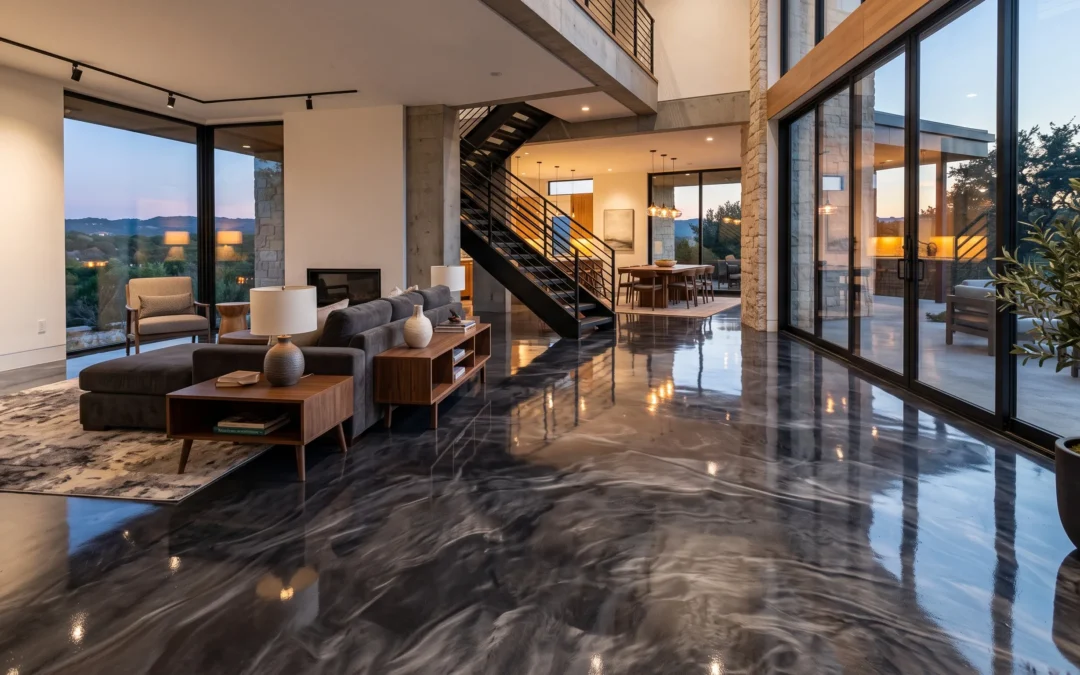
Metallic epoxy belongs in more rooms of a house than most homeowners realize. The finish — pearlescent pigments moved through clear resin until they settle into swirls, drifts and veins — was born in commercial showrooms, but its best modern applications are residential: basements that need to stop feeling like basements, open-plan living areas that want a signature surface, bathrooms chasing a spa mood, and yes, garages that double as trophy rooms. Below are the ideas we see succeed most often in Southern California homes, room by room, with the color logic behind each one. Every installation runs three to four days, because the artistic layers cure in sequence.
The Basement: Metallic’s Best-Kept Secret
Basements are where metallic earns its keep hardest. The floor is usually the biggest unbroken surface in the room, ceilings are low, and natural light is scarce — three conditions that a reflective, luminous floor fixes at once. Light-forward pours in champagne, silver or pearl bounce whatever light the room has and visually lift the ceiling. Because the system bonds directly to the slab over a moisture-vapor-barrier epoxy basecoat, it also sidesteps the classic below-grade problem that ruins carpet and laminate: vapor pushing up from the concrete. If your project starts with damp-slab concerns, begin at our basement floor coating page — the metallic finish is simply the decorative top layer of that same engineered system.
The Living Room: One Bold Surface, Everything Else Quiet
A metallic pour in a main living space works on a simple rule: the floor is the statement, so the palette around it stays disciplined. Three pairings that consistently photograph — and live — beautifully:
- Charcoal and pewter under warm wood furniture and off-white walls. Reads as honed dark stone until the light moves, then the metal flickers through.
- Warm taupe drifted with bronze for Spanish and Mediterranean homes, where cool grays would fight the architecture.
- White pearl with faint gray movement in minimalist interiors — the quietest metallic there is, closer to fog than to swirl.
Our living room epoxy flooring page shows how these finishes tie into open-plan layouts, and the underfoot experience surprises people: seamless, easy to keep dust-free, and friendlier to allergy sufferers than any carpet.
The Kitchen: Depth Without Grout
Kitchens punish floors with drips, drops and traffic lanes, and grout is where tile kitchens go to die. A metallic kitchen epoxy floor replaces the grid with one wipeable sheet of color. The trick in kitchens is choosing movement scale: tight, small-scale marbling flatters a kitchen’s busy visual field of cabinets and counters, while huge sweeping drifts — gorgeous in a great room — can feel chaotic in a 12-foot galley. Mid-tone colors are the practical sweet spot, hiding crumbs between sweeps better than either white or near-black.
Bathrooms and Powder Rooms: Small Space, Maximum Drama
A powder room is the one place to take the risk you wouldn’t take in the great room. Deep ocean blue with pearl streaks, emerald with gold, smoke black shot with copper — in twenty square feet, drama is a feature, not a commitment. Metallics in bathrooms get a light anti-slip additive broadcast into the topcoat, which knocks the gloss down a single step and adds wet-floor grip you’ll never see but will feel. The seamless surface also means no grout lines an arm’s length from the toilet — a hygiene argument that sells itself.
The Garage-Showroom: Where Metallic Started
For the collector’s garage, metallic remains the ceremony floor. Gunmetal, graphite and silver pours make automotive paint look a foot deep, and the UV-stable polyaspartic topcoat shrugs off hot-tire pickup that would delaminate a hardware-store coating. If the garage is a working space first and a showpiece second, be honest with yourself: a flake floor hides sawdust and brake dust far better, and plenty of clients split the difference — metallic under the lift bay, flake through the work zone.
Which Colors Should You Actually Pick?
Start from your fixed elements — cabinets, stone, wall color — and choose a floor that shares their temperature. Warm interiors want bronze, copper, champagne and taupe families; cool interiors want silver, pewter, steel blue and smoke. Then pick your contrast level: low-contrast pours (two neighboring tones) read as elegant stone, high-contrast pours (dark base, bright metal) read as art. Browse the metallic families on our color chart, then ask for a physical sample pour — pigment behaves differently in person than on any screen, and a reputable installer will happily show you cured samples. Full system details live on our metallic epoxy floors page.
One Honest Caveat Before You Commit
Metallic finishes are smooth and glossy by nature, and gloss shows life: dust, paw prints, squeegee marks from mopping. None of it damages the floor — the wear layer is the same tough resin as our garage systems, backed by a limited lifetime residential warranty — but a household that won’t enjoy occasional dust-mopping of a dark reflective surface should choose a lighter pour, a satin topcoat, or a flake system instead. The clients who love their metallic floors for decades are the ones who chose them with open eyes.
Frequently Asked Questions
Is metallic epoxy flooring practical for a whole house?
It’s practical anywhere there’s a concrete slab beneath, which in Southern California often means the entire first floor. The surface is seamless, VOC-free once installed, and easier to clean than tile or wood. Most homeowners run one continuous pour through connected living areas and switch finishes in utility spaces.
How long does a residential metallic epoxy installation take?
Plan on three to four days. Diamond grinding and basecoat come first, then the metallic design layers, then the protective topcoat — each stage cures before the next begins. Furniture typically returns after the final cure window your installer specifies.
Will two rooms with the same metallic colors look identical?
No, and that’s the point. The pigment settles according to how it’s poured and moved that day, so every floor is a one-off. Installers can match a palette and general movement style between rooms, but an exact duplicate of a photo is impossible — approve colors and technique, not a specific swirl.
Are metallic epoxy floors slippery in a home?
Dry, they grip about like polished stone. For bathrooms, entries and any wet-prone room, a clear anti-slip additive goes into the topcoat, adding texture you can feel but barely see. Kitchens and living areas are usually fine without it unless the household prefers extra traction.
Top Epoxy Flooring pours metallic floors throughout Southern California using coating systems we manufacture ourselves — VOC-free, backed by a limited lifetime residential warranty. Call (818) 945-0915 for a free in-home estimate and sample colors.
Recent Comments