
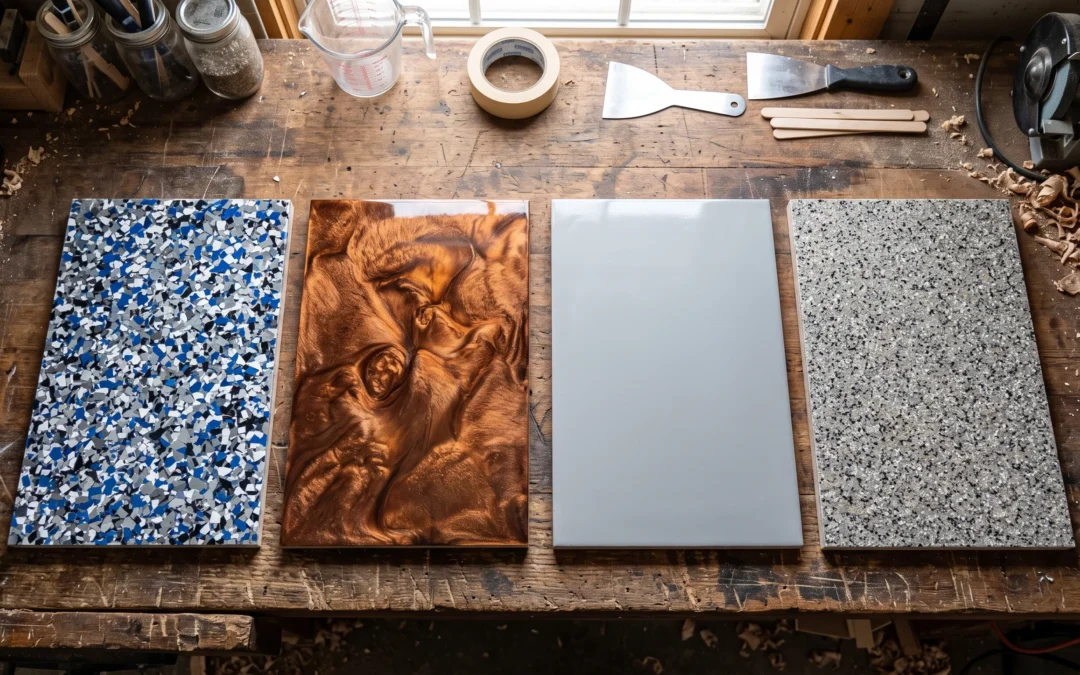
Epoxy flooring comes in six main types you’ll actually encounter: flake, metallic, solid color, quartz broadcast, self-leveling, and chemical-resistant novolac — plus specialty variants like mortar and anti-static systems for industrial work. They all share the same two-part resin chemistry; what separates them is what gets built into the layers and how thick the system is poured. The type determines the look, the texture, the durability profile and the install timeline, so choosing between them is really choosing what job the floor needs to do. Here’s the whole family, sorted the way we actually spec them for customers.
Two Ways to Sort Epoxy Floors
Product pages tend to mash everything into one list, which is why the category feels confusing. It gets simple when you separate two independent questions. First: what finish system is on top — the decorative or functional build that decides how the floor looks and wears. Second: what formulation is underneath — 100% solids, water-based or solvent-based resin, which decides how much cured material actually ends up on your slab. This post walks through the finish systems; formulation deserves its own discussion, and the short version is that everything we install is 100% solids.
The Decorative Types
These four cover nearly every residential project and most commercial showpieces.
Flake epoxy
Colored vinyl chips broadcast to full rejection into the wet basecoat, sealed under a clear topcoat. It’s the workhorse of garages: tough, lightly textured for grip, and endlessly forgiving because the multicolor blend hides dust and tire marks. Installs in one day. Dozens of blends are available — browse them on our color chart, and see finished examples on the epoxy flake flooring page.
Metallic epoxy
Metallic pigments folded into clear resin, then manipulated with blowers and brushes as it self-levels, producing marble veining, lava swirls and pearl depth. Every metallic epoxy floor is a one-off — there is no repeating pattern. It’s the choice for showrooms, living areas and statement garages, and the artistry takes time: three to four days, because each design layer cures before the next.
Solid color epoxy
One uniform, pigmented color, smooth and architectural. Solid color epoxy flooring is what you see in service bays, commercial kitchens and modern interiors where a clean, bright, monolithic surface is the goal. Typically a two-to-three-day install. Add safety striping or anti-slip grit as the space requires.
Quartz broadcast
Colored quartz sand broadcast into the resin instead of vinyl flakes, yielding a dense, granite-look surface that is the toughest and most slip-resistant of the decorative family. Schools, locker rooms, restrooms and pool areas run on quartz. One to two days.
The Industrial and Specialty Types
Beyond decoration, epoxy branches into engineered systems for specific abuse:
- Self-leveling epoxy — poured at higher thickness so it flows out into a dead-flat, seamless surface; the fix for worn, uneven industrial slabs that need a new working floor, not just a coating.
- Epoxy mortar — 100% solids resin mixed with graded sand and troweled down; the heaviest-duty build in the family, used under forklifts, loading docks and impact zones, and as a repair material for badly damaged concrete.
- Novolac epoxy — a tighter-crosslinking chemistry that shrugs off aggressive acids, solvents and caustics that would attack standard epoxy. Battery rooms, chemical processing, secondary containment. Details on our novolac epoxy coating page.
- Anti-static (ESD) epoxy — conductive systems that bleed off static charge for electronics manufacturing and cleanrooms.
- Moisture-vapor-barrier epoxy — a basecoat engineered to block vapor drive through the slab; less a floor type than an insurance layer that goes under any of the above when moisture testing says so.
- Epoxy terrazzo — marble, granite or glass chips seeded through the resin and ground smooth after cure; the premium architectural option you see in airports and lobbies, gorgeous and essentially permanent.
Close Cousins That Aren’t Technically Epoxy
Three systems live in every epoxy conversation without being epoxy. Polyaspartic and polyurea are faster-curing, UV-stable resins — we use a UV-stable polyaspartic as the topcoat over epoxy basecoats, pairing each chemistry’s strength. Urethane cement is a cementitious-resin hybrid for brutal thermal and chemical duty — commercial kitchens and breweries — covered on our urethane cement flooring page. And grind and seal isn’t a coating build at all: the concrete is diamond-ground and then sealed clear, keeping the industrial concrete look. Knowing these exist keeps you from comparing apples to slogans when quotes use different words.
Color, Texture and Sheen Across the Types
Type also decides how much creative control you get, which matters more to most homeowners than any spec sheet. Flake offers the widest catalog — chip blends in different sizes and color mixes, from quiet granite looks to bold customs, all with a light built-in texture. Metallic trades predictability for depth: you choose the pigments and the general movement, and the resin improvises the final pattern. Solid color is the precision option — any pigment, uniform everywhere, in gloss or satin — and quartz blends colored sand for a speckled, stone-like reading with the most aggressive texture of the group. Sheen is a separate dial on all of them: the topcoat, not the type, sets gloss level and slip resistance, so a satin flake floor and a mirror-gloss flake floor are the same system finished differently. If you’re starting from a color idea rather than a system idea, that works too — pick the palette first and let the type follow the room’s workload.
Which Type Belongs in Your Space?
The shortcut version of how we spec floors:
- Garage: flake, almost always — durability, grip and camouflage in one system.
- Living space, showroom, office: metallic for drama, solid color for minimalism.
- Wet or barefoot areas: quartz broadcast.
- Warehouse and manufacturing: self-leveling or mortar, with line striping.
- Chemical exposure: novolac.
- Steam, fryers, thermal shock: urethane cement.
The honest footnote: the best type for you also depends on your slab’s condition and moisture readings, which is why we quote from an on-site look rather than a phone description. A slab with vapor drive, old coatings, or heavy repairs can shift the recommendation — and it’s far cheaper to learn that before the resin is chosen than after.
Frequently Asked Questions
What is the most popular type of epoxy flooring?
Flake epoxy, by a wide margin — it’s the default garage system across the country because the broadcast texture adds grip, the chip blend hides everyday mess, and the build takes daily vehicle traffic for decades.
What is the most durable type of epoxy flooring?
Epoxy mortar is the heaviest-duty build, followed closely by quartz broadcast systems. For chemical durability specifically, novolac formulations lead. In a home setting, any professionally installed 100% solids system with a polyaspartic topcoat is more than durable enough for a lifetime warranty.
Which epoxy floor types can be installed in one day?
Flake systems install in a single day, and quartz typically runs one to two. Solid color usually takes two to three days, and metallic three to four, because their coats and design layers each need cure time.
Can different epoxy types be combined?
Yes — real projects mix them constantly. A shop might run mortar in the work bays and solid color in the showroom, or a home garage might get a moisture-vapor-barrier basecoat under a flake finish. Systems are layered to match each zone’s abuse.
Top Epoxy Flooring manufactures and installs every system in this guide — VOC-free materials, Southern California crews, limited lifetime residential warranty. Call (818) 945-0915 for a free estimate.
Recent Comments