
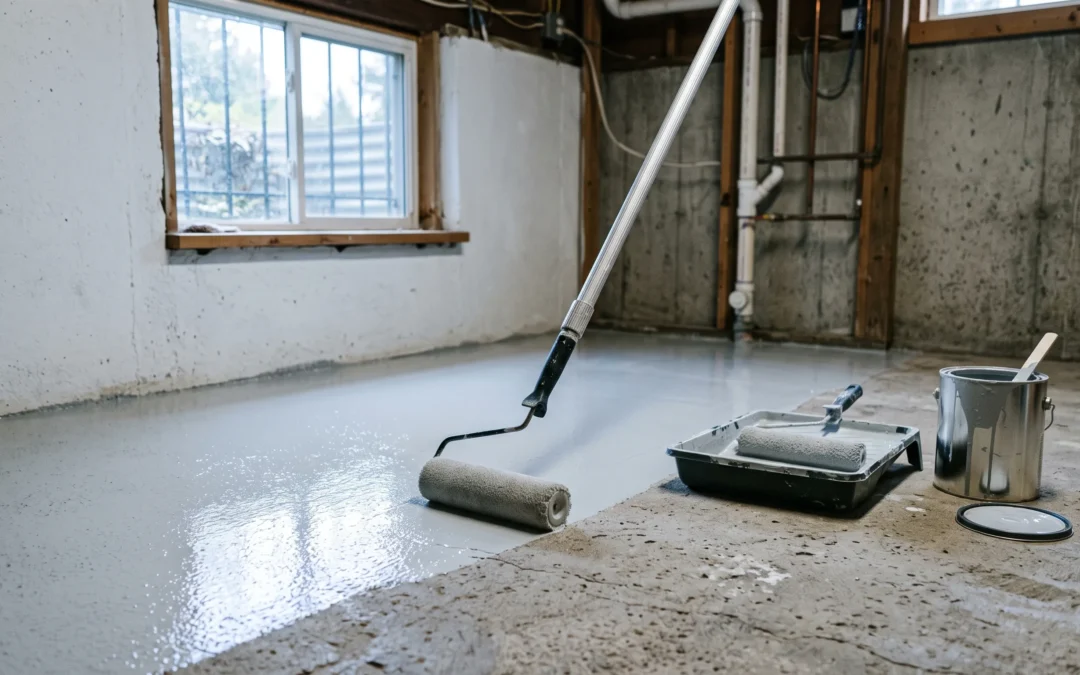
Sometimes. Water-based epoxy is worth it as a low-odor sealer for lightly used interior concrete — a storage room, a basement you want brighter, a surface you plan to redo properly later. It is not worth it where most people are tempted to use it: the garage. The water carrier that makes it cheap and easy to roll also means most of what you apply evaporates, leaving a film too thin to survive vehicles, sun and chemistry. As a company that manufactures coatings for a living, we have no product-line reason to sugarcoat either direction — so here’s the fair version of both.
What Water-Based Epoxy Actually Is
It’s genuine two-part epoxy — resin and hardener — dispersed in water so it spreads like ordinary paint. The chemistry crosslinks as the water evaporates, and the result is a true epoxy film, just a modest one. Applied at typical spread rates it dries down to roughly 1 to 3 mils, a fraction of what a professional basecoat leaves behind. In exchange, you get real conveniences: almost no odor, soap-and-water cleanup, a working time measured in hours rather than minutes, and a forgiving tolerance for slightly damp concrete. Those are honest engineering trade-offs, not flaws. The problem starts when a product engineered for convenience gets sold as armor.
Where Water-Based Epoxy Genuinely Makes Sense
There are five situations where we’d tell a caller it’s a reasonable choice:
- As a primer. Some water-based formulations penetrate and tolerate residual moisture well, which is why the chemistry survives in professional use as a priming layer under heavier systems.
- Low-traffic interior rooms. A storage room, laundry corner or workshop that sees foot traffic only — sealed against dust, brightened, done.
- Occupied buildings where odor is the constraint. Though note that a VOC-free 100% solids system solves the same problem without giving up thickness.
- A short time horizon. Freshening a floor before a sale or the end of a lease, where a few good years is genuinely all the assignment calls for.
- Walls and curbs. Vertical concrete never meets a tire; a thin film is fine there.
Used inside that lane, with clean prepared concrete and honest expectations, water-based epoxy performs as designed.
Where It Fails — and Why It Fails There
Outside that lane, physics takes over. In a garage, a 2-mil film sits between a 4,000-pound vehicle and the slab. Tires arrive hot, sit for hours, and grip the coating as they cool; a thin film over lightly etched concrete loses that tug-of-war, which is why tire-patch peeling is the classic ending. UV coming through the door yellows and chalks it. Gasoline and brake fluid, harmless sitting briefly on a thick full-solids floor, can soften a thin one. Abrasion simply runs through the material — there isn’t much there to wear away.
The pattern shows up on our side of the business as repair calls. Most of the failed coatings we grind off began life as a weekend roll-on, and the owner effectively pays for the floor twice. That failure sequence — and what recovery involves — is laid out in how to fix peeling epoxy flooring. If you’re comparing the retail route in detail, our breakdown of whether a DIY garage floor epoxy kit is worth it runs the same analysis on the whole kit, not just the resin.
The Two Products, Side by Side
Strip away the branding and the comparison is short:
- Cured thickness: roughly 1–3 mils for water-based; 10+ mils per coat for a 100% solids basecoat, several times that as a full system.
- Bond: water-based products are usually applied over acid-etched or merely cleaned concrete; professional systems bond into a diamond-ground profile.
- Wear layer: none versus a UV-stable polyaspartic topcoat.
- Service life in a garage: commonly one to three years versus decades — the gap is large enough that we warranty residential systems for the life of the floor.
- Odor during install: a tie, perhaps surprisingly — our full-solids materials are VOC-free, so low odor is no longer an argument the thin product wins.
- Cost over ten years: the thin coating wins the first receipt and loses the ledger — recoat it every couple of years, or pay once to grind it off and start over, and the “cheap” option quietly becomes the expensive one.
How to Tell What You’re Actually Being Sold
Retail shelf labels blur the categories on purpose, so here’s the thirty-second decode. If the product is one part — no separate hardener to mix — it isn’t epoxy at all, whatever the can says; it’s an acrylic or a blend borrowing the word. If it mixes two parts and cleans up with water, it’s water-based epoxy: real chemistry, thin result. If the data sheet states 100% solids and warns you about pot life, you’re holding the professional material, and the honest question becomes whether you want to apply it yourself. Three more tells worth a glance: coverage claims (a product covering vastly more square feet per gallon is spreading itself thinner), the prep instructions (acid etch in the directions signals a coating designed to skip grinding), and whether a wear topcoat is included at all. None of this requires expertise — just reading the fine print the marketing hopes you’ll skip.
What We’d Recommend Instead, by Situation
If you’re holding a can of water-based epoxy over a garage floor, the better answer is a broadcast system — the standard garage floor coating installs in one day and closes the question for good. For a basement, moisture is the design driver, and a proper basement floor coating starts with a vapor evaluation rather than a roller. And if what you really want is a clean, sealed, industrial-looking slab at minimal build, say that out loud — grind and seal delivers exactly that honestly, without pretending to be a coating system. There’s a right product for nearly every floor and budget; the only wrong move is a thin film in a heavy-duty room.
Frequently Asked Questions
How long does water-based epoxy last on a garage floor?
Typically one to three years before visible wear or tire-patch peeling, sometimes less with daily parking and sun exposure. The same product in a low-traffic interior room can look good for many years — the material didn’t change, the abuse did.
Is water-based epoxy easier to apply than 100% solids?
Much easier: long working time, ordinary rollers, soap-and-water cleanup, and tolerance for imperfect conditions. That applicator-friendliness is precisely why it dominates retail shelves — ease of application sells boxes, but thickness protects floors.
Can I apply a professional epoxy system over old water-based epoxy?
Not directly. Any existing coating is a bond breaker with unknown adhesion, so it gets removed by diamond grinding during prep. That’s routine work for an installer and shouldn’t scare you off upgrading — it just means the old coat bought nothing permanent.
Is water-based epoxy safer or greener than other epoxies?
It’s low-odor and low-VOC, which is real. But modern 100% solids systems can be VOC-free too — ours are — so you no longer have to trade durability for air quality. The environmental edge that once justified thin coatings has largely evaporated with the solvents.
Top Epoxy Flooring manufactures VOC-free, 100% solids coating systems and installs them throughout Southern California — honest recommendations, free on-site estimates. Call (818) 945-0915.
Recent Comments