
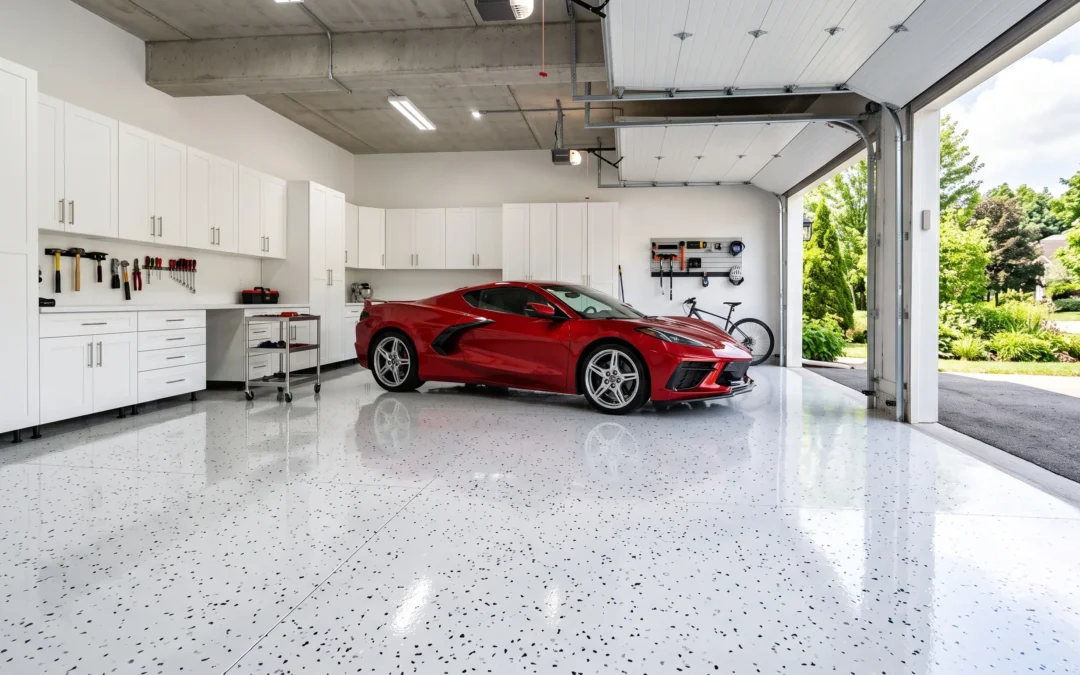
A white epoxy garage floor does one thing no other color can: it turns a garage into the brightest room in the house. White bounces so much light that owners routinely report needing fewer fixtures on after the install, and the showroom effect under a parked car is unmatched. But white is also the color that demands the most honesty from whoever sells it to you — it displays tire marks, red dust and leaf litter faster than anything else on the chart. The good news is that smart design choices close most of that gap. Here are the white floor ideas that work in real garages, and the candid maintenance math behind each one.
Why White Transforms a Garage Like No Other Color
Garages are usually the worst-lit rooms on the property, and every dark surface in them eats lumens. Flip the floor — the room’s largest surface — to white and the same bulbs suddenly do double duty, reflecting light up into engine bays, under workbenches and into corners. Detailers and home mechanics choose white for exactly this reason: it’s task lighting you walk on. The second effect is psychological: a white floor reads as clean-room, lab, showroom. It changes how the space gets treated — households with white floors tend to keep the whole garage sharper, because the floor sets the standard.
Idea 1: The Pure Solid — Maximum Showroom, Maximum Commitment
A single unbroken field of gloss white is the boldest version: automotive paint pops against it, chrome doubles in its reflection, and the space photographs like a dealership. It’s built on our solid color epoxy system, and here’s the honest part — this is the highest-maintenance floor we install. Tire scuff, a drip of dark oil, one autumn’s leaf tannin: all of it is visible until you wipe it, and wiping it is the lifestyle. Choose the pure solid if the garage is a display space first, if cars roll in clean, and if a weekly dust-mop-and-spot-wipe genuinely sounds fine. It’s a stunning floor for the right owner and a regret for the wrong one, and we say so at every estimate.
Idea 2: White Flake Blends — 90% of the Brightness, Half the Upkeep
The most-recommended white floor isn’t pure at all. A white basecoat under a full broadcast of white, gray and black chips keeps nearly all of the reflectivity while adding a randomized pattern that visually digests dust, scuffs and small drips between cleanings. Blend proportions tune the personality:
- White-dominant with fine silver flecks — reads as bright quartz; the subtlest option.
- White with scattered black chips — crisp, graphic, the classic “cookies and cream” garage; hides dark scuffs remarkably well.
- White with gray and taupe — softens toward warm stone, flattering next to wood-tone cabinets and earth-tone driveways.
Because the chips ride in a full-rejection broadcast under a clear coat, you also gain texture and grip a smooth solid doesn’t have. This is the configuration we point most families toward, built on the same flake flooring system as any other blend and installed in a day.
Idea 3: Pearl and Ice Metallics — White With Depth
For a garage that leans showpiece, white metallic pours trade the flat field for dimension: pearl pigment drifted through white resin creates a floor like polished alabaster or wind-blown snow, with faint silver movement that catches under LED lighting. It’s quieter than the dramatic dark metallic floors and pairs beautifully with modern black-and-glass garage doors. Plan three to four days of installation for the layered pour, versus one day for flake.
Idea 4: White as the Frame, Not the Field
White works brilliantly in supporting roles. A white smooth border around a gray flake field brightens the perimeter where walls meet floor — the zone that defines how clean a garage reads. A white workshop bay beside darker parking bays puts the brightness where hands and eyes work. Checkerboard layouts with alternating white and black or gray zones deliver retro motorsport energy without committing the whole slab to white’s upkeep. These composed layouts cost little extra complexity during installation and age more gracefully than any single-color decision.
The Honest Care Sheet for White Floors
Every white floor owner should hear this before signing, not after: white shows more, full stop. What that means in practice — a dust mop weekly keeps any white configuration sharp; tire marks wipe off gloss coatings with a neutral cleaner but you will see them until you do; fluid leaks announce themselves instantly, which is annoying aesthetically and genuinely useful mechanically (white floors catch failing gaskets months before dark floors would). Two spec choices make white dramatically easier to live with: a UV-stable polyaspartic topcoat so the white stays white instead of ambering near the sun-facing door, and texture — flake or a light additive — so scuffs sit less visibly than on dead-smooth gloss. Full routines are in our maintenance guide.
Pulling the Look Together
White floors reward a finished room. Matching white or light-gray cabinetry, dark walls for contrast or light walls for the full studio effect, and upgraded LED lighting to exploit all that reflectivity — the floor is the anchor of a garage renovation more than a standalone product. Compare white solids, blend cards and pearl samples side by side on our color chart, then look at them inside your actual garage at night; white shifts more under different lighting than any other floor color, and the five-minute sample check has saved plenty of clients from a too-blue or too-cream surprise. The underlying build is our standard garage floor coating system regardless of color.
Frequently Asked Questions
Is a white epoxy garage floor hard to keep clean?
Cleaning is easy — the surface is non-porous, so everything wipes off with a neutral cleaner. What white demands is frequency: dust, tire scuffs and drips are visible sooner than on darker floors. A white flake blend keeps most of the brightness while hiding daily mess far better than a pure solid.
Will a white garage floor yellow over time?
Only if the wrong chemistry is used. Standard epoxy clear coats amber with UV exposure, and white shows that shift worst. A UV-stable polyaspartic topcoat holds its color even near a sun-facing garage door, which is why we specify it on every white installation.
Do white floors show tire marks?
Yes — warm tires can leave gray scuffs on any light floor, and white displays them until wiped. They remove easily from a quality topcoat and don’t harm it. Broadcasting black and gray flakes into the white dramatically reduces how much scuffing you notice day to day.
Which white floor style is best for a family garage?
A white-dominant flake blend with gray and black chips. It delivers the bright, showroom feel, adds slip-resistant texture, hides the traffic of daily life, and installs in one day. Pure gloss white solids are better reserved for display garages where cars arrive clean.
Ready for the brightest room in the house? Top Epoxy Flooring installs white solids, blends and pearls across Southern California with VOC-free systems we manufacture — limited lifetime residential warranty. Call (818) 945-0915 for samples and a free estimate.
Recent Comments