
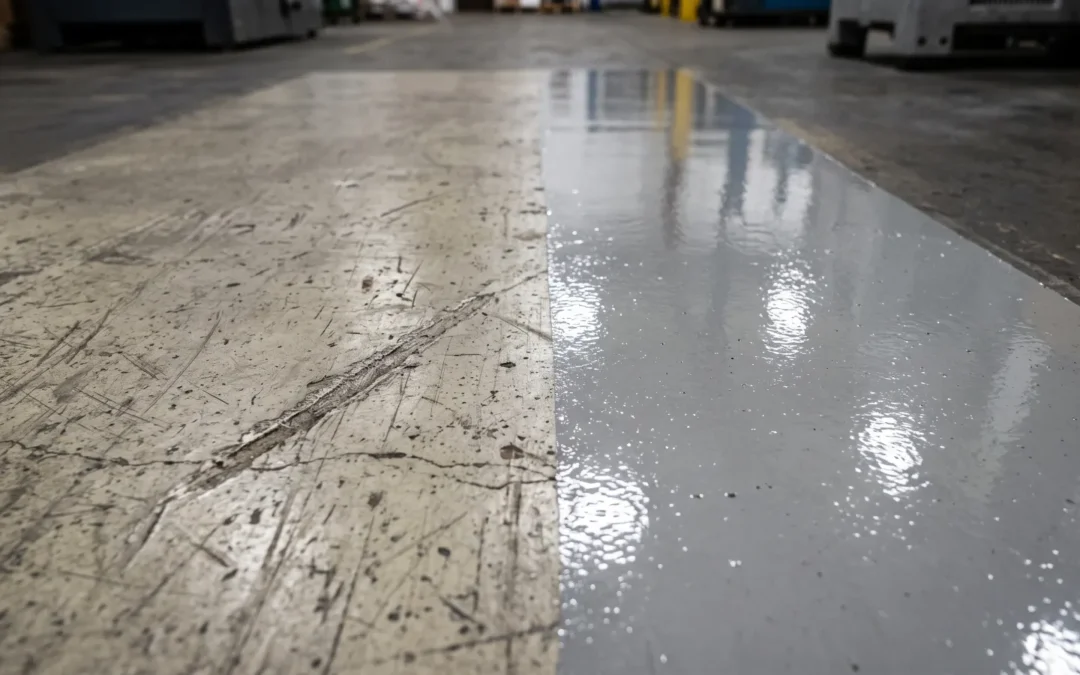
The disadvantages of epoxy flooring are real and worth knowing before you commit: it can peel if the concrete wasn’t prepared properly, it’s slick when wet unless texture is added, bare epoxy yellows in direct sun, the floor is hard and cold underfoot, and installation takes your garage or business offline for a day or more. What separates a floor you love from a floor you regret is understanding which of these drawbacks are permanent traits of the material — and which only show up when corners get cut. We manufacture and install these coatings, so here is the unvarnished version.
Delamination: The Failure Everyone Fears
The most serious complaint against epoxy is a coating that lifts, bubbles, or sheets off the slab. Here is the uncomfortable truth: this is almost never the epoxy’s fault. Resin bonds to concrete mechanically, gripping the open pore structure of the slab — and that structure only exists if the surface was opened with diamond grinding to create a proper bonding profile. Coat over a steel-troweled slab, an old sealer, or paint, and the bond has nothing to hold. Moisture does the rest: ground vapor pushing up through a slab will blister any coating that lacks a moisture-vapor-barrier epoxy basecoat. If you’re weighing this risk, our guide to diagnosing a peeling epoxy floor shows exactly what each failure pattern means. The disadvantage, stated fairly: epoxy punishes shortcuts more than almost any flooring product.
Slipperiness When Wet
A smooth, unbroken gloss surface offers little grip under standing water — a legitimate concern in garages where cars drip rain, around pool decks, and at commercial entries. The material has no built-in answer; the specification does. Full-rejection flake broadcast creates surface texture, and anti-slip aggregate can be blended into the final coat. If your installer doesn’t raise slip resistance for a wet-exposure floor, that’s a red flag about the whole job.
Yellowing and Chalking in Sunlight
Epoxy resin, as a chemistry, is not UV-stable. Sunlight through a west-facing garage door will amber a bare epoxy surface over time, and outdoors it will chalk. This is a genuine material limitation — and the reason professional systems don’t leave epoxy on top. A UV-stable polyaspartic topcoat over the epoxy base is what faces the light, and it doesn’t yellow. Floors that discolored were built without that wear layer. Budget kits skip it; that’s a large part of why they age badly.
Hardness, Cold, and Sound
Three traits you cannot spec away, because they’re what makes epoxy epoxy:
- It’s hard. The cured surface has no give. Dropped glassware doesn’t survive, and standing in one spot for hours is tiring without an anti-fatigue mat.
- It’s cold. The coating takes on the slab’s temperature. Pleasant in a Southern California summer, chilly in a winter basement without rugs or radiant heat.
- It reflects sound. A large, hard, seamless surface makes a room slightly more live. In garages nobody cares; in a converted living space, soft furnishings balance it.
If softness underfoot is your top priority for a bedroom or family room, epoxy is honestly the wrong material — no reputable installer will tell you otherwise.
Downtime During Installation and Cure
The floor must be empty, and it must stay empty while coats cure: a flake garage system typically runs one day, metallic systems three to four. Traditional epoxies then want time before vehicles return, though modern polyaspartic-topped systems generally take cars back in about 24 hours. For a household with two daily drivers or a business that can’t close, the schedule is a genuine cost of the project — plan it like one. On the odor question: solvent-heavy products of years past earned their reputation, but our systems are VOC-free, which removes the lingering-fumes problem from the list.
Repairs Show, and Recoating Has Rules
A deep gouge or a slab crack that telegraphs through the coating can be repaired — but a spot repair in the middle of a decorative floor rarely disappears completely, especially in metallics where the pattern is one-of-a-kind. Fixes blend far better in flake floors, which is one more argument for them in hard-working spaces. And once a floor is glossy and sealed, any future coat needs the surface abraded first so it can grip. Neither issue is a dealbreaker; both are covered honestly in our epoxy floor repair guide.
Weighing the List
Sort the disadvantages into two piles. Permanent ones: hard, cold, acoustically live, offline during install, repairs that can show. Avoidable ones: peeling, blistering, slipperiness, yellowing — every item in that second pile is an installation or specification failure with a known professional answer. That’s why the same product line produces both 20-year floors and one-year disasters, and it’s the honest lens for reading our full pros and cons of epoxy flooring breakdown — or judging any installer’s proposal: ask how they prep, how they handle moisture, and what their topcoat is. The answers predict which pile your floor lands in. A floor built right carries our limited lifetime residential warranty precisely because the avoidable pile has been engineered out.
Frequently Asked Questions
What is the biggest problem with epoxy floors?
Delamination — the coating peeling from the slab. It’s caused by skipped surface preparation or untreated moisture, not by the resin itself, and diamond grinding plus a moisture-vapor-barrier basecoat prevents it.
Why do people say epoxy floors fail?
Because the market is full of thin, DIY-grade coatings applied over unprepared concrete. Failed floors overwhelmingly trace back to no grinding, no moisture test, and no protective topcoat.
Is epoxy flooring bad for bedrooms or living rooms?
It’s hard and cool underfoot, so comfort-first rooms need area rugs to balance it. Plenty of modern homes use decorative epoxy in living areas deliberately — it’s a style choice, not a mistake, as long as you know the feel.
Does epoxy yellow over time?
Unprotected epoxy exposed to sunlight does. A UV-stable polyaspartic topcoat — standard on professional systems — is unaffected by UV and keeps the color true.
Top Epoxy Flooring manufactures and installs its own VOC-free coating systems across Southern California, with a limited lifetime warranty on residential work. Free onsite estimates: (818) 945-0915.
Recent Comments