
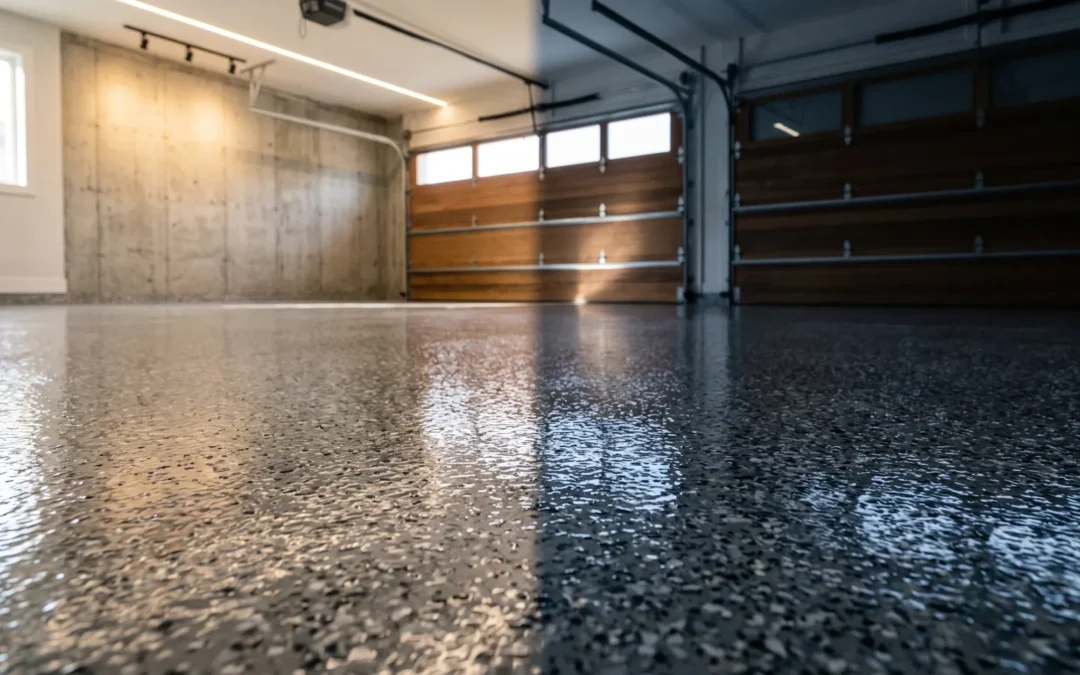
Epoxy flooring earns its reputation: it’s the most durable, easiest-to-clean finish you can put on concrete, and it turns garages and work spaces into rooms people are proud of. It also has real drawbacks — slickness when wet, UV yellowing, unforgiving installation — that most articles either exaggerate or bury. As a company that manufactures epoxy systems, here’s both columns of the ledger, with the honest note on which cons are chemistry and which are just bad installation.
The Pros — Why Epoxy Owns Garages and Work Floors
- Durability measured in decades. A professional multi-coat system over ground concrete runs 15–20+ years in a residential garage — here’s the honest lifespan breakdown. It shrugs off dropped tools, jack stands, and daily traffic.
- Chemical and stain resistance. Oil, brake fluid, coolant, road salt — everything beads on the non-porous film and wipes off. Nothing soaks in, nothing stains.
- Cleaning is a mop. No grout, no seams, no wax, no refinishing. Dust-mop the grit, damp-mop occasionally — the entire maintenance program fits in a sentence.
- Looks that go from workshop to showroom. Flake blends, marbleized metallics, clean solid colors — dozens of finishes on one durability platform.
- Brightness. A light gloss floor bounces lamp light around a garage dramatically — the free lighting upgrade nobody expects.
- Seamless hygiene. No joints to trap moisture or grime — why commercial kitchens and hospitals run resin floors.
The Cons — And Which Ones Are Actually Solvable
- Slippery when wet (solvable). Smooth high-gloss epoxy is slick under water. The fix is standard practice, not luck: flake texture and a slip-resistant additive in the topcoat. Ask for it; we include it on garage and outdoor work by default.
- UV yellowing (solved by chemistry). Bare epoxy ambers in sunlight — true. That’s why professional systems finish under a UV-stable polyaspartic topcoat that doesn’t react to sun at all. Yellowing floors are missing that layer.
- Unforgiving installation (real). Surface preparation decides everything: most failures trace to coating over smooth, sealed, or damp concrete. Diamond grinding and moisture testing aren’t optional steps — they’re the floor.
- Cure time (mostly solved). Traditional epoxy wants days. Modern polyaspartic systems put a garage back in service in about 24 hours — a one-day install is now the residential standard.
- Hard underfoot (real). It’s concrete’s surface, not cushioning. In living spaces, rugs solve comfort where you stand long; in garages, nobody notices.
- Cold slab feel (situational). The floor takes the slab’s temperature — a plus in a SoCal summer, a rug’s job in winter rooms.
- Upfront investment (context matters). A professional system costs more than paint or a kit — and gets recouped by not redoing the floor every couple of years. The honest comparison is in our DIY kit breakdown.
The Pattern Behind the Cons
Read the list again and a pattern shows: the permanent disadvantages are comfort preferences (hardness, temperature), while the famous failures — slipperiness, yellowing, peeling — are all installation and specification problems with known professional answers. That’s the real takeaway of any pros-and-cons list: epoxy done right has few cons; epoxy done cheap collects all of them.
Where Epoxy Is the Right Answer — and Where It Isn’t
Right answer: garages above all, basements, laundry and utility rooms, workshops, commercial and industrial floors, showrooms, and modern interiors that want the seamless look. Think twice: bedrooms and cozy living spaces where softness underfoot matters most, badly cracked slabs that need resurfacing first, and outdoor surfaces — which want our UV-stable exterior systems rather than standard epoxy.
Frequently Asked Questions
Is epoxy flooring worth it overall?
For garages and hard-working spaces, overwhelmingly yes: decades of service, minimal maintenance, and stain immunity outweigh the upfront cost and cure window. For comfort-first living spaces, weigh the hardness honestly.
What is the biggest disadvantage of epoxy flooring?
Its intolerance of bad installation. Skipped grinding or an untested damp slab will fail regardless of product quality — the floor’s fate is decided before the first coat.
Does epoxy flooring increase home value?
A finished garage with a professional floor consistently shows better and photographs better at sale; agents treat it as a genuine upgrade, especially in car-culture markets like Southern California.
How do the cons get avoided in practice?
Three specifications: diamond-ground preparation with a moisture test, a slip-resistant additive in the topcoat, and a UV-stable polyaspartic wear layer. Every famous epoxy complaint traces to skipping one of them.
Top Epoxy Flooring manufactures and installs its own coating systems across Southern California — limited lifetime warranty on residential installations, VOC-free materials, free onsite estimates: (818) 945-0915.
Recent Comments