
Here’s the answer most coating companies won’t give you: a properly installed epoxy system and a properly installed polyurea system last about the same — decades — because lifespan is decided by surface preparation and material quality, not by which resin family wins a marketing fight. The bigger secret is that you rarely have to choose. The best modern garage floors use both chemistries in one system: an epoxy basecoat where epoxy is strongest, and a polyaspartic topcoat — which is itself a type of polyurea — where polyurea is strongest. We manufacture and install both, so let’s take the sales pitch out of this comparison.
Where the “Polyurea Lasts 10x Longer” Claim Comes From
Search this topic and you’ll find pages claiming polyurea lasts 15–20 years while epoxy fails in 3–5. Read closely and you’ll notice what’s actually being compared: a professionally installed polyurea system — diamond grinding, thick build, trained crew — against a thin water-based epoxy kit rolled onto acid-etched concrete over a weekend.
That’s not a chemistry comparison. It’s a comparison between professional installation and a DIY kit, and the kit loses no matter what resin is in the can. A commercial-grade 100%-solids epoxy, installed over a mechanically ground slab, does not fail in 3–5 years. Ours are backed by a limited lifetime warranty on residential floors — you don’t warranty a floor for life if the material quits in five years.
The Chemistry, in Plain English
Both materials are two-part resins that cure into a hard plastic layer bonded to concrete. They just have different personalities.
Epoxy cures slowly, rigid and thick. That slow cure is a feature: it gives the resin time to soak into a ground slab and lock into the bonding profile, which is why epoxy’s adhesion to concrete is the benchmark everything else is measured against. It builds serious thickness per coat, tolerates slab moisture when formulated for it, and self-levels over minor imperfections. Its two real weaknesses: standard epoxy ambers under direct UV exposure, and it’s rigid enough that severe slab movement can crack it.
Polyurea cures fast, flexible and tough. It shrugs off abrasion and impacts, stays flexible through temperature swings, and the aliphatic versions don’t yellow in sunlight. Pure polyurea cures so fast it’s genuinely hard to install well — which is why the flooring industry uses polyaspartic, a modified aliphatic polyurea engineered for a workable pot life. When a garage floor company says “polyurea,” a polyaspartic is almost always what’s in the bucket.
Notice the pattern: epoxy’s strengths live at the bottom of a floor system, and polyurea’s live at the top.
Why the Best Systems Use Both
This is the part of the debate that the “versus” framing hides. Our standard garage system stacks the two chemistries exactly where each one wins:
- Diamond grinding opens a clean bonding profile in the slab — no acid etching, ever.
- A moisture-vapor-barrier epoxy basecoat bonds into that profile and manages vapor pressure from below. This is epoxy doing what nothing else does as well: gripping concrete and handling moisture.
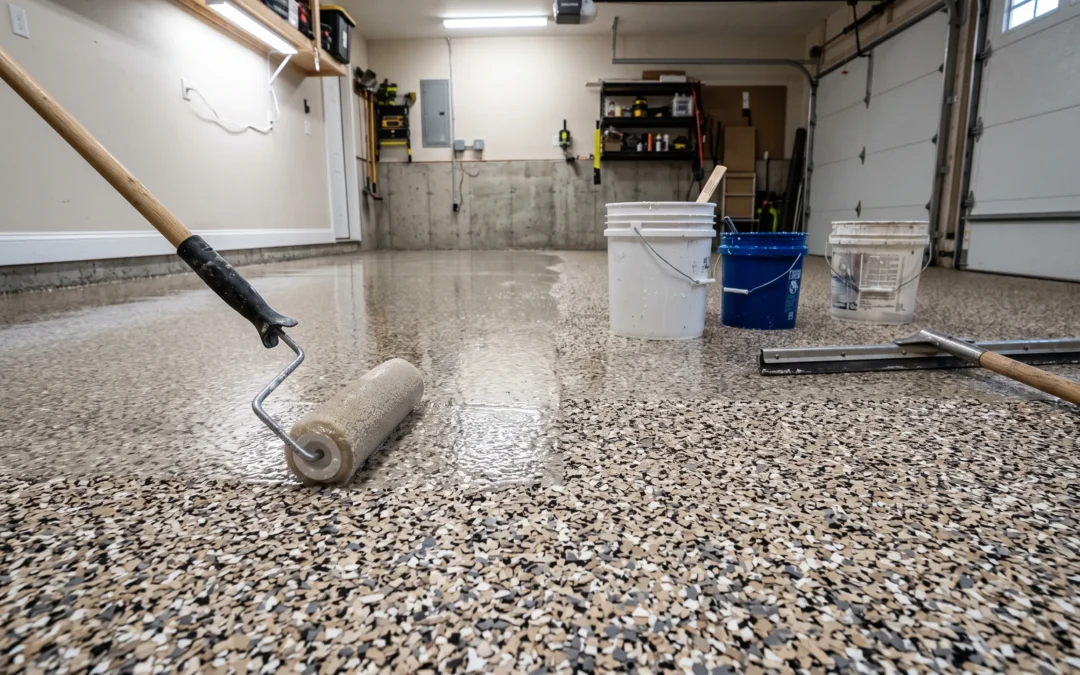
- A full-rejection flake broadcast loads the wet basecoat with color chips to full saturation for texture and looks.
- A UV-stable polyaspartic topcoat seals it all under the wear surface — polyurea chemistry doing what it does best: abrasion resistance, flexibility, and zero yellowing in the sun.
Asking whether epoxy or polyurea lasts longer is like asking whether a foundation or a roof lasts longer. A well-built house needs both, in the right places. The same logic applies whether the decorative layer is flake, metallic, or solid color.
What Actually Determines How Long a Coating Lasts
After years of installing floors — and repairing other people’s — we can tell you the failures almost never come down to resin family. They come down to these:
- Surface preparation. Coatings on acid-etched or merely cleaned concrete peel. Hot-tire pickup — the classic garage failure where a coating peels up under parked tires — is an adhesion failure caused by weak prep, not by “epoxy being bad.” Diamond grinding is non-negotiable.
- Moisture handling. Slab vapor pressure blisters coatings that weren’t formulated for it. A moisture-vapor-barrier basecoat exists precisely for this.
- Solids content and film thickness. A high-solids material leaves a thick wear layer; a diluted one leaves a skin. This is where DIY kits quietly lose the comparison.
- Matched system chemistry. Basecoat and topcoat need to be designed to bond to each other. Because we manufacture our own VOC-free materials, our layers are formulated as a set — not mixed and matched from three suppliers.
- Installer skill. Fast-curing polyaspartics punish hesitation; slow-curing epoxies punish impatience. Either one installed badly fails early.
Get those five right and either chemistry serves for decades. Get them wrong and neither one saves you. If you want the deeper dive on coating lifespan, we’ve written up how long epoxy flooring actually lasts and what shortens it.
When a Single-Chemistry System Does Make Sense
Honesty requires saying the hybrid isn’t the only right answer:
- All-polyaspartic systems shine when speed rules — the fast cure supports true one-day installation and cold-weather application. Our flake garage floors go in and return to service on that schedule. For garages with known slab moisture, we still argue for the epoxy base underneath; polyaspartics are less forgiving of vapor pressure.
- All-epoxy systems make sense indoors and in heavy industry. With no UV exposure, epoxy’s ambering never comes up, and for harsh chemical environments a novolac epoxy outperforms polyurea outright. Warehouses, plants, and commercial kitchens run on epoxy for a reason.
- Pure polyurea — the spray-applied, fast-set kind — is a superb material for bedliners and containment linings, but it’s the wrong tool for a decorative garage floor and rarely what’s actually being sold under that name.
So Which Lasts Longer?
Installed correctly, it’s effectively a tie measured in decades — and installed incorrectly, it’s a race to peel. The honest ranking isn’t epoxy vs. polyurea; it’s professional system vs. thin kit, ground slab vs. etched slab, matched chemistry vs. mystery layers. Choose the installer and the system, and the resin debate mostly resolves itself: epoxy on the bottom, polyaspartic on top, each doing the job it’s best at. That’s how we build every garage floor coating we put our lifetime warranty behind — and why we’re comfortable installing polyurea garage systems too, instead of pretending one chemistry is the villain.
Frequently Asked Questions
Is polyaspartic the same thing as polyurea?
Yes — polyaspartic is a type of polyurea, specifically an aliphatic polyurea modified to cure slowly enough for a crew to work with. It keeps polyurea’s toughness, flexibility, and UV stability while adding a practical pot life. Nearly every “polyurea garage floor” marketed today is finished with a polyaspartic topcoat, so the two terms usually describe the same wear surface.
Does epoxy really only last 3 to 5 years?
No — that number describes thin DIY kits on poorly prepared concrete, not professional material. A 100%-solids epoxy basecoat installed over a diamond-ground slab is one of the most durable bonds in construction, which is why our residential systems carry a limited lifetime warranty. When a coating does fail early, the cause is almost always preparation or moisture, not the word on the resin drum.
Can polyurea be applied over epoxy?
Yes — that’s exactly what a modern hybrid system is. The polyaspartic topcoat is applied over the epoxy basecoat within the recoat window so the layers bond chemically as they cure. Over an old, already-cured epoxy floor it can still work, but the surface has to be mechanically abraded and the existing coating has to be well-bonded first; a topcoat over a peeling floor just peels with it.
Which is better for a garage in Southern California?
The hybrid: moisture-vapor-barrier epoxy basecoat, full-rejection flake broadcast, UV-stable polyaspartic topcoat. Sun through an open garage door will amber an unprotected epoxy surface, and slab moisture will challenge a stand-alone polyaspartic — the two-chemistry stack covers both risks. As a bonus, the polyaspartic cure schedule means a typical flake garage installs in one day.
Top Epoxy Flooring manufactures its own VOC-free epoxy and polyaspartic systems and installs them across Southern California — epoxy, polyurea, or the hybrid of both that we’d put in our own garages. Call (818) 945-0915 for a free estimate and a straight answer about which system your floor actually needs.
Recent Comments