
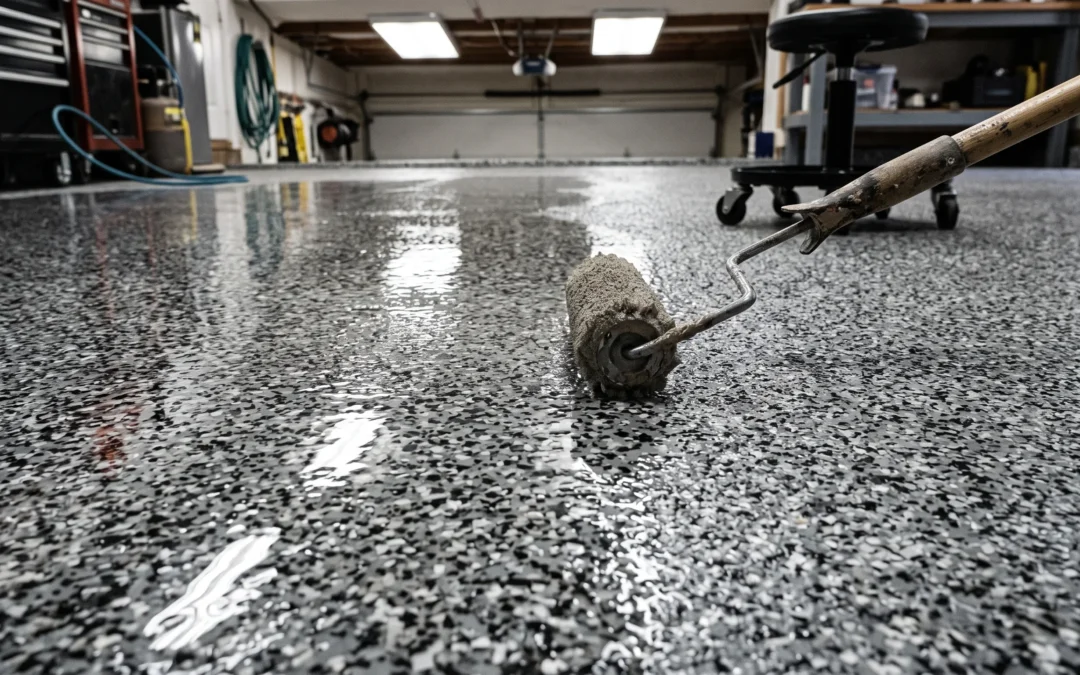
Yes — a garage floor epoxy coating needs a clear coat, and skipping it is the single most common corner cut in cheap installations. The clear coat is not cosmetic gloss; it’s the wear layer. It takes the tire heat, the UV, the chemicals, and the abrasion so the color coat underneath never has to, the same way clear coat on a car protects the paint. The real question isn’t whether to have one — it’s what the clear coat is made of, because an epoxy clear and a polyaspartic clear are very different products with very different lifespans. We manufacture both, so here’s the unvarnished breakdown.
What the Clear Coat Actually Does
Think of a coated garage floor as a three-layer system: basecoat for bond and moisture defense, color layer (pigment or flake) for looks, clear coat for survival. The clear layer contributes four things no other layer can:
- Abrasion resistance. Foot traffic, tires, jack wheels, and dragged bins wear on the sacrificial clear layer instead of grinding through your color or flake.
- Hot-tire pickup protection. The classic failure of bargain floors: a car comes home from the freeway, tires at well over a hundred degrees soften a weak coating, and when the car leaves, the coating goes with it. A quality clear coat with proper adhesion doesn’t soften at tire temperatures — this failure is almost always a clear coat and preparation problem, not an “epoxy” problem.
- Chemical and stain defense. Oil, brake fluid, gasoline, and road salts sit on the clear layer and wipe off instead of soaking into the color coat.
- Locking in the broadcast. On a flake floor, the clear coat is what encapsulates the chips into a smooth, cleanable surface. Without it, chips snag, shed, and trap dirt — an unsealed flake floor isn’t a finished floor at all.
Epoxy Clear vs. Polyaspartic Clear: The Real Decision
Here’s where most articles go vague and we won’t. An epoxy clear coat is hard and chemical-resistant, but it has a known flaw: UV instability. Sunlight — even the indirect daily dose through an open garage door — makes epoxy clears amber, yellow, and eventually chalk. Over a white or gray floor that reads as dinginess; over blues it reads as murk; over any flake blend it slowly shifts every color in the mix.
A polyaspartic topcoat solves precisely this. Polyaspartics are UV-stable — they don’t amber — while also curing fast, flexing slightly to absorb impacts, and bonding tenaciously enough to shrug off hot-tire pickup. That combination is why every floor we install, from garage floor coatings to commercial work, is finished with a UV-stable polyaspartic topcoat rather than an epoxy clear: epoxy is the right chemistry for the basecoat, where bond strength and moisture defense matter, and polyaspartic is the right chemistry for the surface, where sunlight and tires live. Right material, right layer. It’s also the fast-cure topcoat that lets a full flake system install in one day instead of a multi-day epoxy-clear schedule.
“But Epoxy Is Already a Resin — Why Add Another Layer?”
A fair objection you’ll find on every garage forum: the color coat is resin, so why buy more resin on top? Two honest answers. First, specialization — pigmented coats are formulated to carry color and bond; clear wear coats are formulated for abrasion, UV, and chemical exposure. Asking one layer to do both jobs means it does both worse. Second, sacrifice — wear that lands on a clear coat is invisible and eventually recoatable; wear that lands on the color coat is permanent damage you look at every day. Can a floor technically function without a clear coat? Briefly, indoors, under gentle use — yes. Will it still look installed-last-year after five Southern California summers of UV and hot tires? No. That’s the actual trade.
Signs an Existing Floor Needs Its Clear Coat Renewed
The clear layer is also your maintenance interface: when it wears, you renew it, not the whole floor. Watch for these:
- Dull traffic lanes where the tires roll while the edges stay glossy — the classic first sign.
- Fine scratch haze that whitens the surface in raking light.
- Yellowing near the door — an ambering epoxy clear announcing itself.
- Stains that no longer wipe off — the protective film has thinned past usefulness.
Caught at this stage, a sound floor can be scuffed and recoated with fresh polyaspartic and be effectively new again. Ignored, wear reaches the color coat and the fix becomes a bigger job — our guide to epoxy floor maintenance covers the habits that stretch the interval, and how long epoxy flooring lasts covers the full lifespan math.
The Bottom Line
Every question in this post collapses into one principle: the clear coat is where a garage floor lives or dies, because it’s the layer that meets the world. Specify it as UV-stable polyaspartic, put it over a properly built base — diamond grinding for a bonding profile, a moisture-vapor-barrier epoxy basecoat, a full-rejection flake broadcast if you’re going decorative — and the system earns its limited lifetime residential warranty. All of it VOC-free, all of it manufactured by us, which means no gap between who made the clear coat and who answers for it.
Frequently Asked Questions
Is a clear coat necessary over garage floor epoxy?
Yes. The clear coat is the wear layer — it absorbs tire heat, abrasion, UV, and chemical spills so the color coat never has to, and on flake floors it’s what seals the chips into a smooth, cleanable surface. A floor without one works briefly but wears visibly and ages fast, which is why skipping it is the most common budget-install shortcut.
What’s better for a garage clear coat: epoxy or polyaspartic?
Polyaspartic. Epoxy clears amber and chalk under UV exposure — even the daily light through an open garage door — while polyaspartic clears are UV-stable, more flexible against impacts, and more resistant to hot-tire pickup. Epoxy still belongs in the system, but as the basecoat; the surface layer should be polyaspartic.
Does a clear coat prevent hot-tire pickup?
A quality one is a big part of the defense. Hot-tire pickup happens when heat from freeway-warmed tires softens a weak coating and peels it on contact; a UV-stable polyaspartic topcoat doesn’t soften at tire temperatures. The other half of the defense is preparation — diamond grinding so every layer is mechanically locked to the slab.
Can I add a clear coat to an existing epoxy floor?
If the existing coating is soundly bonded — no peeling, bubbling, or moisture problems — yes: the surface is scuff-sanded and a fresh polyaspartic clear goes over it, restoring gloss and protection. If the floor is already failing, a clear coat just seals in the failure; it needs assessment and repair first, which is exactly what a free estimate determines.
Top Epoxy Flooring manufactures its own polyaspartic and epoxy systems and installs them across Southern California — so the clear coat on your floor was engineered for the basecoat under it. Call (818) 945-0915 for a free estimate.
Recent Comments