
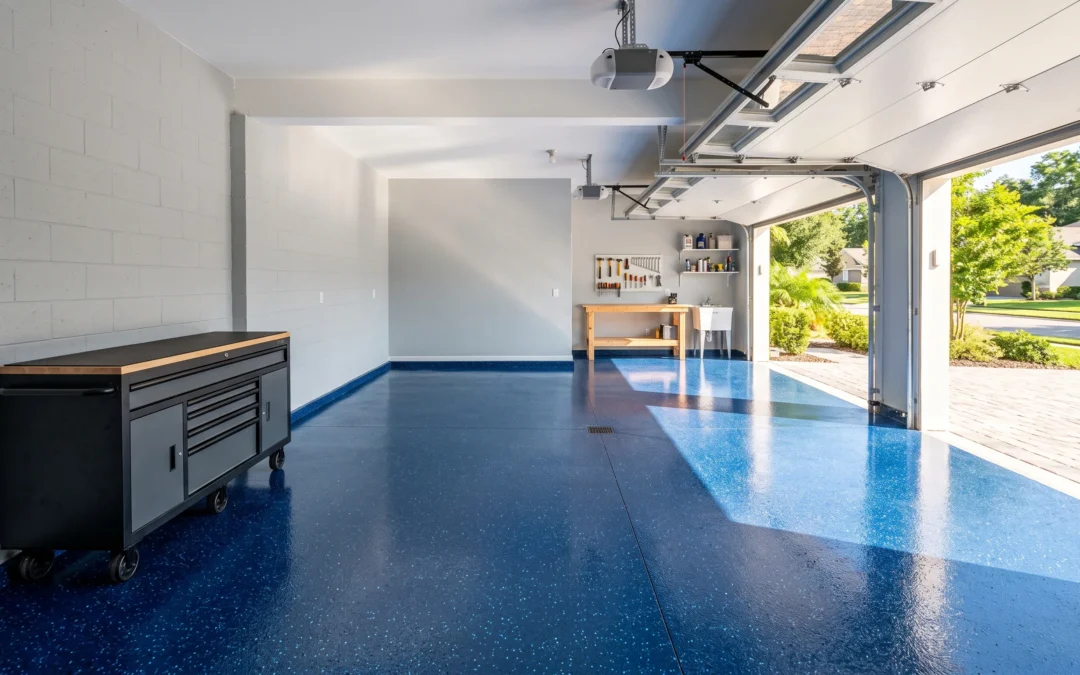
The way to make epoxy flooring last longer is to pull seven levers — and to know that the three biggest ones get pulled before you ever walk on the floor. Preparation quality, moisture protection and material thickness are set on installation day and establish the ceiling on the floor’s life; cleaning habits, mechanical protection, early repairs and recoat timing then decide how close to that ceiling you actually get. Most longevity articles only cover the last four, which is like giving oil-change advice for an engine that was assembled wrong. We manufacture the coating systems we install across Southern California, so this guide ranks all seven levers honestly, biggest first — including the ones that are our job, not yours.
The Ceiling-Setters: Three Levers Pulled on Installation Day
Lever 1: Surface preparation — the lifespan multiplier
No habit, cleaner or topcoat rescues a coating from a bad bond. A floor installed over diamond ground concrete with a proper bonding profile can serve for decades; the same materials over acid-etched or unprepared concrete can fail inside two years. If you’re choosing an installer, this is the single question that predicts your floor’s lifespan: how do you prepare the slab? Mechanical grinding is the only right answer. If you already own a coated floor, this lever is history — but it explains why two identical-looking garages age so differently, and it’s the first thing we verify before quoting work on an existing floor.
Lever 2: Moisture defense — the silent-killer insurance
Moisture vapor migrating up through the slab is the failure mode that takes out otherwise well-made floors, pushing coatings off from below years after installation. The countermeasure is built into the system, not the maintenance: a moisture-vapor-barrier epoxy basecoat that blocks vapor pressure at the bond line. Every residential system we install starts with one, precisely so this lever is never left to luck. If your slab was coated without moisture testing or a barrier layer, watch for early blistering — catching it small is the difference between a zone repair and a full rebuild.
Lever 3: Thickness and topcoat chemistry — the wear budget
A floor’s life under traffic is a budget of sacrificial material. A thin single-coat product arrives with a small budget; a full system — 100% solids basecoat, full-rejection flake broadcast, and a UV-stable polyaspartic topcoat — arrives with a deep one, wearing at the top while the structure below stays untouched. Polyaspartic chemistry matters twice here: it out-wears epoxy as a surface layer, and it doesn’t yellow or chalk in sunlight, which is what keeps a garage floor coating near a sun-facing door looking new instead of amber. These decisions are locked in at purchase — which is why the cheapest quote is so often the shortest-lived one.
The Ceiling-Reachers: Four Levers You Control for Life
Lever 4: Grit discipline
Abrasion, not chemistry or impact, is how most floors age — and abrasion is mostly imported sand and grit being ground between shoes, tires and the topcoat. The countermeasures cost almost nothing: a dust mop or blower pass on a regular rhythm, walk-off mats at doorways, and a quick clean after any project that produces debris. Pair that with pH-neutral washing — never vinegar, citrus or soap-film products — and you’ve covered the entire chemical side of care. The complete routine lives on our epoxy floor maintenance page.
Lever 5: Point-load and drag protection
Epoxy handles a parked car all day; what it dislikes is concentrated force in motion. The habits that prevent nearly all mechanical damage:
- Lift or dolly heavy items — never drag steel across the floor.
- Put plywood squares under jack stands and motorcycle kickstands.
- Choose soft, non-marking casters for toolboxes and carts, and keep embedded debris out of the wheels.
- Drop-prone zones — under the workbench, at the mechanic’s corner — earn a rubber mat.
Lever 6: Fix small, stay small
An intact coating is a sealed envelope over the slab; every unrepaired chip is a hole in the envelope where water, oil and salt reach bare concrete and start working sideways under the surrounding coating. The floors that reach old age gracefully are the ones whose owners treat a chip like a chipped windshield — a same-month fix, not a someday one. Small fills are simple, and our epoxy floor repair page covers which ones are DIY and which deserve a pro.
Lever 7: Recoat before you have to
The most underused lever. Topcoats wear on schedule — gloss flattens in the traffic lanes, fine scratching accumulates — and there is a window where a screen-and-recoat renews the wear surface over a still-perfect system. Recoat inside that window and the floor effectively restarts its clock; wait until wear breaks through into the color coat and the job grows from a refresh into a repair-plus-rebuild. A tired-but-sound floor recoated on time is how installations run twenty, thirty years and beyond — the full math is in how long does epoxy flooring last.
What Doesn’t Move the Needle
Longevity folklore worth clearing out: waxing an epoxy floor adds a soft film that dulls it and complicates future recoats — skip it. “Rejuvenator” polishes are cosmetics, not protection. Parking mats under cars are optional on a professionally built floor; hot-tire pickup is a thin-coating disease, not something a healthy system needs a mat to survive. And garage floors don’t need to be babied — a floor you’re afraid to use isn’t lasting longer, it’s just being used less.
The Honest Summary
Buy the ceiling, then live up to it. Choose an installation with real preparation, moisture defense and a full-thickness system — the three levers that set the maximum. Then keep grit off it, protect it from dragged steel, fix damage while it’s small, and recoat when the wear layer asks. Do that and “how long will it last” stops being a durability question and becomes a patience question — which is exactly why we can put a limited lifetime warranty on our residential floors.
Frequently Asked Questions
What single thing extends epoxy floor life the most?
Before installation: mechanical surface preparation — diamond grinding determines whether the coating stays bonded, and nothing after installation can compensate for skipping it. After installation: grit control. Regular dust-mopping and doorway mats stop the sandpaper effect that wears topcoats down, and they cost minutes, not money.
Does parking a car on epoxy shorten its lifespan?
Not on a properly built system. Full-thickness coatings over ground concrete handle daily parking, turning tires and summer-hot rubber for decades — hot-tire pickup afflicts thin, poorly bonded coatings, not professional ones. The automotive habits that do matter are simpler: sweep up tracked-in grit and wipe fluid drips promptly.
When should an epoxy floor be recoated?
When the topcoat shows flattened gloss and accumulated fine scratches in traffic lanes but the coating is still fully bonded — before wear breaks through to the color layer. Recoating inside that window renews the sacrificial surface over an intact system and effectively resets the floor’s age; waiting past it turns a refresh into a repair project.
Do epoxy floor sealers or waxes help it last longer?
No. Wax builds a soft, slippery film that dulls the finish and has to be stripped before any future recoat, and consumer “sealers” add nothing a real topcoat doesn’t already do better. Longevity comes from the engineered wear layer — a UV-stable polyaspartic topcoat — maintained with neutral cleaning and renewed professionally when it wears.
Top Epoxy Flooring builds floors designed to be the last one your slab needs — manufacturer-direct, VOC-free systems installed across Southern California under a limited lifetime residential warranty. Call (818) 945-0915 for a free estimate.
Recent Comments