
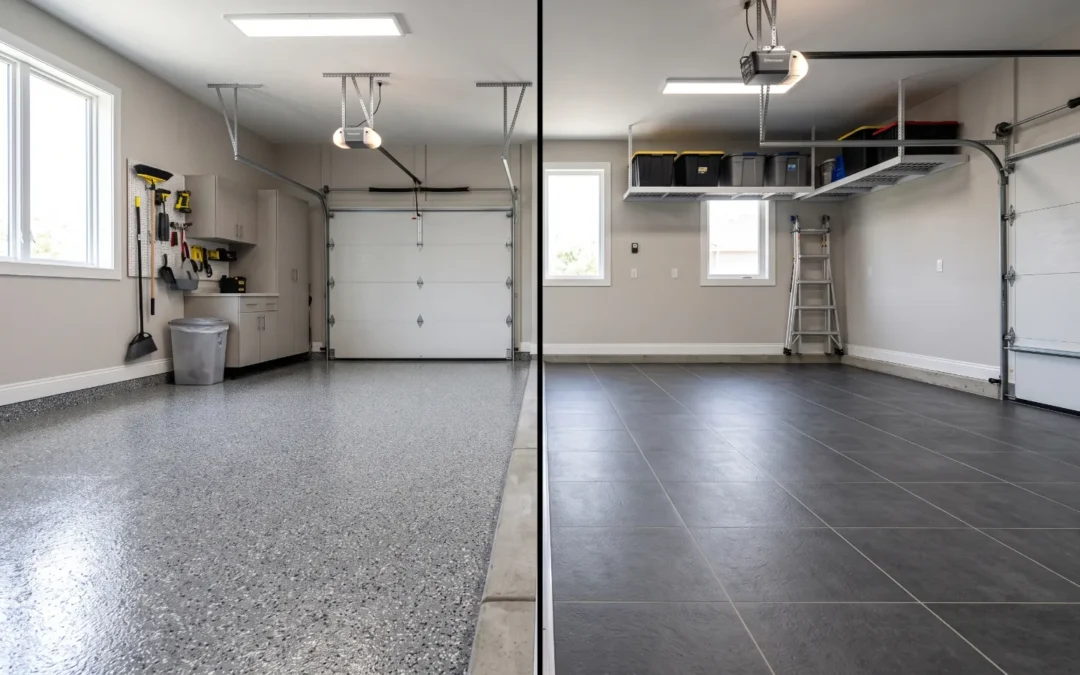
For a garage, epoxy flooring beats tile in the categories that decide the room: impact resistance, point-load strength under jacks and stands, seamless waterproofing, and tolerance for the slab movement that cracks grout lines. Porcelain tile is a superb material — in kitchens and bathrooms. Bolted to a working garage’s demands, its weaknesses (brittle under impact, hundreds of grout joints, hollow spots that crack under a jack) surface fast. We install coatings for a living, so read this as an informed position rather than a neutral shrug: here’s the head-to-head, category by category, including the two situations where tile genuinely makes sense.
Impact and Point Loads: The Garage Reality Test
Garages drop things. A wrench, a hitch, a full jack stand under one corner of a car — these are point loads a floor either absorbs or fractures under. Cured epoxy over sound concrete takes them without ceremony; the coating flexes microscopically with the slab beneath it. Porcelain tile is hard but brittle: a dropped tool can chip a glazed edge, and a floor jack concentrated on a tile with any void beneath it can crack it outright. One cracked tile means sourcing a match years later and cutting out grout. One gouge in an epoxy floor is a patch-and-blend covered in our repair guide.
Water, Oil, and the Grout Problem
An epoxy system is one continuous, non-porous film — nothing reaches the concrete, and a coolant leak wipes up without a trace. Tile itself resists stains, but a tiled floor is only as sealed as its weakest grout line, and a two-car garage has hundreds of feet of them. Grout absorbs oil, traps road grime, darkens unevenly, and needs periodic resealing. In a room where cars drip, the seams are the story.
Hot-Tire Pickup vs Thermal Shock
Each material has a famous failure mode here, so let’s be fair to both. Cheap epoxy coatings can suffer hot-tire pickup — softening and peeling where warm tires park. Professional systems eliminate it with diamond grinding for a real bonding profile and a UV-stable polyaspartic topcoat that shrugs off tire heat; it’s a solved problem in quality work, as our garage floor coating systems demonstrate under warranty. Tile’s equivalent is cracking from slab movement: concrete slabs shift and hairline-crack over time, and rigid tile bonded to a moving slab telegraphs every bit of it, usually through the grout first.
Installation and Downtime
A flake epoxy garage system installs in one day, with vehicles typically back on the floor in about 24 hours. Tiling the same garage is a multi-day project — layout, thinset, cuts around obstacles, curing, then grouting and grout curing — before the first car rolls in. Tile also raises the finished floor height enough to matter at the door threshold and can complicate garage-door seals. A coating adds millimeters, not a step.
Looks, Comfort, and Daily Life
- Appearance: tile offers patterns and a familiar residential look; epoxy offers flake blends, metallics, and solid colors in a seamless, showroom-style sweep. Style is taste; seamlessness is function.
- Cleaning: both mop easily — but epoxy has no grout to scrub, and dust has nowhere to collect.
- Grip: glazed tile is slick when wet unless you choose a textured series; epoxy’s flake texture and anti-slip additives are built into the spec.
- Underfoot: both are hard and cool. Neither wins comfort; mats do.
Where Tile Actually Wins
Two honest cases. First, interlocking tile — the PVC snap-together kind — suits renters and anyone who wants a floor they can take with them, accepting that liquid finds the seams and the subfloor stays unprotected. Second, a homeowner set on a specific ceramic aesthetic for a garage that works more as a showroom than a shop. If cars get serviced, projects get built, or the slab ever sees a jack stand, the argument tilts hard back to coatings.
The Verdict for Garages
Epoxy — not as a coin flip, but because the garage environment attacks exactly where tile is weakest: impacts, point loads, seams, and slab movement. A professionally installed system over a diamond-ground slab carries our limited lifetime residential warranty and, per the honest numbers in our lifespan breakdown, runs decades. Full trade-off inventory, both directions, lives in our pros and cons guide.
Frequently Asked Questions
Is epoxy cheaper than tile for a garage?
Rather than quoting numbers that vary by slab condition and square footage, compare scope: epoxy is a one-day, single-trade installation; tile is a multi-day job with materials, thinset, and grout labor. Get a free onsite estimate for the real answer on your floor.
Does porcelain tile crack in garages?
It can — from dropped tools, concentrated jack loads over voids in the thinset, and normal slab movement that rigid tile can’t absorb. Grout lines usually show the stress first.
Can you epoxy over an existing tile floor?
Not well. The right path is removing the tile and thinset, then diamond grinding the slab so the coating bonds to concrete — a service included in professional installation.
Which lasts longer in a garage, epoxy or tile?
A professional epoxy system with a polyaspartic topcoat typically delivers 15–20+ years of garage service. Tile’s lifespan in a garage is usually decided by its first cracked tile or stained grout, not by the material wearing out.
Top Epoxy Flooring manufactures and installs its own VOC-free coating systems across Southern California — limited lifetime residential warranty, free onsite estimates: (818) 945-0915.
Recent Comments