
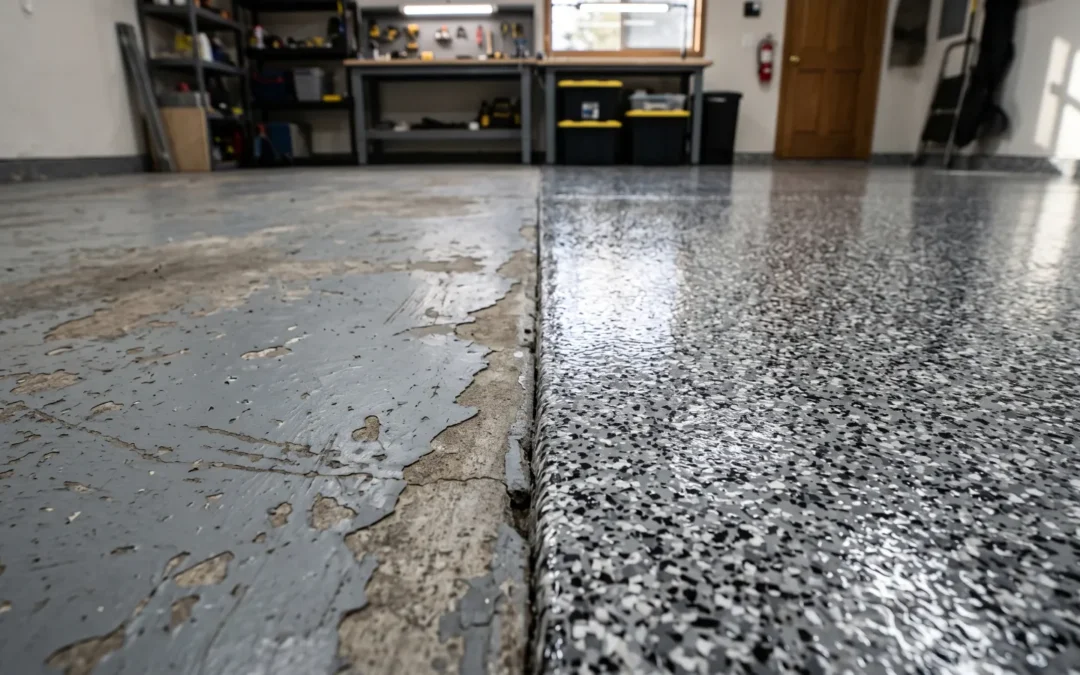
Garage floor paint and epoxy flooring are not two versions of the same thing — they’re different chemistries doing different jobs. Paint is a thin decorative film that sits on concrete and typically starts failing under car tires within a year or two. A real epoxy system is a thermoset coating, many times thicker, that chemically cures into a wear surface bonded to the slab and lasts decades. The confusion is manufactured: hardware-store cans labeled “epoxy paint” are mostly latex paint with a little epoxy resin stirred in, and they perform like paint. Here’s how to tell what you’re actually buying, and when each one makes sense.
The Chemistry Gap: Drying vs Curing
Paint dries — its solvent evaporates and leaves a soft film that re-softens under heat and chemicals. Epoxy cures — resin and hardener cross-link into a rigid plastic that nothing un-links. That single difference drives everything downstream: thickness (a paint coat measures a few mils; a professional multi-coat system is many times that), hardness, chemical resistance, and how each responds to a hot tire. The moment you see “one-part epoxy” on a label, you’re holding paint; true epoxy is always two components mixed at the floor.
Hot-Tire Pickup: Where Paint Dies First
Park a car after a freeway drive and the tires transfer real heat into the floor. Paint softens under it, grips the cooling rubber, and peels up in tire-shaped patches — the signature failure you see in year-old painted garages. A professionally installed system doesn’t do this: diamond grinding gives the basecoat a mechanical bonding profile in the concrete, and the UV-stable polyaspartic topcoat is unbothered by tire heat. Hot-tire pickup is the single best reason the two products shouldn’t share a name; our garage floor coating page shows what the real system looks like layer by layer.
Durability Head-to-Head
- Service life: floor paint in a working garage is a 1–3 year finish before touch-ups begin. A professional epoxy system runs 15–20+ years — the full math is in our lifespan guide.
- Abrasion: paint scuffs and wears through at traffic lanes; epoxy’s sacrificial topcoat absorbs the wear while the color coat underneath stays intact.
- Chemicals: gasoline and brake fluid soften paint on contact; a cured epoxy film wipes clean.
- Moisture: paint blisters over damp slabs; professional systems start with a moisture-vapor-barrier epoxy basecoat for exactly that condition.
- Appearance over time: paint fades and chalks; a polyaspartic-topped system keeps its gloss, and decorative options like flake broadcast floors hide dust and wear besides.
Why Paint Still Sells: The Honest Case for It
Paint has three legitimate wins. It’s cheap up front. It’s a genuinely easy weekend DIY — roll it like wall paint. And it beautifies fast: for staging a house you’re about to sell, refreshing a rental between tenants, or covering stains in a garage that stores boxes rather than cars, a coat of floor paint is a rational short-term play. Just go in knowing you bought a finish, not a floor — and that every repaint is another weekend, because paint’s failures compound. If you’re deciding between a DIY kit and paint, our DIY kit breakdown covers the middle ground honestly.
Preparation: The Tell That Separates the Two Trades
Paint instructions say “clean and etch.” Professional coating starts with diamond grinding — mechanically opening the slab so the basecoat locks in, then repairing cracks and testing moisture before anything is mixed. Preparation is most of what you’re paying a professional for, and it’s the reason one product peels and the other carries a limited lifetime residential warranty. No amount of premium paint survives bad prep, and even modest epoxy over great prep outlives it.
The Verdict
If the garage is a working room — cars parked daily, projects built, anything stored that matters — paint is a false economy that resets every couple of years, and a professional epoxy system is the last floor decision you’ll make for decades. If you need a fast, low-cost cosmetic refresh on a floor cars barely touch, paint does that job honestly. Weigh the full trade-offs in our pros and cons of epoxy flooring guide, then get a free onsite estimate to see what your actual slab needs.
Frequently Asked Questions
Is epoxy paint the same as epoxy flooring?
No. “Epoxy paint” is largely latex paint with a small amount of epoxy resin added, applied in a thin coat. Epoxy flooring is a two-component thermoset system, many times thicker, that chemically cures into a bonded wear surface.
How long does garage floor paint last?
In a garage that parks cars, expect visible wear and tire-path peeling within one to three years. Professional epoxy systems last 15–20+ years under the same use.
Can I epoxy over a painted garage floor?
Not directly — coatings bond to concrete, not to paint. The paint is removed by diamond grinding during preparation, which also creates the bonding profile the new system needs.
Why did my painted garage floor peel where the car parks?
Hot-tire pickup: heat from the tires softens the paint film, and the cooling rubber pulls it off the slab. It’s a limitation of paint chemistry, not an application mistake — cured epoxy with a polyaspartic topcoat doesn’t soften under tire heat.
Top Epoxy Flooring manufactures and installs its own VOC-free coating systems across Southern California — limited lifetime residential warranty, free onsite estimates: (818) 945-0915.
Recent Comments